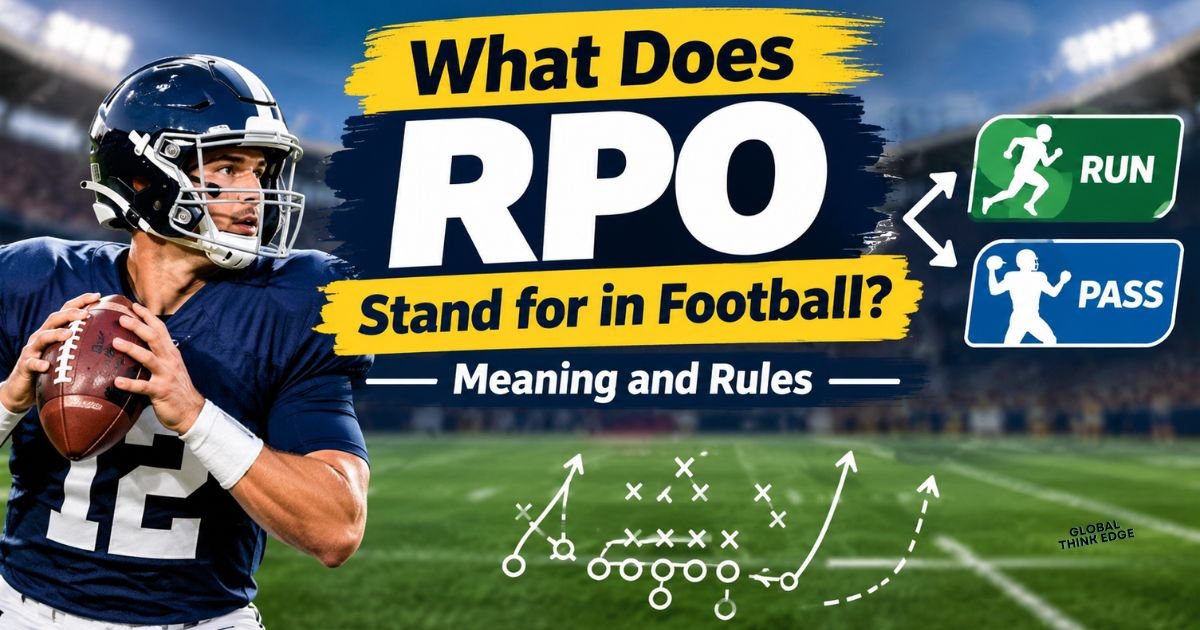
What Does RPO Stand for in Football? Meaning and Rules
If you’ve watched an American football game, you’ve probably noticed how quickly a quarterback must make decisions. Sometimes, a play looks like a handoff to a running back, but suddenly, the quarterback throws the football instead. That exciting combination of possibilities is often part of an RPO.
So, what does RPO stand for in football? RPO means Run-Pass Option, an offensive strategy that gives the quarterback the choice between handing the ball to a running back and throwing a pass based on how the defense reacts.
You’ll see this concept used in both college football and the NFL. It’s especially useful because it forces defenders to account for two different threats during the same play.
In this guide, you’ll discover how RPO plays work, how quarterbacks make their reads, why coaches use this strategy, and how it differs from other offensive concepts.
What Does the Term RPO Mean in Football?
In American football, RPO stands for Run-Pass Option. It’s an offensive play that combines elements of a running play and a passing play into one coordinated design.
Instead of deciding before the snap whether to run or throw, the quarterback can make that decision during the play.
Here’s the basic idea:
- Run option: The quarterback hands the football to the running back when the defense creates a favorable running opportunity.
- Pass option: The quarterback keeps the football and throws a quick pass when a defender moves toward the running play and leaves a receiver available.
What makes this strategy effective is the pressure it places on a defender who must help stop the run while also covering a potential pass.
For example, imagine you’re playing quarterback and notice a linebacker stepping toward the line of scrimmage to stop your running back. You can pull the football away from the handoff and throw to a receiver moving into the space that linebacker just abandoned.
If the linebacker stays back in coverage, you can complete the handoff and allow your running back to attack the defense.
This creates a difficult choice for the defender and gives your offense a way to respond immediately.
What Is an RPO Play and How Does It Work?
An RPO play is a designed offensive concept that gives you two possible outcomes based on the defense’s movement after the snap.
Although the concept sounds complicated, you can understand it by breaking the action into a few simple steps.
Step 1: The Offense Lines Up
Before the snap, your offense lines up in a formation that supports both a running play and a passing route.
You might see a running back positioned beside the quarterback in shotgun formation, with receivers spread across the field.
The formation doesn’t necessarily reveal whether the quarterback will hand off or throw.
Step 2: The Offensive Line Blocks for the Run
When the ball is snapped, the offensive linemen generally begin blocking as though a running play is developing.
This action makes the running threat believable and can encourage linebackers or safeties to move forward.
However, the offensive line must also respect rules limiting how far ineligible players can move downfield before a forward pass is thrown.
Step 3: The Quarterback Reads a Defender
This is where the decision happens.
The quarterback watches a specific defensive player, commonly called the conflict defender.
That defender might be a linebacker, safety, or another player responsible for both run support and pass coverage.
If the defender moves forward to defend the run, the quarterback may choose to pass.
If the defender stays in coverage, the quarterback may hand the ball to the running back.
Step 4: The Quarterback Makes the Decision
The quarterback must react quickly, often while the running back is crossing in front of them.
You might see the quarterback briefly place the ball near the running back’s stomach before either completing the handoff or pulling it away.
The entire decision can happen in a fraction of a second.
Step 5: The Play Develops
Once the decision is made, the offense executes the chosen option.
If the quarterback hands off, the running back follows the designed blocking scheme.
If the quarterback throws, the receiver usually runs a quick route designed to exploit the defender’s movement.
The important thing to remember is that both possibilities are built into the same play.
How to Tell If a Play Is an RPO
When you’re watching football, distinguishing an RPO from an ordinary running or passing play can be challenging.
However, several visual clues can help you recognize one.
Watch the offensive line. If the linemen appear to be run-blocking while the quarterback throws a quick pass, you may be watching an RPO.
Look at the quarterback and running back. Many RPO concepts include a brief handoff mesh, during which the quarterback decides whether to give or keep the football.
Observe the linebackers. If a linebacker steps forward and the quarterback immediately throws into the vacated area, that’s a strong indication of an RPO.
Pay attention to the timing. RPO passes are frequently thrown quickly because offensive linemen cannot continue blocking downfield indefinitely before a legal forward pass.
Keep in mind that these clues aren’t definitive. A normal play-action pass can look similar, and you sometimes need to understand the blocking assignments and quarterback’s instructions to identify the play accurately.
How Do You Pass on an RPO Play?
If you’re learning how to execute an RPO as a quarterback, the most important skill is reading the correct defender and making a quick decision.
Before the snap, you identify the defender your play is designed to read. You also need to understand the receiver’s route and the running back’s path.
After the snap, you briefly extend the football toward the running back while watching the defender.
If the defender commits to stopping the run, you can pull the ball away and deliver a quick pass.
If the defender stays in the passing lane, you complete the handoff.
Common Passing Routes Used in RPOs
You’ll often see the following routes paired with running plays:
- Slant route: A receiver cuts diagonally toward the middle of the field.
- Bubble screen: A receiver moves toward the sideline and catches a short pass behind or near the line of scrimmage.
- Glance route: A receiver attacks the space behind a linebacker with a quick inside-breaking route.
- Hitch route: A receiver runs forward briefly before stopping and turning toward the quarterback.
- Quick out: A receiver breaks toward the sideline for a short completion.
Each route gives the quarterback a relatively fast throwing opportunity.
For successful execution, your timing, ball placement, and understanding of defensive coverage are essential.
What Is the Difference Between an RPO and a Zone Read?
Although RPOs and zone-read plays can look similar, they aren’t exactly the same.
The biggest difference is what the quarterback can choose to do with the football.
In a traditional zone read, the quarterback decides whether to hand the football to the running back or keep it and run.
In an RPO, the quarterback decides whether to hand off or throw a forward pass.
| Feature | RPO | Zone Read |
| Full name | Run-Pass Option | Zone Read |
| Primary decision | Run or pass | Running back or quarterback run |
| Typical defender read | Linebacker, safety, or other conflict defender | Often an unblocked edge defender |
| Passing component | Built into the play | Not part of the basic concept |
| Main objective | Exploit run-pass defensive conflict | Create an advantage in the running game |
What Is a Zone Read in Football?
A zone read is a running play in which the quarterback reads a designated defender, often near the edge of the defensive formation.
Imagine you’re the quarterback and the defender moves toward your running back.
You may keep the football and run into the space the defender leaves open.
If the defender stays outside to contain your run, you hand the ball to the running back.
This gives your offense two potential rushing threats.
Some modern offenses combine zone-read principles with passing options, creating more advanced concepts that can include a quarterback run as an additional possibility.
Is RPO the Same as Play Action?
No. RPO and play action are different offensive concepts, even though both can make a passing play resemble a run.
With play action, the offense has generally decided to attempt a pass before the snap. The quarterback uses a fake handoff to influence defenders and create opportunities for receivers.
With an RPO, the quarterback has a genuine post-snap choice between the designed run and a pass.
Is Play Action a Fake Handoff?
Yes. A play-action pass commonly involves the quarterback pretending to hand the ball to a running back before preparing to throw.
The fake can draw linebackers toward the line of scrimmage and create space behind them.
For example, you might see a quarterback extend the football toward a running back, pull it away, drop into the pocket, and throw downfield.
The defense initially reacts to the possibility of a run, but the offense intends to pass.
RPO vs. Play Action: Key Differences
| Feature | RPO | Play Action |
| Decision | Run or pass based on a read | Pass is generally predetermined |
| Handoff | Can be completed | Usually faked |
| Offensive line | Often run-blocks | Uses protection or designed play-action blocking |
| Passing timing | Frequently immediate | Can involve short or deeper routes |
| Main purpose | Put a defender in conflict | Influence defenders with a run fake |
Both strategies can be effective, but they challenge the defense in different ways.
Is RPO Allowed in the NFL?
Yes, RPO plays are legal in the NFL, and teams use them as part of their offensive systems.
However, NFL rules create an important limitation involving ineligible offensive players moving downfield before a forward pass.
Under NFL rules, an ineligible player generally cannot be more than one yard beyond the line of scrimmage before a legal forward pass is thrown, subject to the applicable rule exceptions.
This matters because offensive linemen often block aggressively on RPO plays.
If the quarterback waits too long before throwing, a lineman may move illegally downfield, resulting in a penalty.
College football rules generally allow more room for ineligible players downfield before a pass, making some RPO designs easier to execute at that level.
For NFL quarterbacks, fast decision-making and precise timing are particularly important.
Do NFL Teams Use RPOs?
Yes. You’ll find RPO concepts in modern NFL offenses, although the frequency and design vary from team to team.
Coaches use them because they can help create favorable matchups and prevent defenses from concentrating entirely on stopping the run.
For example, teams have incorporated RPO concepts into offenses associated with quarterbacks such as Patrick Mahomes, Jalen Hurts, and Tua Tagovailoa.
That doesn’t mean every play involving these quarterbacks is an RPO. Their offenses also use traditional runs, dropback passes, play action, and other concepts.
Why Do NFL Teams Run the RPO?
You can understand the appeal by looking at the advantages:
- It challenges defenders: A linebacker may have to choose between stopping the run and protecting a passing lane.
- It supports quick passing: The quarterback can get the ball to a receiver before the pass rush develops.
- It complements the running game: Defenders cannot always commit aggressively to stopping the running back.
- It creates manageable gains: Quick completions and efficient runs can help the offense stay ahead of the chains.
- It adapts to defensive behavior: The quarterback can select the option that best fits the immediate defensive reaction.
Still, RPOs aren’t guaranteed to work. Disciplined defenders, disguised coverage, poor execution, and accurate defensive reads can all limit their effectiveness.
What Are the Different Types of RPO Plays?
Not every RPO uses the same defender or route combination.
Coaches design different variations depending on the defensive alignment, the quarterback’s strengths, and the offensive system.
1. Pre-Snap RPO Decisions
Some offensive concepts allow the quarterback to decide before the snap whether to run or throw.
For example, if you notice defenders giving a receiver a large cushion, you may choose a quick perimeter pass instead of the originally available running option.
These concepts are often grouped with RPO systems, although a true post-snap RPO involves making the run-pass decision after the ball is snapped.
2. First-Level RPOs
First-level reads focus on defenders near the line of scrimmage.
Depending on the play design, the quarterback may evaluate an edge defender whose movement influences whether a running or passing option is favorable.
These plays require a clear understanding of how the blocking scheme interacts with the defender being read.
3. Second-Level RPOs
Second-level RPOs commonly involve reading linebackers.
Suppose you’re watching a linebacker positioned between the running game and a short passing route.
If the linebacker moves toward the running back, the quarterback can throw behind that defender.
If the linebacker remains in coverage, the running back may have more space to advance.
This is one of the clearest examples of putting a defender in conflict.
4. Third-Level RPOs
Third-level RPOs involve reading deeper defensive players, usually safeties.
Which RPO type reads a third-level defender? In terminology that classifies RPOs by defensive level, it’s a third-level or safety-read RPO.
For example, the quarterback might monitor a safety responsible for supporting the run and covering a receiver’s route.
If the safety moves aggressively toward the line of scrimmage, the quarterback may find a passing opportunity behind that movement.
If the safety remains deep, the offense may prefer the designed run.
Exact terminology and read assignments vary among coaching systems.
What Are the Advantages and Disadvantages of RPO Football?
RPOs can make an offense more versatile, but they also introduce challenges.
Advantages
Defensive uncertainty: You force defenders to prepare for a run and a pass within the same play.
Quick decisions: The quarterback can respond directly to a defender’s movement.
Offensive flexibility: You can build different passing routes around established running schemes.
Potential efficiency: A successful read can help the offense exploit favorable numbers or positioning.
Disadvantages
Limited decision time: The quarterback often has very little time to determine whether to throw or hand off.
Penalty risk: Offensive linemen can move illegally downfield if a pass is delayed.
Defensive adjustments: Well-coached defenses can disguise their intentions or assign defenders to limit both options.
Restricted passing development: Many RPO designs favor quick throws rather than longer-developing passing routes.
Execution demands: Mistakes in timing, ball handling, or reading the defense can cause negative plays or turnovers.
The most effective offenses use RPOs as one part of a broader strategy rather than relying on them exclusively.
How Do Defenses Stop RPO Plays?
If you’re trying to understand football from a defensive perspective, knowing how teams respond to RPOs is just as useful.
Defenses often focus on reducing the quarterback’s ability to identify a favorable option.
Assign Clear Responsibilities
A defense can give different players specific responsibilities for stopping the run and defending passing routes.
This reduces the pressure on a single defender to handle two threats.
Disguise Coverage
A linebacker or safety may initially show one responsibility before moving into another assignment after the snap.
This can make the quarterback’s read more difficult.
Control the Running Game
If defensive linemen consistently win their matchups, the running option becomes less attractive.
That can help the defense focus more attention on short passing routes.
Defend Quick Passing Lanes
Defensive backs can position themselves to contest slants, screens, and other short routes.
The goal is to prevent easy completions without creating large running lanes.
Use Disciplined Reads
Rather than reacting immediately to the quarterback’s handoff action, defenders can follow their assignments and maintain proper positioning.
Successful RPO defense often depends on coordination across multiple defensive levels.
Does Anyone Run the Option Anymore?
Yes. Option football remains part of modern American football, although teams use different versions.
Traditional option offenses frequently emphasize rushing decisions involving the quarterback and running backs.
Modern spread offenses may combine option running concepts with quick passing opportunities.
You’ll see option principles in college football and the NFL, even when teams don’t operate a traditional option-based offense.
Do Any Teams Still Run the Wishbone?
The wishbone is a classic offensive formation associated with option running football.
It typically features a quarterback, a fullback, and two additional running backs aligned in a shape resembling a wishbone.
Although the formation is far less common in major college football and the NFL than it once was, traditional option systems and wishbone variations still appear at some levels of the sport.
You may encounter them in high school football, specialized offensive systems, and programs that emphasize disciplined rushing attacks.
The wishbone and RPO are not interchangeable concepts. The wishbone traditionally emphasizes multiple running options, while an RPO combines a run with a passing choice.
Why Is Reading the Defense So Important for an RPO Quarterback?
When you’re operating an RPO offense, physical ability alone isn’t enough.
You must understand where defenders are positioned, how they’re likely to react, and which offensive option gives your team the best opportunity.
Before the snap, you can evaluate the number of defenders near the line of scrimmage, the alignment of linebackers, and the positioning of defensive backs.
After the snap, your attention shifts to the defender specified by the play design.
You then need to make a quick decision without disrupting the timing of the running back or receiver.
This combination of mental processing, ball handling, and throwing accuracy makes the quarterback’s role particularly demanding.
What Is the Hardest Position on Offense?
There’s no universally accepted answer, but quarterback is often considered one of the most challenging offensive positions.
You’re responsible for understanding the playbook, recognizing defensive alignments, managing the offense, and executing decisions under pressure.
RPO plays add another layer because you may need to make the run-pass decision almost immediately after the snap.
Other positions, including offensive tackle and center, also require considerable technical skill and mental preparation.
The difficulty depends on the responsibilities involved and the offensive system being used.
Frequently Asked Questions
Can a quarterback run the ball on an RPO?
Sometimes. A basic RPO gives the quarterback a choice between handing off and throwing, but some more advanced option designs also include a quarterback running opportunity. The available choices depend on the specific play.
Can an RPO produce a deep pass?
Yes, but deep throws are less common in traditional RPO concepts because the offensive line may be run-blocking downfield. Many designs prioritize quick passes to reduce penalty risk and maintain timing.
Are RPO plays only used in shotgun formations?
No. Shotgun formations are common because they give the quarterback a useful view of the defense and space to execute the handoff mesh. However, coaches can incorporate run-pass options into other formations and backfield alignments.
Who decides whether an RPO becomes a run or pass?
In a typical post-snap RPO, the quarterback makes the final decision based on a designated defender’s reaction. Some related concepts involve a decision made before the snap instead.
What happens if the quarterback makes the wrong read?
The play may still gain yards, but a poor decision can send the football into a covered passing lane or direct the running back toward an unfavorable defensive alignment. Mistakes can result in lost yardage, incomplete passes, or turnovers.
Is an RPO effective against every defense?
No. Its effectiveness depends on the offensive design, defensive structure, and quality of execution. A disciplined defense can limit the opportunities an RPO is intended to create.
Why are RPO passes usually quick?
The offensive line often blocks as if the play is a run. The quarterback must throw before ineligible linemen move too far downfield, and the intended passing window may close quickly.
Final Thoughts
Now that you understand what RPO means in football, you’ll be better equipped to recognize one of the game’s most interesting offensive strategies.
RPO stands for Run-Pass Option, and its defining feature is the quarterback’s ability to choose between a designed running play and a passing play based on the defense’s reaction.
When you watch your next game, pay attention to the quarterback’s handoff motion, the offensive line’s blocking, and the movement of linebackers or safeties.
Those details can help you recognize how a quarterback uses a defender’s reaction to choose the most favorable option.
Whether you’re learning the rules, following your favorite team, or developing your own football knowledge, understanding RPOs gives you a clearer picture of how modern offenses challenge defenses.
