MAGY Dividend History: Essential Yield Data (2026)
Why MAGY Dividend History Matters to Income Investors
Investors searching for reliable income often look beyond traditional dividend stocks, and that’s where MAGY dividend history becomes important. The Roundhill Magnificent Seven Covered Call ETF (MAGY) combines exposure to leading technology companies with a covered call strategy that aims to generate regular cash distributions.
Understanding MAGY dividend history helps you evaluate payment consistency, current yield, distribution trends, and the factors that may affect future payouts. In this guide, you’ll learn how MAGY generates income, how its distribution schedule works, and the key risks and opportunities every investor should know before investing.
Understanding MAGY and Its Income Strategy
What Is MAGY?
MAGY is an actively managed ETF that invests in the group commonly known as the ‘Magnificent Seven’ large-cap technology companies that have driven much of the U.S. stock market’s recent growth. Instead of relying solely on stock appreciation, the fund also uses a covered call strategy to generate additional income.
This approach appeals to investors who prioritize regular distributions while still maintaining exposure to leading technology companies.

How Does MAGY Generate Distributions?
Unlike traditional dividend ETFs, MAGY’s cash distributions are not produced exclusively by dividends received from its underlying holdings.
The fund primarily earns income through:
Covered call option premiums
Dividends paid by portfolio companies
Portfolio management activities
Investment income generated by fund holdings
Because option premiums vary with market conditions, MAGY’s distribution amounts may also change over time.
Why Investors Monitor MAGY Dividend History
Historical distribution data provides useful insights into the fund’s income characteristics.
Reviewing previous distributions allows investors to:
Identify payment trends.
Compare current yield with previous periods.
Estimate potential income.
Understand how market volatility affects payouts.
Make informed long-term investment decisions.
Rather than focusing on a single month’s distribution, investors should evaluate the overall payment pattern across multiple distribution periods.
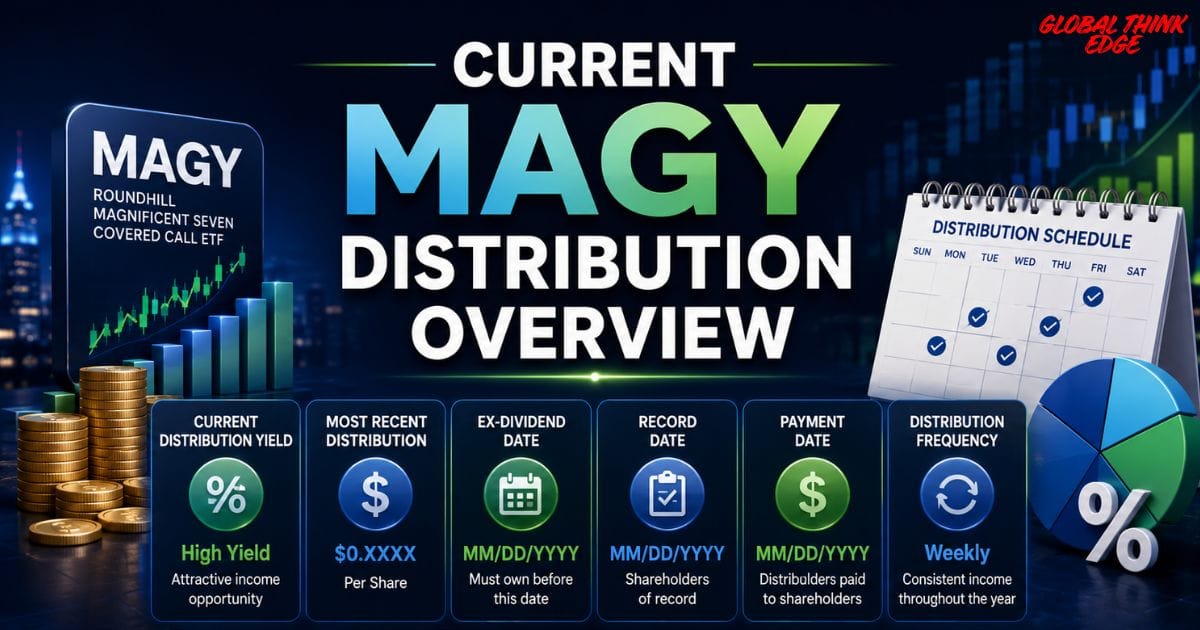
Current MAGY Distribution Overview
Current Distribution Yield
The distribution yield represents the annual income investors receive relative to the ETF’s current market price.
A higher yield may appear attractive, but it should always be evaluated alongside the sustainability of future distributions. Since MAGY uses covered calls, its yield can fluctuate depending on option premium income and market conditions.
Most Recent Distribution Amount
MAGY announces its distribution amount before each payment cycle.
The announced amount reflects the income generated during the previous period and may differ from earlier distributions. Investors should avoid assuming that every payment will remain identical throughout the year.
Ex-Dividend Date Explained
The ex-dividend date determines whether an investor qualifies to receive the upcoming distribution.
To receive the next payment, investors must generally own shares before the ex-dividend date. Purchasing shares on or after that date usually means waiting until the following distribution cycle.
This is one of the most closely monitored dates for income-focused investors.
Record Date
The record date identifies shareholders who are officially eligible for the declared distribution.
Although investors often hear about the record date, the ex-dividend date usually has greater practical importance because it determines purchasing eligibility.
Payment Date
The payment date is when eligible shareholders receive the announced distribution.
Payments are typically deposited directly into broking accounts, where investors can either withdraw the cash or automatically reinvest it.

How Often Does MAGY Make Distributions?
Distribution Frequency
MAGY follows a regular distribution schedule designed to provide investors with recurring income.
Many income-focused ETFs pay monthly, while others follow quarterly schedules. Investors should always verify the current payment schedule because fund policies can change over time.
A consistent payment schedule makes income planning easier for retirees and long-term investors seeking dependable cash flow.
Can Distribution Amounts Change?
Yes.
Unlike fixed-income investments, ETF distributions are not guaranteed.
Several factors influence future payments, including:
Option premium income
Stock market volatility
Performance of underlying holdings
Fund expenses
Portfolio adjustments
Periods of increased market volatility often produce larger option premiums, which may increase distributions. Conversely, calmer markets can reduce available option income.
Reviewing MAGY Distribution History
Why Historical Payments Matter
Past distributions cannot guarantee future results, but they provide valuable context.
Studying MAGY dividend history helps investors determine whether distributions have remained relatively stable or experienced significant fluctuations over time.
Instead of evaluating only the latest payment, reviewing multiple distribution periods offers a more balanced understanding of the fund’s income performance.
What Distribution Trends Can Reveal
Historical data can help answer several important questions:
Has the distribution generally increased or decreased?
Are payments relatively consistent?
Have market events caused temporary changes?
Does income vary significantly throughout the year?
Looking at longer-term trends allows investors to separate temporary market-driven changes from broader income patterns.
Recent Distribution Activity
Recent distribution history offers the clearest picture of the fund’s current income profile.
When reviewing recent payments, investors should consider:
Distribution amount
Ex-dividend date
Payment date
Distribution frequency
Overall consistency
Evaluating these factors together provides a more complete picture than simply focusing on the latest yield percentage.

How Covered Calls Influence MAGY’s Dividend History
A defining characteristic of MAGY is its covered call strategy.
The fund sells call options on portions of its portfolio, collecting option premiums in return. These premiums become an important source of distributable income.
This strategy can enhance cash flow during many market environments, but it also limits some upside potential if underlying stocks experience strong price appreciation.
As a result, MAGY’s distribution history is influenced not only by corporate dividends but also by option market conditions. Investors should therefore expect distributions to fluctuate more than those of traditional dividend-growth ETFs.
Factors That May Affect Future MAGY Distributions
Several variables can influence the amount MAGY distributes to shareholders. Understanding these factors helps investors set realistic expectations rather than assuming every payment will remain the same.
Market Volatility
Covered call strategies generally perform best when market volatility creates higher option premiums. During these periods, MAGY may generate more income from selling call options.
When volatility declines, option premiums often decrease, which can result in smaller distributions.
Performance of the Underlying Holdings
MAGY invests in some of the largest technology companies in the market. Their share price movements, dividend policies, and overall performance indirectly affect the fund’s income potential and portfolio value.
Strong stock performance can support long-term returns, while weaker markets may influence both distributions and share price.
Portfolio Management Decisions
The fund manager may adjust option positions or portfolio allocations as market conditions change. These decisions can affect the amount of income available for distribution in future payment periods.
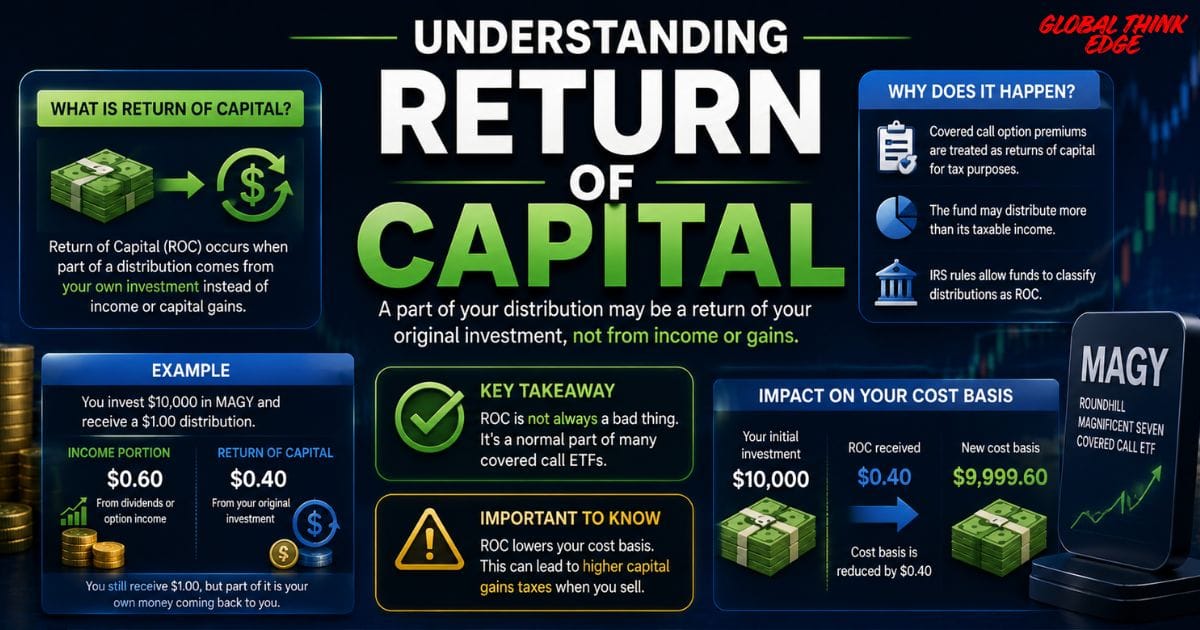
Understanding Return of Capital
One topic that often causes confusion among investors is return of capital (ROC).
Return of capital occurs when part of a distribution comes from an investor’s original investment rather than from investment income or realised gains.
This does not automatically indicate a problem. Some covered call ETFs regularly classify a portion of their distributions as return of capital because of how option premiums are treated for tax purposes.
However, investors should review annual tax documents and fund reports to understand how each distribution is classified.

Distribution Yield vs. Total Return
A high distribution yield should never be the only factor when evaluating an ETF.
Total return includes:
Cash distributions
Capital appreciation
Changes in share price
Reinvested distributions
An ETF with a lower yield but stronger long-term price growth may outperform one offering a much higher yield.
For this reason, experienced investors evaluate both income generation and overall investment performance before making a decision.
MAGY Compared With Similar Income ETFs
| Feature | MAGY | Traditional Dividend ETF | Covered Call Income ETF |
| Primary Goal | Generate income with market exposure | Long-term dividend growth | High current income |
| Income Source | Option premiums and stock dividends | Corporate dividends | Mostly option premiums |
| Distribution Stability | Can vary | Often more predictable | Moderate variability |
| Upside Potential | Partially limited | Higher | Limited by covered calls |
| Best For | Income-focused investors seeking technology exposure | Long-term dividend investors | Investors prioritizing regular cash flow |
This comparison highlights that MAGY occupies a unique position by combining exposure to leading technology companies with an income-focused options strategy.

Who May Find MAGY Suitable?
MAGY may appeal to investors who:
Prefer regular cash distributions.
Want exposure to large-cap technology companies.
Understand how covered call strategies work.
Accept that distributions may fluctuate.
Are you comfortable trading some growth potential for higher income?
Investors focused primarily on long-term capital appreciation may find a traditional growth ETF more suitable than a covered call strategy.
Tips for Tracking Future MAGY Distribution Announcements
Staying informed about future distributions can help investors plan their income and investment decisions.
Useful practices include:
Monitoring official fund announcements.
Reviewing distribution declarations before each payment cycle.
Checking upcoming ex-dividend dates.
Following payment schedules through a broking account.
Comparing historical distributions over time instead of focusing on a single payment.
Regularly reviewing these details provides a clearer picture of the fund’s income pattern.
Key Takeaways
MAGY combines exposure to the Magnificent Seven companies with a covered call strategy to generate income.
Distribution payments are influenced by both option premiums and dividends received from underlying holdings.
Historical distribution trends provide valuable context but do not guarantee future payments.
Return of capital may appear in some distributions and should be understood rather than viewed negatively by default.
Evaluating total return alongside distribution yield leads to more informed investment decisions.
Conclusion
MAGY dividend history offers more than a list of past payouts; it helps investors understand how the ETF generates income and whether its distributions are likely to match their financial goals. Because MAGY uses a covered call strategy, payments can vary with option premiums, market volatility, and overall portfolio performance.
Before investing, review MAGY dividend history alongside its yield, distribution consistency, return of capital, and total return instead of focusing only on headline income. A complete evaluation will help you decide whether MAGY fits your long-term income strategy and risk tolerance.
Frequently Asked Questions
Does MAGY pay distributions regularly?
Yes. MAGY follows a recurring distribution schedule, although the payment amount can vary depending on market conditions and option income.
Why does MAGY have a relatively high yield?
Much of MAGY’s income comes from covered call option premiums in addition to dividends from its underlying holdings. This strategy can produce higher distributions than many traditional equity ETFs.
Can MAGY’s distribution amount change each period?
Yes. Distribution amounts are not fixed and may increase or decrease based on market volatility, option premiums, portfolio performance, and fund management decisions.
Is MAGY designed for long-term income investors?
It can be suitable for investors seeking ongoing income, provided they understand the trade-off between higher cash distributions and potentially limited upside during strong market rallies.
Should investors focus only on the dividend yield?
No. Yield is an important metric, but investors should also consider total return, expense ratio, investment strategy, risk level, and long-term performance before making an investment decision.
