RPO Football: Smart Strategy for Better Offense
Understanding RPO Football
RPO football, short for Run-Pass Option, is one of the most influential offensive concepts in modern football. Instead of committing to a run or pass before the play begins, the quarterback makes a real-time decision based on how the defence reacts. This flexibility allows offences to attack defensive weaknesses without changing the play call.
From high school programmes to college football and the NFL, football has become a valuable strategy for creating explosive plays while keeping defences off balance. Although the concept appears simple, successful execution requires timing, communication, and quick decision-making from every player on the field.
This guide explains how football works, why teams use it, how it differs from similar concepts, and what makes it so effective in today’s game.
What Does RPO Mean in Football?
RPO stands for Run-Pass Option. It is an offensive play that combines a designed running play with a passing option. The offensive line blocks for the run, while eligible receivers prepare to run pass routes.
The quarterback reads a specific defender either before or immediately after the snap. If that defender commits to stopping the run, the quarterback throws the ball. If the defender stays in pass coverage, the quarterback hands the ball to the running back.
This built-in decision gives the offence two potential plays within a single design.
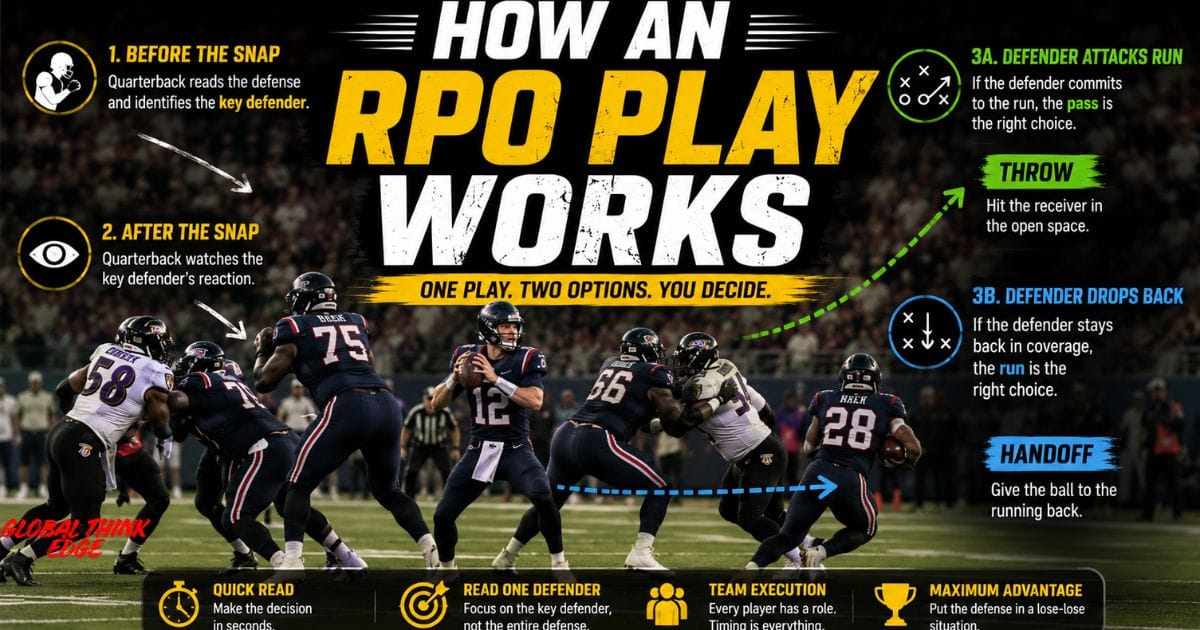
How an RPO Play Works
Although every offensive system has variations, most RPO plays follow the same sequence.
Before the Snap
The quarterback studies the defensive alignment.
He identifies the defender responsible for the read and looks for clues such as linebacker positioning, safety depth, or cornerback leverage.
After the Snap
Once the ball is snapped, the quarterback watches the key defender rather than the entire defence.
If that defender attacks the run, a passing lane often opens behind them.
If the defender drops into coverage, the running lane usually becomes more favourable.
Making the Decision
The quarterback must make the decision within seconds.
A quick throw keeps the ball away from defenders, while a handoff allows the running back to attack open space created by the offensive line.
Timing is critical because delaying the decision can disrupt both the running and passing aspects of the play.
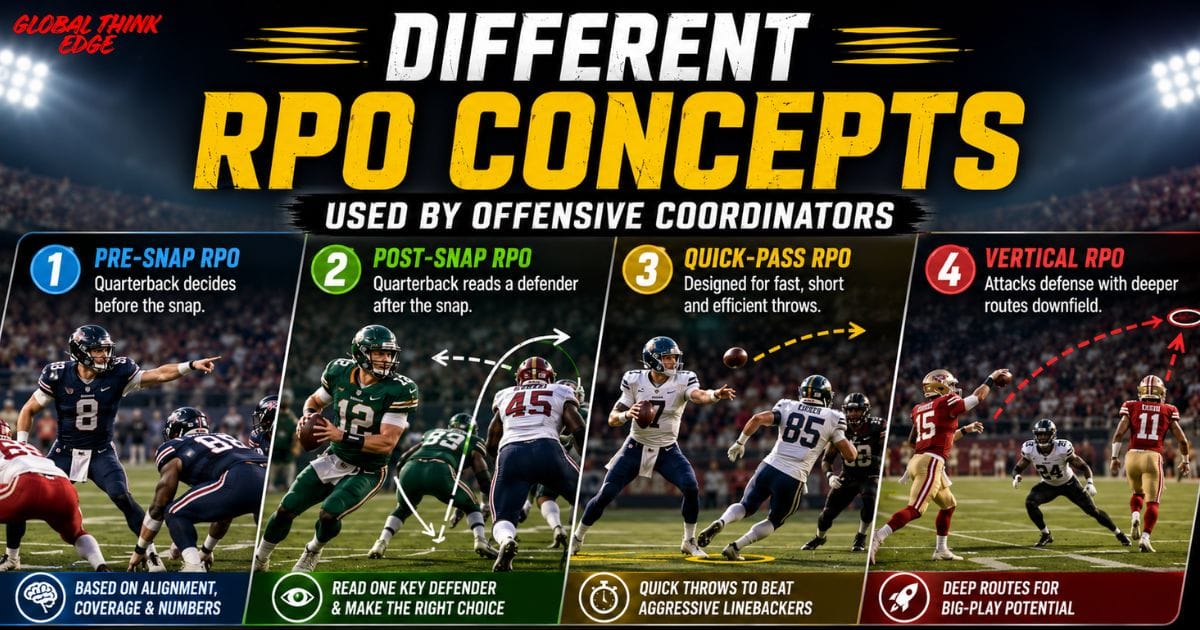
Different RPO Concepts Used by Offensive Coordinators
Not every run-pass option play works the same way. Coaches often choose different concepts depending on the defence and game situation.
Pre-Snap RPO
The quarterback decides whether to run or throw before the snap.
This decision is based on defensive numbers, coverage alignment, or blitz indicators.
Post-Snap RPO
The decision is made after the snap by reading a specific defender.
This version places greater responsibility on the quarterback but often creates bigger opportunities.
Quick-Pass RPO
These plays use short, high-percentage throws such as slants, hitches, or bubble screens.
They are effective against aggressive linebackers.
Vertical RPO
Some offences attach deeper passing routes to the running play.
Although riskier, they can produce explosive gains when safeties commit to stopping the run.
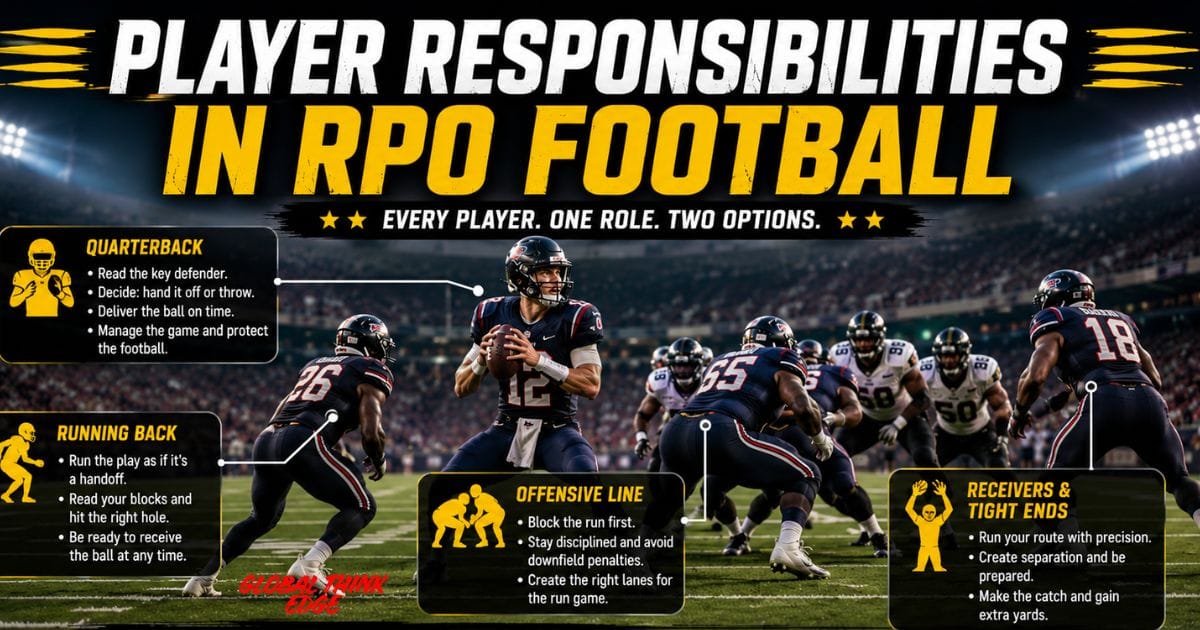
Player Responsibilities in RPO Football
Every offensive player has a specific role, making teamwork essential.
Quarterback
The quarterback controls the decision-making process.
He must recognize defensive movement, protect the football, and deliver an accurate throw or execute a clean handoff.
Running Back
The running back follows the designed run as though there is no passing option.
Good vision and patience are important because the ball may arrive at the last moment.
Offensive Line
The offensive line blocks the running play.
Linemen must avoid moving too far downfield before the quarterback releases the football to prevent penalties.
Wide Receivers and Tight Ends
Receivers run their assigned routes regardless of whether they expect the ball.
Precise route timing helps create separation if the quarterback chooses the passing option.
Why RPO Football Is So Effective
Several advantages explain why coaches continue expanding their RPO playbooks.
It forces defenders into difficult decisions.
It punishes aggressive defensive fronts.
It creates efficient running lanes.
It improves short-yardage success.
It increases offensive versatility without changing personnel.
It helps quarterbacks make simpler reads instead of scanning the entire field.
Because one defender often cannot stop both the run and the pass simultaneously, the offence gains a strategic advantage.
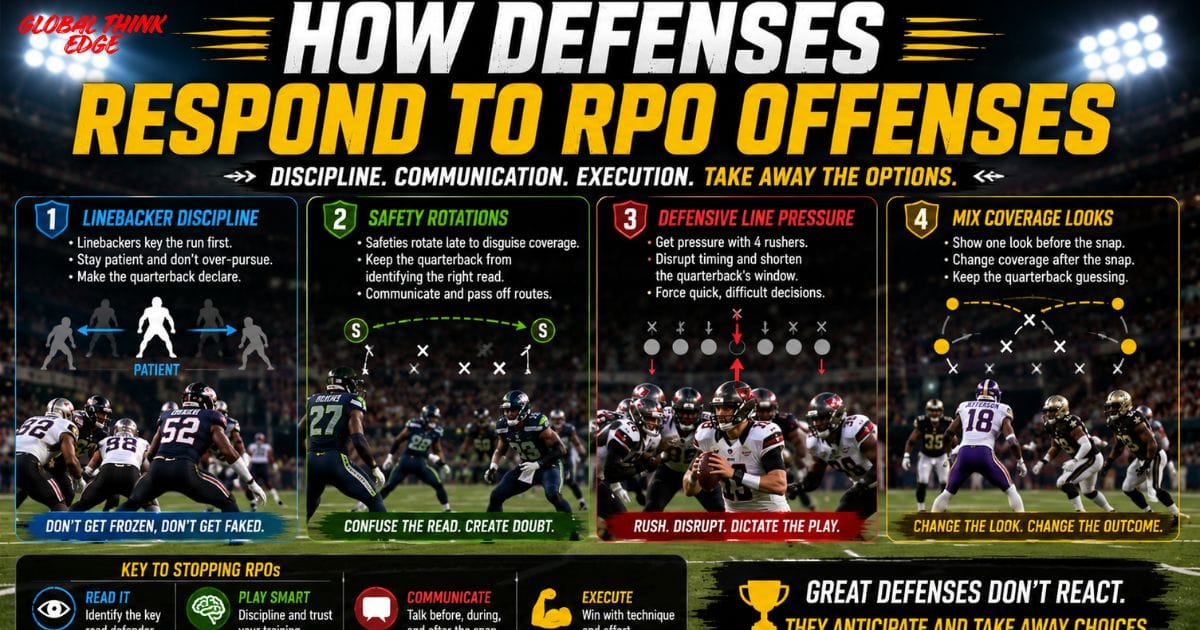
How Defenses Respond to RPO Offenses
Defensive coordinators have developed several methods to reduce the effectiveness of RPO football.
Disciplined Linebackers
Instead of attacking immediately, linebackers stay patient until the quarterback declares the play.
Rotating Safeties
Late safety movement disguises coverage and makes the quarterback’s read more difficult.
Defensive Line Pressure
Quick pressure shortens the quarterback’s decision window and limits available passing options.
Mixed Coverage Looks
Changing coverages before and after the snap prevents quarterbacks from becoming comfortable with predictable reads.
Even so, well-executed RPO offences can still exploit defensive hesitation.
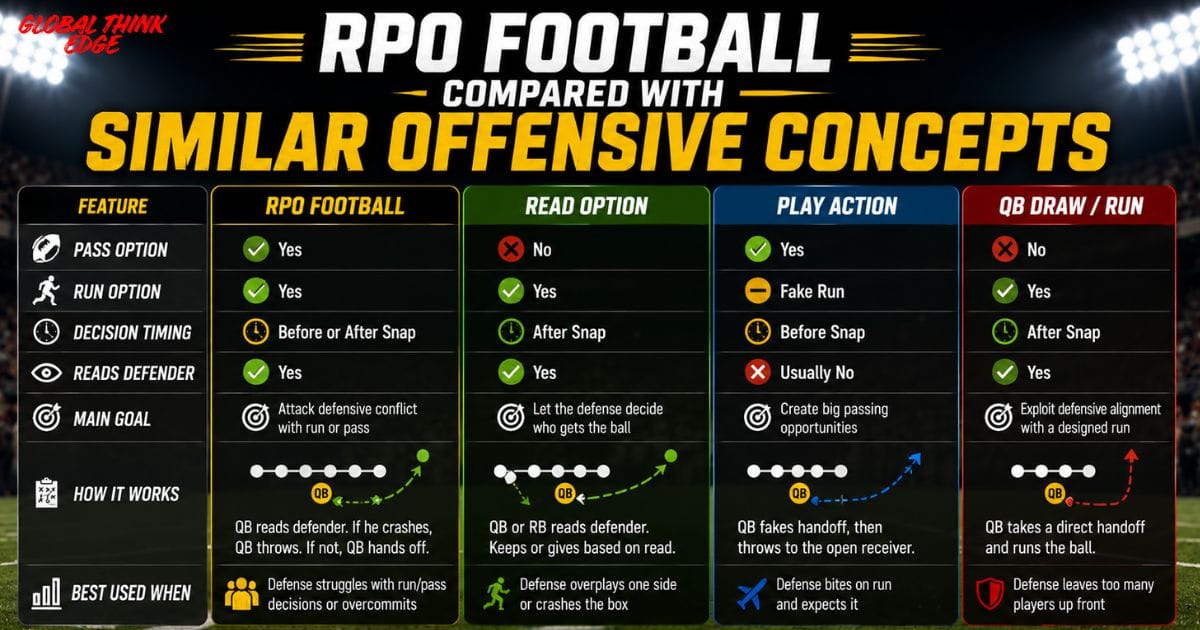
RPO Football Compared With Similar Offensive Concepts
| Feature | RPO Football | Read Option | Play Action |
| Pass Option | Yes | No | Yes |
| Run Option | Yes | Yes | Fake Run |
| Decision Timing | Before or after snap | After snap | Before snap |
| Reads Defender | Yes | Yes | Usually no. |
| Main Goal | Attack defensive conflict | Choose ball carrier | Create passing opportunities |
Understanding these differences helps fans appreciate why coaches use each concept in different situations.
Rules That Shape RPO Football
RPO football operates within strict rules that offences must respect.
One of the most important involves offensive linemen.
Since they block for the run, they cannot move too far beyond the line of scrimmage if the quarterback throws the ball.
If they advance illegally before the pass, officials call an ineligible player downfield penalty.
Quarterbacks must also make quick decisions because waiting too long increases the chance of penalties or negative plays.
These rules require excellent coordination between the quarterback, offensive line, and receivers.
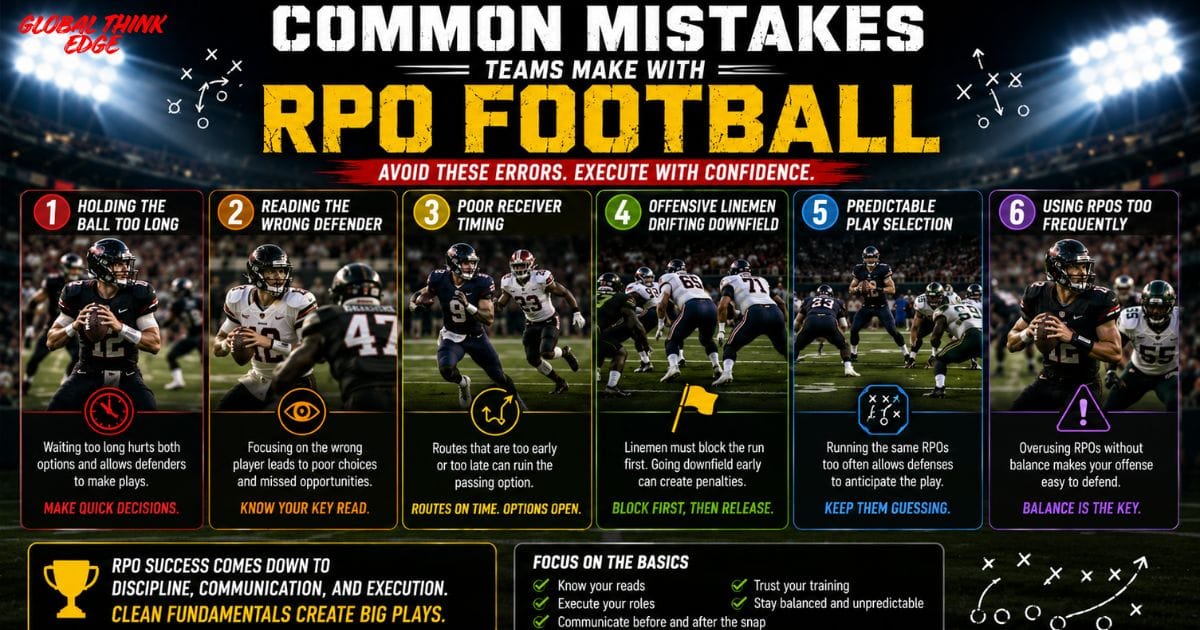
Common Mistakes Teams Make With RPO Football
Even talented offences can struggle when execution breaks down.
Some of the most common mistakes include:
Holding the ball too long.
Reading the wrong defender.
Poor receiver timing.
Offensive linemen drifting downfield too early.
Predictable play selection.
Using RPOs too frequently without complementary plays.
Successful offences continuously mix formations and concepts to keep defences guessing.
Where RPO Football Fits Best
RPO football is effective at nearly every competitive level.
High school teams often use simplified reads to help developing quarterbacks.
College offences frequently build entire systems around RPO concepts because they maximise athletic quarterbacks and fast receivers.
NFL teams generally use more advanced RPO packages that complement traditional passing attacks rather than replacing them.
When paired with strong running games and disciplined execution, RPO football becomes a powerful offensive weapon regardless of the level of competition.
Key Takeaways
RPO stands for Run-Pass Option.
The quarterback chooses between a run and pass based on a defensive read.
Every offensive player has a defined responsibility.
Proper timing is more important than complexity.
Defensive discipline is the best answer against well-designed RPOs.
Modern offences use RPOs to increase efficiency and create mismatches.
Conclusion
RPO football has transformed offensive strategy by combining intelligent decision-making with traditional run concepts. Rather than relying on a single predetermined play, offences can react instantly to defensive movement and exploit weaknesses as they appear.
While the concept depends on disciplined execution, quick quarterback reads, and proper timing, its ability to create efficient, high-percentage plays explains why it remains a staple of modern football. Whether you’re a coach, player, or fan, understanding RPO football provides a deeper appreciation of one of the game’s most innovative offensive strategies.
Frequently Asked Questions
Is an RPO considered a running play or a passing play?
It can become either. The quarterback makes the final decision after reading the defence.
What’s the difference between RPO and play action?
Play action always begins with a fake handoff designed to set up a pass, while an RPO gives the quarterback a genuine choice to either hand off or throw.
Can every quarterback run an RPO offence?
Not necessarily. Quarterbacks need quick decision-making skills, accuracy, and the ability to recognize defensive movement almost instantly.
Why has RPO football become so popular?
It gives offences more flexibility, creates favourable matchups, and forces defenders to choose between stopping the run or covering receivers.
Do professional football teams use RPO concepts?
Yes. Many NFL teams include RPO packages within their offensive systems, although they typically use them more selectively than college programmes.
