Growth Navigate Startup Tools: Smart Success for Startups
What Are Growth-Navigating Startup Tools?
Choosing the right technology today can determine how successfully your startup grows tomorrow. Growth Navigate startup tools help founders streamline operations, improve productivity, and make smarter decisions without adding unnecessary complexity. By selecting solutions that match your business goals and growth stage, you can save time, reduce costs, and build a scalable foundation for long-term success.
As your business evolves, review your software stack regularly and invest only in tools that deliver measurable value. Growth Navigate Startup Tools, combined with smart planning and responsible Growth navigation funding can help your startup adapt, compete, and grow with confidence in an ever-changing market.
Why the Right Startup Tools Matter More Than Ever
Today’s startups operate in highly competitive markets where speed, efficiency, and adaptability can determine success. Companies that rely on manual processes often struggle to keep up with customer expectations and increasing workloads.
Growth Navigate startup tools help businesses stay organised while reducing operational complexity.
Some of the biggest advantages include:
Automating repetitive daily tasks
Improving collaboration between team members
Tracking customer interactions in one place
Measuring marketing performance accurately
Reducing unnecessary operating costs
Making faster, data-driven business decisions
Supporting business growth without increasing administrative work
Instead of spending hours updating spreadsheets or switching between different software platforms, startup teams can focus on delivering value to customers.
These tools also improve visibility across the business. Real-time dashboards allow founders to monitor sales performance, customer engagement, marketing campaigns, and financial health without waiting for manual reports.

Challenges Every Startup Faces During Growth
Every startup experiences obstacles, regardless of its industry. While technology cannot solve every challenge, the right Growth Navigate startup tools make overcoming these difficulties much easier.
Limited Budgets
Early-stage companies often have limited financial resources. Hiring additional employees isn’t always possible, making automation one of the most cost-effective ways to improve productivity.
Many startup tools offer free plans or affordable pricing that allows businesses to grow without making large upfront investments.
Small Teams Managing Multiple Roles
Startup employees frequently handle several responsibilities at once. A founder might oversee marketing, customer support, sales, and operations simultaneously.
Growth-focused software reduces workload by automating repetitive processes, organising tasks, and simplifying communication across the team.
Disconnected Systems
Using separate applications that don’t communicate with each other creates inefficiencies and increases the risk of errors.
An integrated startup technology stack connects different departments, allowing customer information, sales data, and project updates to flow seamlessly throughout the business.
Difficulty Attracting New Customers
Customer acquisition remains one of the biggest challenges for growing startups.
Marketing automation tools help businesses:
Capture leads
Nurture prospects
Schedule campaigns
Analyze conversion rates
Improve customer engagement
This enables startups to build stronger marketing strategies while spending less time on manual campaign management.
Lack of Actionable Data
Making decisions without reliable data often leads to wasted resources.
Modern analytics platforms provide insights into customer behaviour, sales performance, marketing effectiveness, and operational efficiency, allowing founders to make informed business decisions based on measurable results.
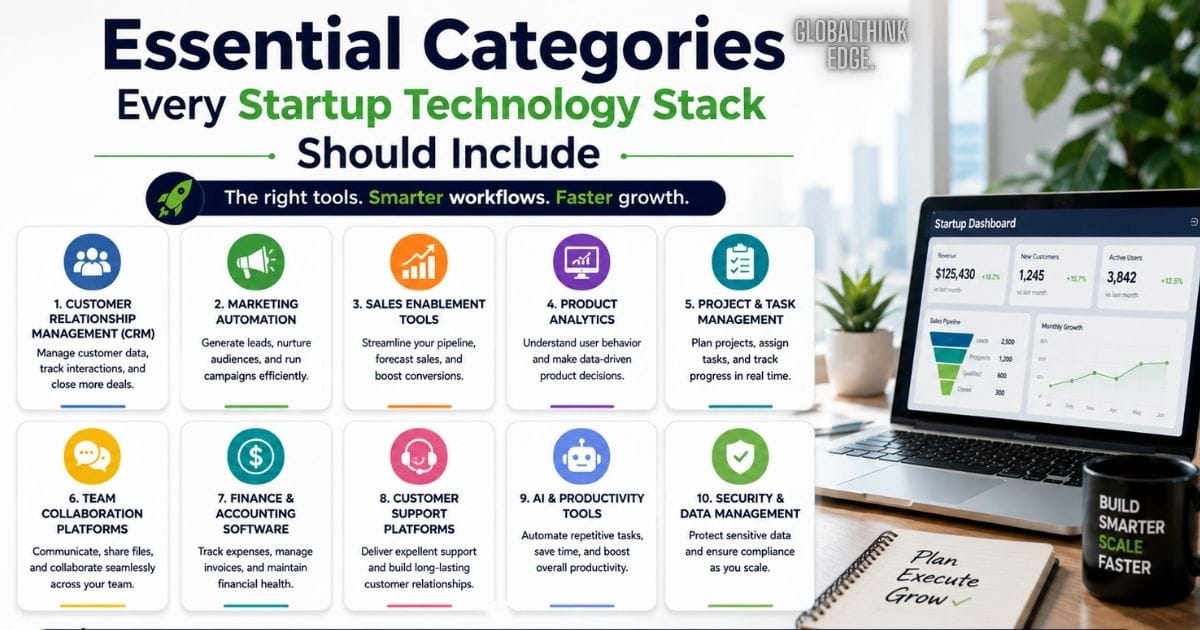
Essential Categories Every Startup Technology Stack Should Include
Building an effective software ecosystem doesn’t require purchasing dozens of applications. Instead, startups should focus on selecting tools that support their current needs while remaining scalable for future growth.
Customer Relationship Management (CRM)
A CRM platform serves as the central hub for customer information.
It helps businesses:
Store customer records
Track sales opportunities
Manage follow-ups
Improve customer communication
Increase customer retention
As a startup grows, having organised customer data becomes increasingly valuable for both sales and customer service teams.
Marketing Automation
Marketing is one of the primary drivers of startup growth, but managing multiple campaigns manually can consume valuable time.
Marketing automation platforms simplify tasks such as the following:
Email marketing
Lead nurturing
Landing page creation
Social media scheduling
Campaign performance tracking
Automation allows marketing teams to deliver personalized experiences while maintaining consistency across multiple channels.
Sales Enablement Tools
Sales software helps businesses convert prospects into paying customers through a structured sales process.
These tools commonly include:
Pipeline management
Proposal generation
Meeting scheduling
Sales forecasting
Communication tracking
Better organisation enables sales teams to respond faster and close more opportunities.
Product Analytics
Understanding how customers interact with your product is essential for continuous improvement.
Product analytics platforms monitor:
User engagement
Feature adoption
Customer journeys
Session duration
Conversion funnels
Instead of relying on assumptions, startups can prioritize updates based on real customer behavior.
Project and Task Management
Every startup needs a system for organising work.
Project management software allows teams to:
Assign responsibilities
Set deadlines
Track project progress
Monitor workloads
Improve accountability
Clear project visibility reduces confusion while helping teams complete work more efficiently.
Team Collaboration Platforms
As startups expand, communication becomes more challenging.
Collaboration tools centralise the following:
Team messaging
Video meetings
File sharing
Shared documents
Knowledge management
Keeping everyone connected improves productivity and ensures projects move forward without unnecessary delays.
Finance and Accounting Software
Financial management plays a critical role in startup success.
Accounting platforms simplify:
Expense tracking
Invoice creation
Cash flow monitoring
Budget management
Financial reporting
Accurate financial records also make future investment discussions and strategic planning much easier.
Customer Support Platforms
Excellent customer service builds trust and encourages long-term loyalty.
Support software helps businesses manage:
Help desk tickets
Live chat
Customer feedback
Knowledge bases
Response time monitoring
Providing timely support strengthens brand reputation while improving customer satisfaction.
AI Productivity Tools
Artificial intelligence is transforming how startups operate.
AI-powered tools can assist with:
Content creation
Meeting summaries
Data analysis
Workflow automation
Customer communication
Research support
Rather than replacing employees, AI improves efficiency by handling repetitive tasks, allowing teams to focus on creative problem-solving and strategic planning.

Selecting Tools That Match Your Business Goals
One common mistake founders make is choosing software based on popularity instead of business needs. A tool that works well for one startup may not deliver the same value for another.
Before investing in any platform, consider:
Your current business objectives
Team size and technical skills
Available budget
Integration capabilities
Ease of implementation
Long-term scalability
Customer support quality
Evaluating these factors helps build a technology stack that grows alongside your business instead of creating unnecessary complexity.
A thoughtful approach to software selection ensures every investment contributes to measurable improvements in productivity, customer experience, and overall business performance.
Best Growth Navigate Startup Tools by Business Function
No single platform can manage every aspect of a startup perfectly. The most successful businesses build a technology stack by selecting tools that match their immediate priorities while leaving room for future growth.
Marketing and Lead Generation
Marketing tools help startups increase visibility, generate qualified leads, and nurture potential customers throughout the buying journey.
Look for solutions that provide:
Email marketing automation
Social media scheduling
Landing page creation
Search engine optimization (SEO) insights
Campaign performance reporting
Using one integrated marketing platform instead of several disconnected tools makes campaign management more efficient and improves reporting accuracy.
Sales and Customer Relationship Management
Sales growth depends on understanding customers and responding to opportunities quickly.
Effective sales platforms help businesses:
Organize customer information
Monitor the sales pipeline
Track follow-up activities
Forecast revenue
Improve conversion rates
A well-managed sales process reduces missed opportunities while creating a better customer experience.
Product Development and Collaboration
As startups grow, product development becomes increasingly collaborative.
Development tools help teams:
Plan product roadmaps
Track feature requests
Report bugs
Manage documentation
Coordinate releases
Keeping developers, designers, and product managers aligned improves efficiency and shortens development cycles.
Analytics and Business Intelligence
Reliable data supports better decision-making.
Analytics platforms allow startups to monitor:
Website traffic
Customer behavior
Revenue trends
Conversion performance
Product engagement
These insights help founders identify strengths, recognize weaknesses, and make improvements based on measurable evidence rather than assumptions.
Workflow Automation
Automation connects different applications so repetitive tasks happen automatically.
Examples include:
Sending welcome emails after customer registration
Updating CRM records
Creating invoices
Assigning support tickets
Generating reports
Reducing manual work saves time while minimising human error.
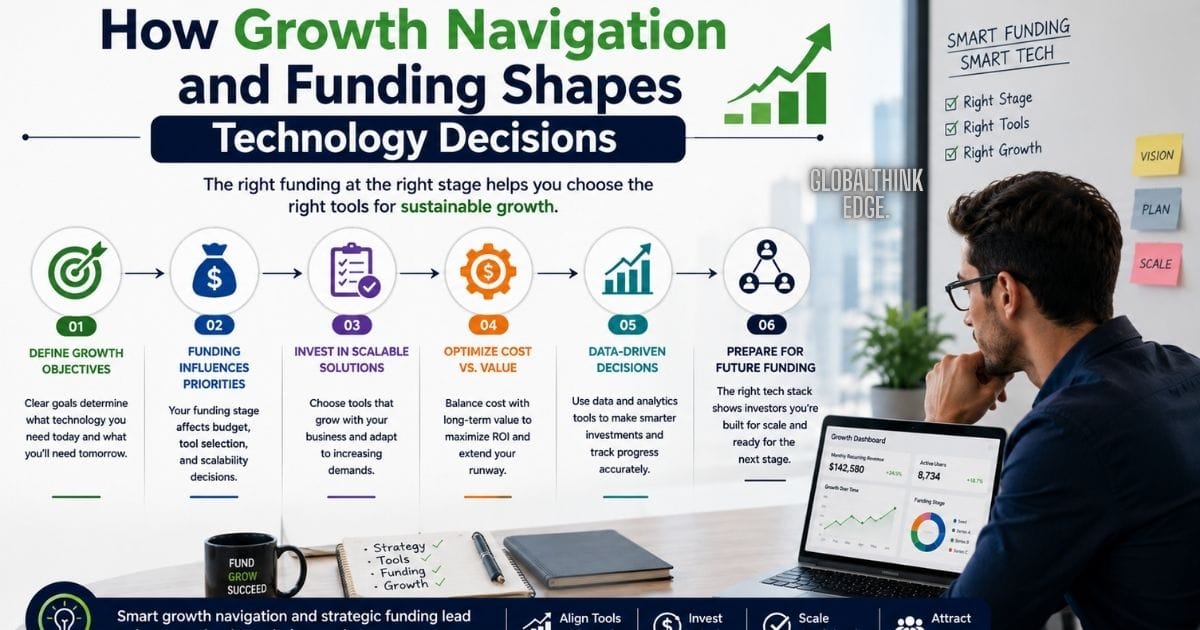
How Growth Navigation and Funding Shapes Technology Decisions
One important factor often overlooked when selecting software is growth navigation funding. Funding directly influences how startups prioritize technology investments.
During the early stages, founders should focus on affordable or free solutions that address essential business needs. Investing heavily in enterprise software before validating a product can increase financial pressure without delivering proportional value.
After securing funding, startups can gradually expand their technology stack by introducing advanced automation, business intelligence, cybersecurity, and customer success platforms.
A practical approach is to evaluate every software purchase by asking one simple question:
Will this tool improve productivity, reduce costs, or generate measurable business growth?
If the answer is yes, the investment is more likely to produce a positive return.
Choosing the Right Tools for Every Startup Stage
The software requirements of a startup change as the business matures.
| Startup Stage | Primary Objective | Recommended Tool Categories |
| Idea & Validation | Test business ideas | Project management, collaboration, note-taking |
| Early Startup | Acquire first customers | CRM, marketing, website analytics |
| Product-Market Fit | Improve operations | Marketing automation, product analytics, customer support |
| Growth Stage | Scale efficiently | Workflow automation, finance management, advanced reporting |
| Expansion | Support larger teams | Enterprise collaboration, cybersecurity, business intelligence |
Regularly reviewing your technology stack ensures your software continues to support business objectives without adding unnecessary complexity.
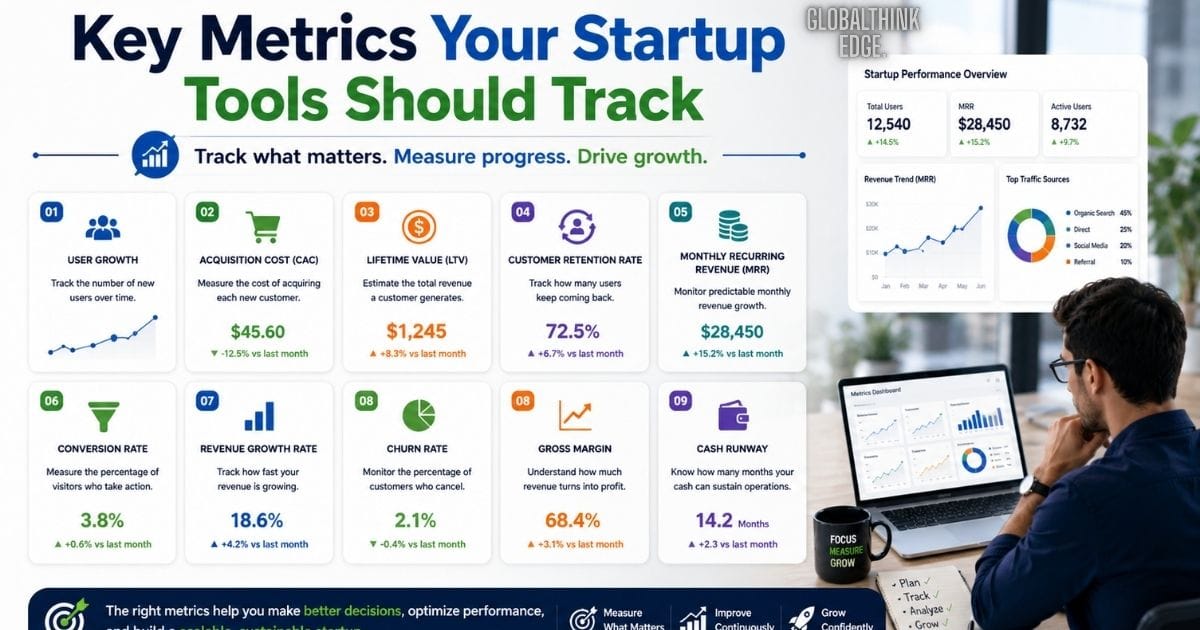
Key Metrics Your Startup Tools Should Track
Even the best software delivers little value if it doesn’t provide meaningful business insights.
Founders should regularly monitor the following performance indicators:
Customer Acquisition Cost (CAC)
Measures how much money is spent to acquire each new customer.
Customer Lifetime Value (LTV)
Estimates the total revenue expected from a customer throughout their relationship with the business.
Monthly Recurring Revenue (MRR)
Essential for subscription-based businesses because it tracks predictable monthly income.
Customer Churn Rate
Shows the percentage of customers who stop using your product or service over a specific period.
Conversion Rate
Measures how effectively website visitors or leads become paying customers.
Revenue Growth
Tracks overall business growth and helps evaluate long-term performance.
Customer Retention
Highlights how successfully the company keeps existing customers satisfied over time.
Monitoring these metrics helps founders make smarter strategic decisions while identifying opportunities for continuous improvement.
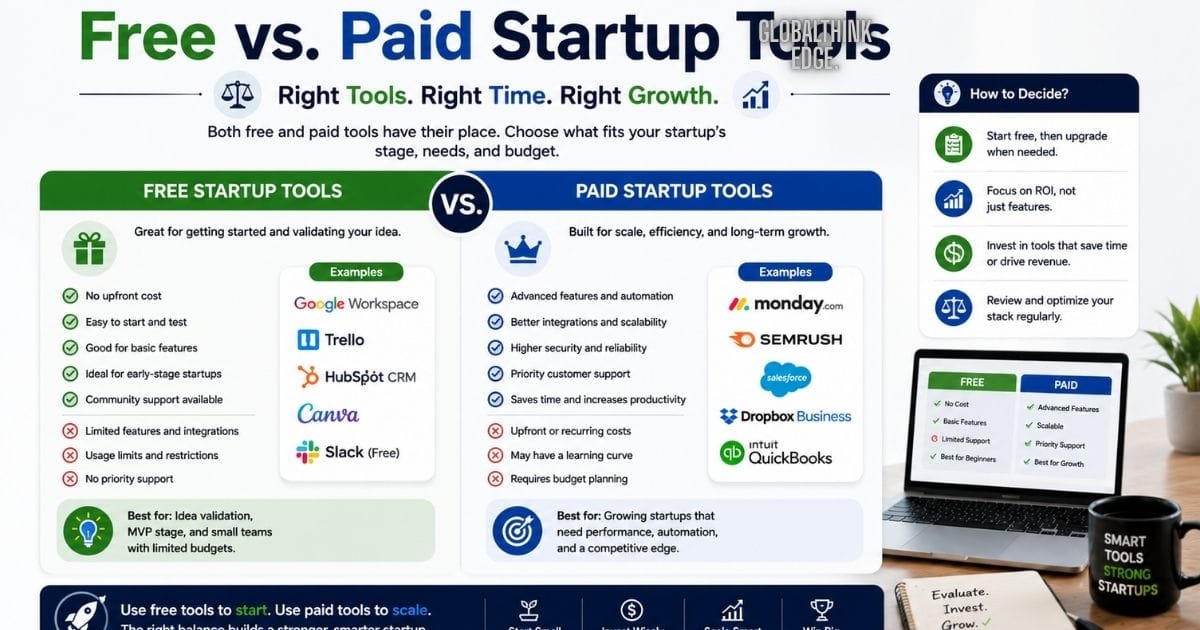
Free vs. Paid Startup Tools
Many founders wonder whether free software is enough.
The answer depends on business size, operational complexity, and growth goals.
| Feature | Free Tools | Paid Tools |
| Cost | Minimal or free | Monthly or annual subscription |
| Features | Basic functionality | Advanced automation and reporting |
| Scalability | Suitable for small teams | Designed for growing businesses |
| Support | Limited | Dedicated customer support |
| Integrations | Basic | Extensive integrations |
A sensible strategy is to begin with free plans and upgrade only when additional features create measurable business value.
Common Mistakes When Building a Startup Tool Stack
Choosing software without careful planning can increase costs and reduce productivity.
Avoid these common mistakes:
Buying multiple tools with overlapping features.
Ignoring software integration capabilities.
Selecting tools based on popularity instead of business needs.
Failing to train employees properly.
Overlooking data security and privacy.
Never reviewing existing software performance.
Paying for premium features that remain unused.
A focused technology stack often performs better than a large collection of disconnected applications.
Future Trends in Startup Growth Technology
Startup technology continues to evolve rapidly.
Several emerging trends are shaping the future of business growth:
Artificial intelligence for smarter automation
Predictive analytics for proactive decision-making
No-code and low-code development platforms
Unified software ecosystems
Privacy-focused data management
Intelligent customer support powered by AI
Cloud-native infrastructure with stronger security
Businesses that embrace these innovations thoughtfully will be better positioned to adapt to changing customer expectations and competitive markets.
Final Thoughts
Building a successful startup requires more than a great idea; it demands efficient systems that support sustainable growth. Growth Navigate startup tools help founders simplify operations, improve collaboration, automate repetitive work, and make informed decisions using real-time data.
Instead of chasing every new software trend, focus on building a technology stack that aligns with your business goals, team size, and stage of growth. Start with the essentials, measure performance regularly, and introduce new tools only when they provide measurable value.
A well-planned software ecosystem, combined with responsible growth navigation funding, creates a strong foundation for long-term success. By investing in the right tools at the right time, startups can improve efficiency, strengthen customer relationships, and confidently scale in an increasingly competitive marketplace.
Frequently Asked Questions
What are Growth Navigate’s startup tools?
Growth Navigate’s startup tools are software solutions that help startups manage operations, marketing, sales, customer relationships, analytics, finance, and team collaboration more efficiently.
Which tools should startups prioritize first?
Most startups should begin with project management software, CRM, marketing automation, analytics, and collaboration tools before investing in advanced enterprise platforms.
Are free startup tools suitable for new businesses?
Yes. Many free tools provide enough functionality for early-stage startups. As operations expand, upgrading to paid plans becomes worthwhile when advanced features improve productivity.
How often should a startup review its software stack?
Review your technology stack every six to twelve months or after major milestones such as funding rounds, rapid hiring, or product expansion.
Does growth navigation funding influence software choices?
Yes. Funding determines how much a startup can invest in technology. Businesses should prioritize essential software first and expand their technology stack as financial resources and operational needs grow.
