120 Volts to Watts: Simple Conversion, Formula, and Examples
What Is 120 Volts in Watts?
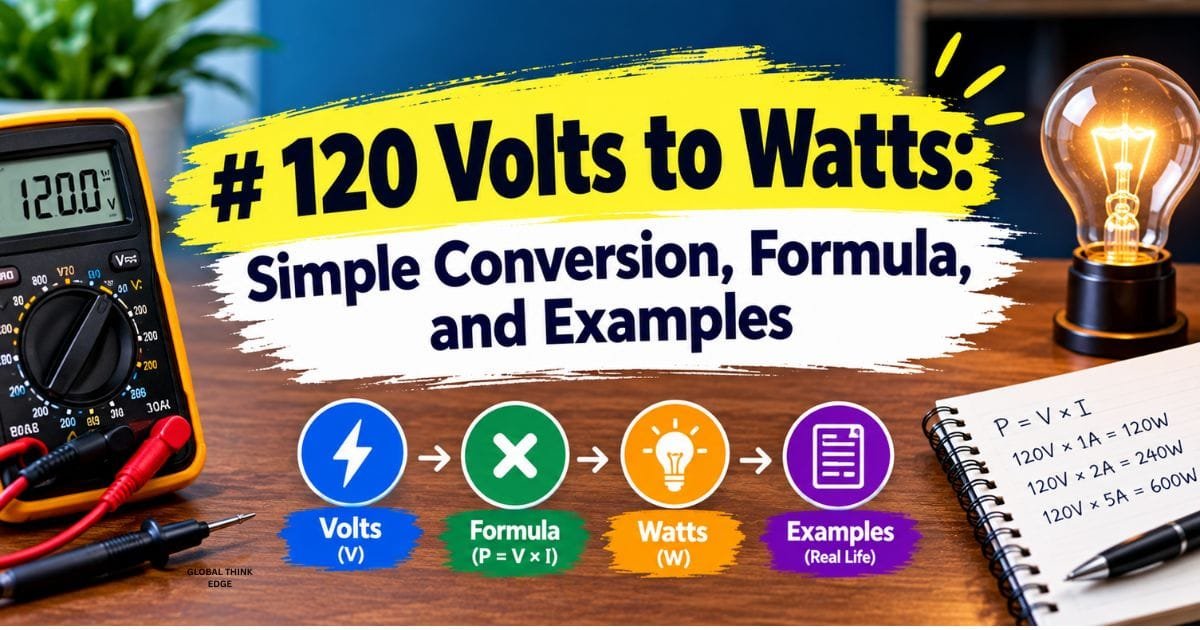
120 volts cannot be converted directly into watts without knowing the current in amps or the electrical resistance. Volts measure electrical pressure, while watts measure electrical power. To calculate watts, multiply volts by amps using the formula P=V×IP=V×I.
For example, a device operating at 120 volts and drawing 1 amp uses 120 watts. If it draws 5 amps, its power is 600 watts, assuming a power factor of 1.
How to Convert 120 Volts to Watts
To convert 120 volts to watts, multiply the voltage by the current in amperes. The result tells you how much electrical power a device uses under the specified conditions.
Basic formula:
Watts=Volts×Amps\text{Watts}=\text{Volts}\times\text{Amps}Watts=Volts×Amps
At 120 volts, the formula becomes:
Watts=120×Amps\text{Watts}=120\times\text{Amps}Watts=120×Amps
You only need to know the current drawn by the device to calculate its power for a direct-current circuit or a simple resistive load.
Example: If a 120-volt appliance draws 3 amps:
120×3=360 watts120\times3=360\text{ watts}120×3=360 watts
The appliance uses 360 watts of electrical power under these conditions.
Why Amps Matter in Voltage-to-Watt Conversion
Amps determine how much electrical current flows through a circuit. Two devices operating at the same 120 volts can consume different amounts of power because they draw different currents.
For instance, a small lamp might use 60 watts, while a larger appliance could use 1,200 watts at the same voltage. The difference comes from their current requirements and electrical characteristics.
Voltage alone does not tell you the total power consumption.
Volts, Amps, and Watts: What’s the Difference?
These three electrical units describe different properties of electricity.
| Unit | What It Measures | Example |
| Volts (V) | Electrical potential difference | 120 V |
| Amps (A) | Electrical current | 5 A |
| Watts (W) | Electrical power | 600 W |
Understanding these units makes it easier to calculate power requirements, compare appliances, and select suitable power supplies or generators.
120 Volts to Watts Conversion Chart
The following chart shows the wattage at 120 volts for different current levels, assuming a power factor of 1.
| Current (Amps) | Voltage (Volts) | Power (Watts) |
| 0.5 A | 120 V | 60 W |
| 1 A | 120 V | 120 W |
| 2 A | 120 V | 240 W |
| 3 A | 120 V | 360 W |
| 4 A | 120 V | 480 W |
| 5 A | 120 V | 600 W |
| 6 A | 120 V | 720 W |
| 8 A | 120 V | 960 W |
| 10 A | 120 V | 1,200 W |
| 12 A | 120 V | 1,440 W |
| 15 A | 120 V | 1,800 W |
| 20 A | 120 V | 2,400 W |
Quick answer: At 120 volts, every amp corresponds to 120 watts for a resistive load or a load with a power factor of 1.
For other AC devices, the actual power in watts may be lower than the voltage-current product because of the power factor.
How Many Watts Are 120 Volts at Different Amps?
The wattage at 120 volts depends on how much current the electrical device draws. Here are common examples and how to calculate them.
120 Volts to Watts at 1 Amp
A 120-volt device drawing 1 amp uses 120 watts when its power factor is 1.
Calculation:
120×1=120 W120\times1=120\text{ W}120×1=120 W
This level of power could suit certain small electrical devices, depending on their actual ratings.
120 Volts to Watts at 5 Amps
A device drawing 5 amps at 120 volts uses 600 watts for a resistive load.
Calculation:
120×5=600 W120\times5=600\text{ W}120×5=600 W
This calculation can help estimate the power needs of heaters, kitchen appliances, or other equipment, but always check the appliance’s actual specifications.
120 Volts to Watts at 10 Amps
At 10 amps, a 120-volt device uses 1,200 watts when the power factor is 1.
Calculation:
120×10=1,200 W120\times10=1,200\text{ W}120×10=1,200 W
This amount of power may be typical of some heating appliances or high-power household equipment.
120 Volts to Watts at 15 Amps
A 120-volt load drawing 15 amps corresponds to 1,800 watts at a power factor of 1.
Calculation:
120×15=1,800 W 120\times15=1,800\text{ W} 120×15=1,800 W
Although the calculation gives 1,800 watts, that does not automatically mean you should operate a continuous 1,800-watt load on a 15-amp circuit. Circuit ratings, electrical codes, and continuous-load requirements matter.
120 Volts to Watts at 20 Amps
A device drawing 20 amps at 120 volts corresponds to 2,400 watts at a power factor of 1.
Calculation:
120×20=2,400 W 120\times20=2,400\text{ W}120×20=2,400 W
A 20-amp circuit must have appropriate wiring, overcurrent protection, and compatible receptacles. Never assume that a standard 15-amp outlet can safely support this load.
How to Calculate Watts for 120-Volt AC Appliances
For alternating-current (AC) appliances, the calculation depends on the type of load.
For a resistive appliance, such as a simple heating element, watts are approximately equal to volts multiplied by amps. For many motors, compressors, and other inductive loads, you must account for the power factor.
The formula for single-phase AC real power is:
P=V×I×PFP=V\times I\times PFP=V×I×PF
Where:
- PPP = real power in watts
- VVV = voltage in volts
- III = current in amps
- PFPFPF = power factor
Example: 120 Volts, 5 Amps, and a 0.8 Power Factor
Suppose an AC appliance operates at 120 volts, draws 5 amps, and has a power factor of 0.8.
120×5×0.8=480 W120\times5\times0.8=480\text{ W}120×5×0.8=480 W
The appliance uses 480 watts of real power under these conditions.
The voltage-current product is 600 volt-amperes (VA), while the real power is 480 watts. This difference matters when sizing generators, inverters, and other electrical equipment.
For three-phase systems, the formula differs, so you should not use this single-phase calculation without checking the system configuration.
How to Calculate Watts From 120 Volts and Resistance
If you know the electrical resistance instead of the current, you can calculate power using Ohm’s law.
The formula for a resistive load is:
P=V2RP=\frac{V^2}{R}P=RV2
Where:
- PPP = power in watts
- VVV = voltage in volts
- RRR = resistance in ohms
Example: 120 Volts With 24 Ohms of Resistance
Suppose a resistive device operates at 120 volts and has a resistance of 24 ohms.
P=120224P=\frac{120^2}{24}P=241202
P=14,40024=600 WP=\frac{14,400}{24}=600\text{ W}P=2414,400=600 W
The device uses 600 watts of power.
This method works for a suitable resistive load when the resistance is known. For AC motors and complex electronic devices, the simple resistance formula may not describe real power accurately.
How Many Watts Can a 120-Volt Outlet Supply?
The potential wattage of a 120-volt outlet depends on its circuit’s amperage rating and the applicable electrical safety requirements.
| Circuit Rating | Theoretical Power at 120 V |
| 15 amps | 1,800 W |
| 20 amps | 2,400 W |
| 30 amps | 3,600 W |
These values are calculated by multiplying 120 volts by the listed amperage. They are not universal recommendations for continuous use.
In the United States, a commonly applied guideline for continuous loads on a standard circuit is to limit the load to 80% of the circuit rating, where that rule applies. This gives approximately 1,440 watts on a 15-amp circuit and 1,920 watts on a 20-amp circuit at 120 volts.
Actual allowable loads depend on local electrical codes, equipment ratings, circuit conditions, and the type of installation.
Safety tip: Check the appliance label and circuit rating before connecting multiple high-wattage devices to one outlet.
Common Mistakes When Converting 120 Volts to Watts
Avoid these common errors when calculating electrical power.
- Assuming voltage equals wattage: A 120-volt supply does not automatically provide 120 watts. You also need the current or other relevant electrical information.
- Ignoring power factor: Some AC motors and electronic equipment draw current that does not translate directly into the same number of watts as volts multiplied by amps.
- Confusing watts with watt-hours: Watts measure power at a given moment. Watt-hours measure energy used over time.
- Overlooking startup current: Motors and compressors can briefly draw more current when starting than during normal operation.
- Exceeding circuit limits: A mathematically correct wattage does not guarantee that an outlet, extension cord, or circuit can safely support the load.
These distinctions help you calculate power more accurately and avoid unsafe electrical setups.
Frequently Asked Questions
How many watts is 120 volts?
There is no single wattage for 120 volts alone. At a power factor of 1, 120 volts multiplied by 1 amp equals 120 watts. You need the current or resistance to calculate the actual power.
Is 120 volts equal to 1,000 watts?
No. Volts and watts measure different things. At 120 volts, a resistive load needs approximately 8.33 amps to use 1,000 watts.
How many amps are needed for 1,500 watts at 120 volts?
For a resistive load:
I=PV=1,500,120=12.5 AI=\frac{P}{V}=\frac{1,500}{120}=12.5\text{ A}I=VP=1201,500=12.5 A
The load requires 12.5 amps at 120 volts. For AC equipment with a power factor below 1, the current needed to deliver 1,500 watts will be higher.
Can I calculate watts without knowing amps?
Yes, if you know other suitable information, such as resistance for a resistive load. Otherwise, voltage alone is insufficient to determine wattage.
Do 120 volts and 240 volts use the same number of watts?
Not necessarily. Wattage depends on voltage, current, and, for many AC loads, power factor. At the same current and power factor, 240 volts produces twice the real power of 120 volts.
Final Verdict
120 volts to watts conversion requires additional electrical information. For a resistive load or a load with a power factor of 1, multiply 120 volts by the current in amps to find watts. For example, 5 amps equals 600 watts, while 10 amps equals 1,200 watts.
For AC motors and other non-resistive equipment, include the power factor when calculating real power. Always check appliance ratings and circuit limits before connecting electrical devices.
