How Does Football Group Stage Work? Easy 2026 Breakdown
How Does Football Group Stage Work?
A football group stage divides teams into smaller groups, where each team plays the other teams in its group. Teams earn 3 points for a win, 1 for a draw, and 0 for a loss. After all group matches, teams are ranked by points and other tiebreakers, with the highest-ranked teams advancing to the knockout stage.
The system gives teams several chances to recover from one poor result. Unlike knockout football, losing one match does not automatically eliminate a team. Instead, every point, goal, and result can influence the final standings.
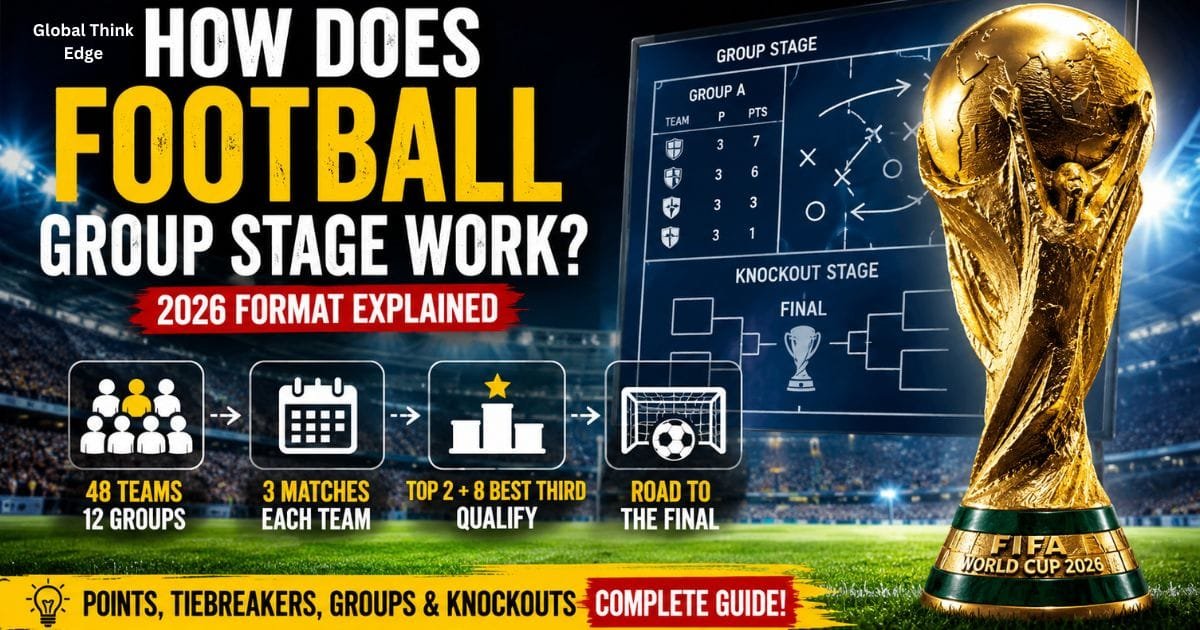
At the 2026 FIFA World Cup, the expanded tournament used 48 teams divided into 12 groups of four. Each team played three group matches, producing 72 group-stage matches in total. The top two teams from every group plus the eight best third-placed teams advanced to the Round of 32.
What Is a Group Stage in Football?
A group stage is the opening competition phase in many football tournaments. Organizers place teams into groups, and teams compete against the other members of their group before the tournament moves into a knockout format.
The basic purpose is simple: use several matches to determine which teams deserve to advance rather than eliminating teams after a single game.
For example, imagine four teams in Group A:
| Team | Wins | Draws | Losses | Points |
| Team A | 2 | 1 | 0 | 7 |
| Team B | 2 | 0 | 1 | 6 |
| Team C | 1 | 0 | 2 | 3 |
| Team D | 0 | 1 | 2 | 1 |
Team A would finish first because it collected the most points. Team B would finish second. Whether Team C advances would depend on the tournament’s qualification rules.
How Many Matches Does Each Team Play?
In a four-team group using a single round-robin format, every team plays three matches.
Each team faces each of the other three teams once. This creates six matches in the entire group:
- Team 1 vs Team 2
- Team 1 vs Team 3
- Team 1 vs Team 4
- Team 2 vs Team 3
- Team 2 vs Team 4
- Team 3 vs Team 4
The formula is n × (n − 1) ÷ 2, where n represents the number of teams.
For four teams, that means:
4 × 3 ÷ 2 = 6 matches
With 12 groups of four, the 2026 World Cup therefore had 72 group-stage matches.
How Do Football Group Stage Points Work?
Points determine the initial order of teams in the table.
The standard scoring system is:
- Win = 3 points
- Draw = 1 point
- Loss = 0 points
A team that wins all three group matches therefore finishes with 9 points. A team recording three draws collects 3 points.
This scoring system makes winning particularly important, but a draw can still be valuable when teams are competing closely for qualification.
What Happens When Teams Finish Level on Points?
If teams have the same number of points, tournament regulations use tiebreaking criteria to separate them.
The exact order can vary between competitions, so readers should always check the regulations for the specific tournament. FIFA competitions can use factors such as head-to-head points, head-to-head goal difference, goals scored, overall goal difference, overall goals scored, disciplinary records, and drawing of lots, depending on the applicable regulations.
This is why a team should not assume that equal points automatically mean equal positions.
Why Goal Difference Matters
Goal difference is calculated as:
Goals scored − goals conceded = goal difference
For example, if a team scores 6 goals and concedes 3, its goal difference is +3.
A strong goal difference can become extremely important when two or more teams finish with the same number of points.
How Do World Cup Groups Work in 2026?
The 2026 FIFA World Cup introduced a major change from the traditional 32-team format.
The tournament featured:
- 48 teams
- 12 groups
- 4 teams per group
- 3 group matches per team
- 72 group-stage matches
- 32 teams advancing to the knockout phase
The top two teams in each group automatically advanced. The competition then compared the 12 third-placed teams, with the eight best third-placed teams also progressing.
This produced a 32-team Round of 32, rather than going directly from the group stage to a Round of 16.
FIFA changed the proposed 16-groups-of-three concept to 12 groups of four, partly to ensure that every team would play at least three matches and to reduce concerns about competitive integrity and possible collusion.
How Many Teams Qualify From Each World Cup Group?
The top two teams from every group qualify automatically for the knockout stage.
Because there are 12 groups, that produces the following:
12 × 2 = 24 teams
The remaining eight places go to the best third-placed teams.
Therefore:
24 automatic qualifiers + 8 third-placed qualifiers = 32 knockout teams
A third-placed team can therefore survive even without finishing in the top two, but its record must be strong enough compared with third-placed teams from the other groups. FIFA ranks those third-placed teams using tournament-specific criteria.
How Does the 2026 World Cup Bracket Work?
After the group stage, the tournament moves into a single-elimination structure.
The knockout pathway is
Round of 32 → Round of 16 → Quarter-finals → Semi-finals → Final
A team must win each knockout match to continue. A defeat ends its tournament.
This creates a major strategic difference between the two phases. In the group stage, teams can survive a defeat through later results. In the knockout stage, there is no comparable second chance.
The 2026 tournament expanded the number of matches a finalist would play to eight, compared with seven in the previous 32-team format.
Can a Team Qualify With Only One Win?
Yes, depending on the other results.
In a four-team group, one win gives a team 3 points. If its other two matches are losses, it finishes with three points.
Whether three points are enough depends on the results of the other teams and the applicable tiebreakers.
A team can also advance without winning a match if it collects enough draws and benefits from the overall standings. That possibility is one reason group-stage football can remain unpredictable until the final matchday.
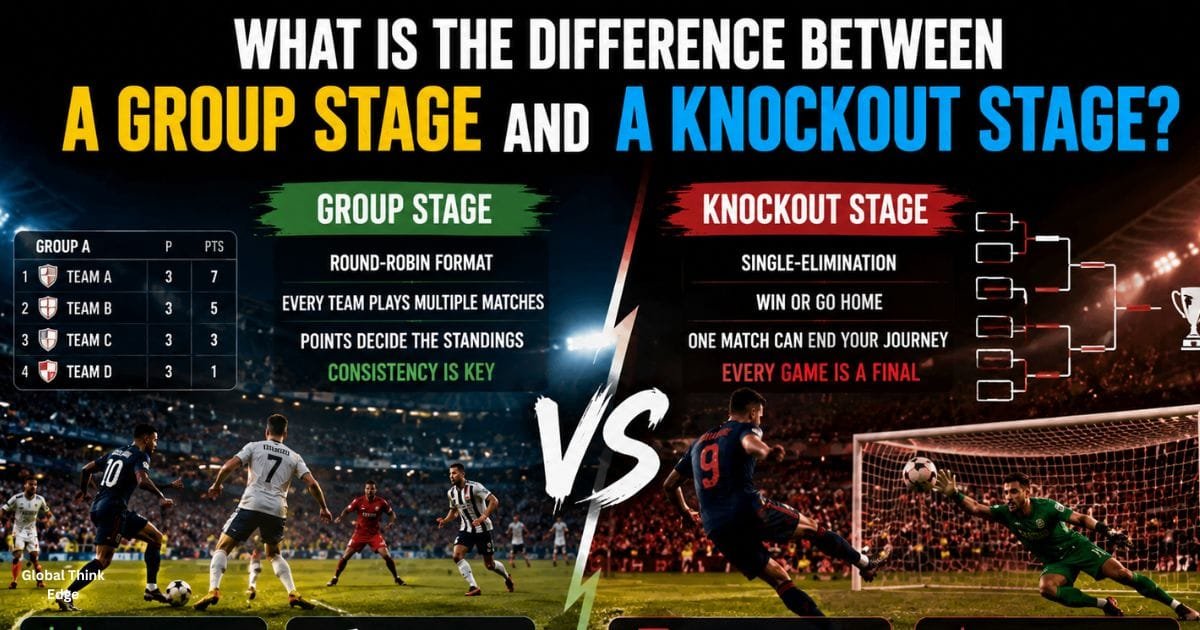
What Is the Difference Between a Group Stage and a Knockout Stage?
| Feature | Group Stage | Knockout Stage |
| Format | League/round-robin | Single elimination |
| Matches | Multiple opportunities | One match can eliminate a team |
| Points | Used for standings | Not used as league points |
| Draw | Can be useful | Usually requires a winner |
| Elimination | Based on final group ranking | Losing normally means elimination |
| Main objective | Finish high enough to qualify | Win and advance |
The group stage rewards consistency, while the knockout stage rewards immediate results under pressure.
Why Is the Final Group Match So Important?
The final group match can determine qualification, group position, or elimination.
A team may enter the last match needing only a draw, while another team may need a win. Goal difference can also change the calculation.
For this reason, teams often monitor results in other matches at the same time. A goal scored or conceded elsewhere can suddenly alter who qualifies.
This becomes especially significant in tournaments where third-placed teams are compared across multiple groups.
How Does the Group Stage Lead to the Knockout Rounds?
The process can be understood in five simple steps:
- Teams are drawn into groups.
- Each team plays the other teams in its group.
- Teams receive points based on results.
- Final standings are determined using points and tiebreakers.
- Qualified teams enter the knockout bracket.
In the 2026 World Cup, this process reduced 48 participating teams to 32 knockout-stage teams. From there, the single-elimination bracket determined the champion.
Why Do Tournaments Use Group Stages?
Group stages create more matches and give teams an opportunity to recover from setbacks.
They also provide a broader test of squad quality. A team must manage several opponents, different tactical challenges, injuries, fatigue, and pressure across multiple fixtures.
For spectators, the format creates meaningful storylines because qualification can remain undecided until the final group matches.
Frequently Asked Questions
How many games do you play in a World Cup group stage?
Under the 2026 World Cup format, every team played three group-stage matches because each group contained four teams and each team faced the other three once.
How many matches are in the World Cup group stage?
The 2026 World Cup had 72 group-stage matches. With 12 groups of four, each group produced six matches.
How many teams qualify for the World Cup 2026 per group?
Two teams from each group automatically qualified for the Round of 32. Eight additional places were awarded to the best third-placed teams across all 12 groups.
How do World Cup knockout stages work?
The knockout stage uses single-elimination matches. The winner advances, and the loser is eliminated. In 2026, the knockout phase began with the Round of 32 before moving through the Round of 16, quarter-finals, semi-finals, and final.
What happens if teams have the same points?
The tournament’s official tiebreaking regulations determine their positions. Depending on the applicable competition rules, criteria can include head-to-head records, goal difference, goals scored, and disciplinary records before a final drawing of lots if necessary.
Key Takeaway
A football group stage is essentially a mini-league inside a larger tournament. Teams play multiple matches, collect points, and compete for a high enough position to reach the knockout rounds.
For the 2026 FIFA World Cup, the format was especially important because 48 teams competed across 12 groups of four. The top two teams from every group and the eight strongest third-placed teams advanced, creating a 32-team knockout bracket.
Understanding points, goal difference, tiebreakers, and qualification rules makes the group table much easier to follow—and explains why even one goal in the final group match can completely change a team’s tournament future.
