
How Do Sports Tie Breakers Work? Brilliant Facts
How Do Sports Tie Breakers Work?
Sports tie breakers are rules used to separate teams or players when they finish level under the normal scoring system. The exact method depends on the sport and competition. Common criteria include head-to-head results, points or goal difference, goals scored, set or game margins, disciplinary records, and sometimes a random draw or ranking.
A tie breaker does not always mean playing another game. In tennis, a tie-break can decide a set or match. In football, basketball, and tournament standings, a tie breaker usually compares existing results to determine who ranks higher.
The key point is that there is no universal sports tie-breaker system. Each governing body or competition establishes its own order of criteria.
Why Are Tie Breakers Needed?
Tie breakers prevent identical records from creating uncertainty over rankings, qualification, playoff positions, or tournament winners.
For example, two football teams may finish a group stage with the same number of points. Instead of automatically replaying a match, the competition can compare their goal difference, goals scored, head-to-head record, or other published criteria.
Basketball competitions often use winning percentage and head-to-head results, while tennis uses a specific point-by-point format when a set reaches the required score.
The Main Types of Sports Tie Breakers
| Tie-break method | Common use | What it compares |
| Head-to-head | Football, basketball | Results between tied competitors |
| Goal difference | Football | Goals scored minus goals conceded |
| Points difference | Basketball | Points scored minus points allowed |
| Goals or points scored | Team sports | Total attacking output |
| Set/game difference | Tennis | Sets or games won versus lost |
| Disciplinary record | Some football tournaments | Yellow and red cards |
| Ranking | Some competitions | Official ranking position |
| Extra contest | Some sports | A new game, match, or playoff |
| Random draw | Last resort | Chance decides the order |
The order matters. A competition may use one criterion first and only move to the next if the tie remains unresolved.
How Does a Tie Breaker Work in General?
A typical tie-break system works like a ladder. Organizers first identify the competitors with identical records, then apply the published criteria in sequence.
Suppose three football teams all finish on the same number of points. The competition might first compare their results against one another. If that does not separate them, it could compare overall goal difference, then goals scored, disciplinary records, and, finally, another predetermined method.
This approach makes the process predictable because teams know the criteria before the competition begins.

How Are Tie Breakers Decided in FIFA?
FIFA tie-breakers vary by competition, so there is no single rule that applies to every FIFA tournament.
For example, the 2026 FIFA World Cup group-stage regulations use a sequence that can consider points from matches between the tied teams, goal difference in those matches, goals scored in those matches, then overall group goal difference and goals scored. Further criteria can include team conduct scores and the latest FIFA men’s world ranking.
This means a 0-0 draw does not automatically decide anything. If teams remain level, the competition continues down the published tie-break list.
What Happens If a Soccer Score Is 0-0?
A 0-0 score simply means neither team scored during the match. It does not automatically create a winner.
In a group-stage match, the game can finish as a draw, with each team receiving the points specified by the competition. If teams later finish level in the standings, the tournament’s tie-break criteria determine their ranking.
In a knockout match, however, a winner may be required. Depending on the competition, that can involve extra time and a penalty shootout rather than a standings tie-breaker.
What Is the Most Common Tiebreaker Score in Football?
There is no single “most common tie-breaker score” in football because football competitions normally use statistical criteria rather than a special score.
A common deciding measure is goal difference. It is calculated as:
Goals scored − Goals conceded = Goal difference
For example, a team scoring 8 goals and conceding 3 has a goal difference of +5.
However, competitions can place head-to-head results, goals scored, disciplinary records, or other criteria before or after goal difference.
How Are Tie Breakers Decided in Tennis?
Tennis tie-breakers are different from league standings. A tennis tie-break is a special scoring game used to settle a set or, under certain formats, an entire match.
Under the standard tie-break format, the first player or team to reach 7 points with a two-point advantage wins the tie-break. If the score reaches 6-6, play continues until someone leads by two points, such as 8-6 or 10-8.
That is why a tennis tie-break can finish at 7-5, 7-6, 8-6, 10-8, or another score that satisfies the required margin.
Is a Tennis Tie-Break 7 or 10 points?
It can be either, depending on the type of tie-break and competition rules.
A standard set tie-break is generally played to 7 points, win by two. A match tie-break can be played to 10 points, win by two, particularly when it replaces a deciding final set. The ITF rules recognize both 7-point and 10-point match tie-break formats.
So the answer is not simply “7” or “10.” You must know whether the competition is using a standard set tie-break, a match tie-break, or a specific event format.
Does Wimbledon Have a 10-Point Tie-Break?
Yes. Wimbledon uses a 10-point tie-break to decide a final set when the score reaches 6-6.
The ITF’s current rules provide for a final-set 10-point tie-break, where the first player or team to reach 10 points with a two-point advantage wins. Wimbledon follows this final-set tie-break approach.
This rule prevents deciding matches from continuing indefinitely while still requiring a meaningful two-point margin.
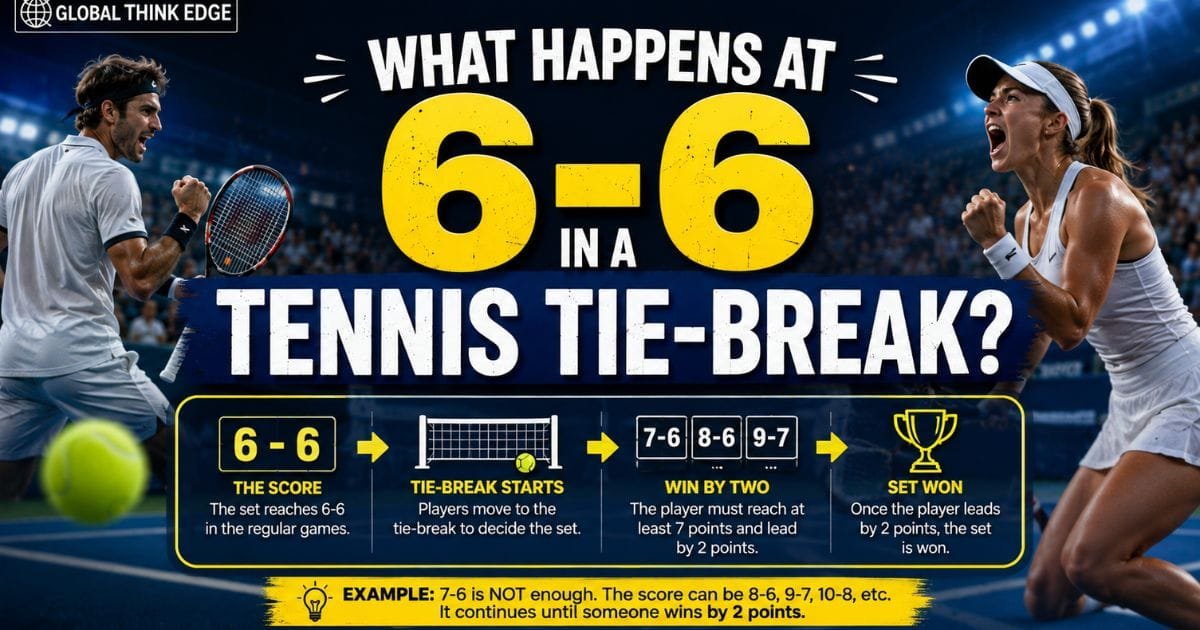
What Happens at 6-6 in a Tennis Tie-Break?
A 6-6 tie in the games means the set reaches its tie-break stage when the event uses a tie-break set.
Players then play the tie-break points rather than another standard game. In a standard 7-point tie-break, one player must reach at least seven points and lead by two.
For example, 7-6 is not enough to win the tie-break because the leader has only a one-point advantage. A score of 8-6 would satisfy the two-point requirement.
What Is a 12-Point Tie-Break in Tennis?
A “12-point tie-break” usually refers to a tie-break played to 7 points with a two-point margin, where the total number of points can reach 12.
For example, 7-5 produces 12 total points. The phrase can therefore be confusing because the target is not necessarily 12 points.
If a tie-break reaches 6-6, it continues beyond 12 total points until a player gains a two-point advantage.
What Is a 6-0, 6-0 Tennis Score Called?
A 6-0, 6-0 result is commonly called a double bagel.
The term “bagel” refers to winning a tennis set 6-0. Winning two consecutive sets 6-0 therefore produces a double bagel.
It is not a tie-break result; it is a dominant straight-sets victory.
How Does the NBA Do Tiebreakers?
The NBA primarily uses statistical criteria to break ties in regular-season standings rather than staging an extra game.
For two teams with identical records, the current NBA procedure begins with head-to-head winning percentage, followed by division-winner status, division record when applicable, conference record, performance against eligible postseason teams, and finally overall point differential.
For three or more tied teams, the procedure starts differently, including division-winner status and winning percentage in games among the tied teams. If a tie still cannot be resolved, the criteria can eventually lead to a random drawing.
This is important because NBA tiebreakers can affect playoff qualification, playoff seeding, and division standings.
NBA Tiebreakers vs Tennis Tie-Breaks
The terms sound similar, but they describe different mechanisms.
NBA tiebreaker: compares teams’ season results and statistical records to establish standings.
Tennis tie-break: is an actual scoring sequence played during a match to decide a set or, in some formats, a match.
The distinction is simple: NBA tiebreakers compare records; tennis tie-breaks are played on the court.
What Happens When a Sports Tie Cannot Be Broken?
If all listed criteria remain equal, the competition rules determine the final solution.
Some tournaments use an additional ranking. Others may use a playoff, extra contest, penalty shootout, or random drawing. The NBA, for example, specifies a random drawing if its applicable tiebreak criteria do not resolve the standings tie.
This final step is important because organizers need a definitive order for qualification or seeding.

Why Tie-Break Rules Matter in Sports
Tie-break rules can decide who qualifies, who advances, who receives a higher seed, or who wins a group.
They also reward different aspects of performance. A football competition may reward goal difference, while basketball can emphasize head-to-head results and point differential. Tennis instead requires players to win a defined number of points with the required margin.
The most important lesson is to check the regulations for the specific competition. Two tournaments within the same sport can use different tie-break criteria.
Key Takeaway
Sports tiebreakers work by applying predetermined rules whenever normal results leave competitors level. The criteria can include head-to-head performance, goal or point difference, goals scored, rankings, disciplinary records, or a separate contest.
There is no universal tie-breaker. FIFA, tennis tournaments, the NBA, and other sports organizations use systems designed for their own competitions, which is why a tie can be resolved differently from one sport or tournament to another.
Frequently Asked Questions
Is a tie-break always played?
No. In many sports, a tie-break is calculated from existing results. Tennis is a major example where a tie-break can be an actual part of the match.
Is a tennis tie-break always first to 7?
No. Standard set tie-breaks commonly use seven points with a two-point margin, while 10-point formats are also used for match or final-set tie-breaks.
Is the fifth-set tiebreak to 10?
In competitions using the current ITF final-set 10-point format, yes: the first player or team to reach 10 points with a two-point advantage wins. However, tournament regulations determine which format applies.
Can a tie-break go beyond 10 points?
Yes. A player must win by two points, so a tie-break can continue beyond the normal target if the score remains close.
How does the round of 32 work?
A round of 32 is a knockout stage containing 32 competitors. Each matchup produces a winner, leaving 16 competitors for the round of 16. If a knockout match finishes level, the competition’s rules determine whether extra time, penalties, or another deciding method is used.

Pingback: How Does Football Group Stage Work? Easy 2026 Breakdown