
How Do Sports Playoff Brackets Work? Brilliant Facts
How Do Sports Playoff Brackets Work?
Sports playoff brackets organize teams into a knockout path that determines who advances and who is eliminated. Teams are usually seeded according to regular-season performance, then placed into matchups. Winners move to the next round until only two teams remain for the championship final.
A bracket makes the postseason easier to follow because it shows the entire potential route from the opening playoff round to the title game. Depending on the sport and competition, the system can use single-game matchups, two-legged ties, series, byes, reseeding, or a fixed bracket.
The basic principle remains simple: win your matchup, advance; lose, and your playoff run ends.
What Is a Playoff Bracket?
A playoff bracket is a visual structure that shows how teams or players are matched against each other throughout a knockout competition.
For example, an eight-team single-elimination tournament normally begins with four quarterfinal matchups. The four winners advance to two semifinals, and the semifinal winners meet in the championship game.
A simplified bracket looks like this:
Quarterfinals → Semifinals → Championship
Team 1 vs Team 8 → Winner A
Team 4 vs Team 5 → Winner B
Team 2 vs Team 7 → Winner C
Team 3 vs Team 6 → Winner D
Then:
Winner A vs Winner B → Finalist 1
Winner C vs Winner D → Finalist 2
Finally:
Finalist 1 vs Finalist 2 → Champion
This structure allows fans to see not only who a team plays next, but also which opponents could potentially appear in later rounds.
How Is a Playoff Bracket Set Up?
A playoff bracket is usually set up after teams qualify through a regular season, group stage, or qualifying tournament. Organizers then determine seeds, matchups, home-field advantages, and the route through subsequent rounds.
1. Teams Qualify
The first step is deciding which teams enter the postseason. Qualification may depend on league position, points, division titles, conference records, or results in an earlier stage.
Not every competition uses the same qualification rules.
2. Teams Receive Seeds
Seeds rank qualified teams based on predetermined criteria. Higher seeds generally earned better regular-season results and may receive advantages such as home games or easier initial matchups.
For example, an eight-team bracket could pair the following:
No. 1 vs No. 8
No. 2 vs No. 7
No. 3 vs No. 6
No. 4 vs No. 5
However, some leagues use a draw rather than automatically pairing the highest seed with the lowest seed.
3. Matchups Are Determined
The competition then establishes who faces whom. Some brackets are completely fixed, while others use a draw or reseeding process.
The result creates a defined route toward the championship.
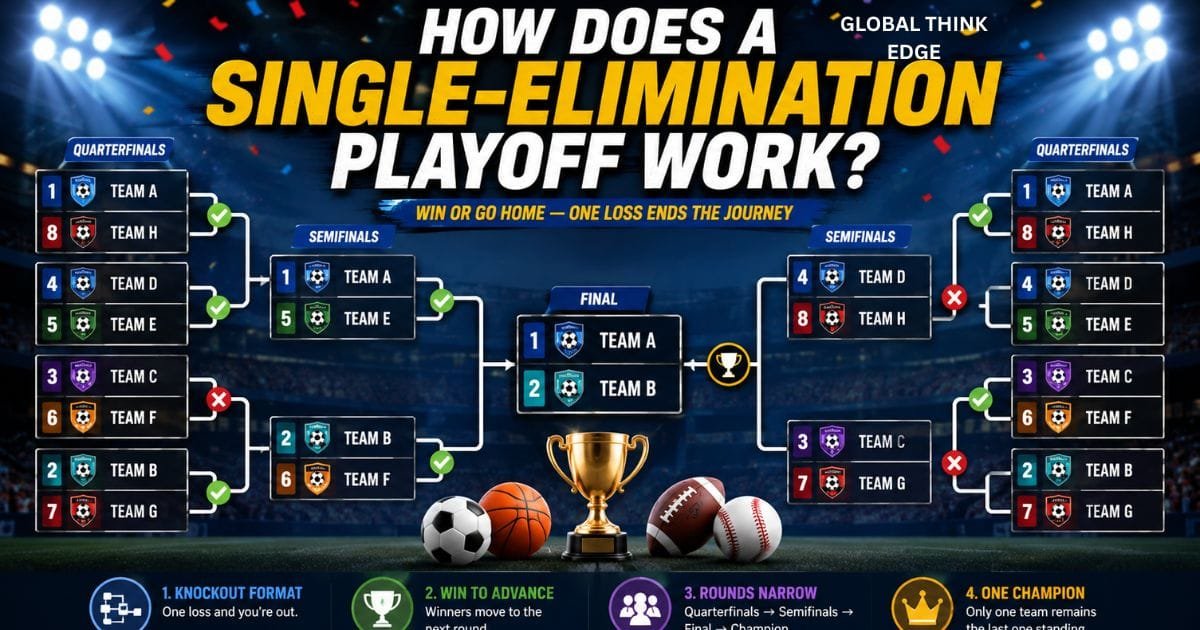
How Does a Single-Elimination Playoff Work?
In a single-elimination playoff, a team is eliminated after losing one matchup. The winner continues to the next round.
This format is popular because it produces quick, high-pressure competition.
A 16-team tournament requires the following:
16 teams in the opening round
8 winners in the quarterfinals
4 semifinalists
2 finalists
1 champion
The number of games required to determine the champion is 15 because every game eliminates one team.
Single elimination is different from a best-of-seven series, where a team may lose several individual games but still advance by winning enough games in the series.
How Do Playoff Brackets Work With Byes?
A bye allows a qualified team to skip an opening playoff round and advance automatically.
Byes are useful when the number of teams does not fit neatly into a standard bracket. They can also reward higher-seeded teams for strong regular-season performance.
For instance, in a seven-team tournament, one team could receive a first-round bye while the remaining six teams compete for three places in the next round.
A bye does not count as a win. It simply means the team does not have to play during that stage.
Does Seeding Matter in a Playoff Bracket?
Yes. Seeding can significantly affect a team’s playoff path.
Higher seeds may receive home advantage, favorable matchups, byes, or a better position in the bracket. Lower seeds may need to defeat stronger opponents earlier.
However, seeding does not guarantee advancement. A lower seed can eliminate a higher seed, creating what fans commonly call an upset.
The importance of seeding depends on the competition’s rules.
How Does a 12-Team Playoff Bracket Work?
A 12-team playoff can use several different structures because 12 is not a power of two. The exact format therefore depends on the league or tournament.
A common approach gives the highest seeds byes while the remaining teams compete in an opening round.
For example, a competition could arrange the following:
Round 1: Seeds 5–12 compete
Quarterfinals: The four winners join Seeds 1–4
Semifinals: Four teams remain
Final: Two teams compete for the championship
The exact pairing rules can vary, so a “12-team playoff” does not automatically mean one universal bracket.
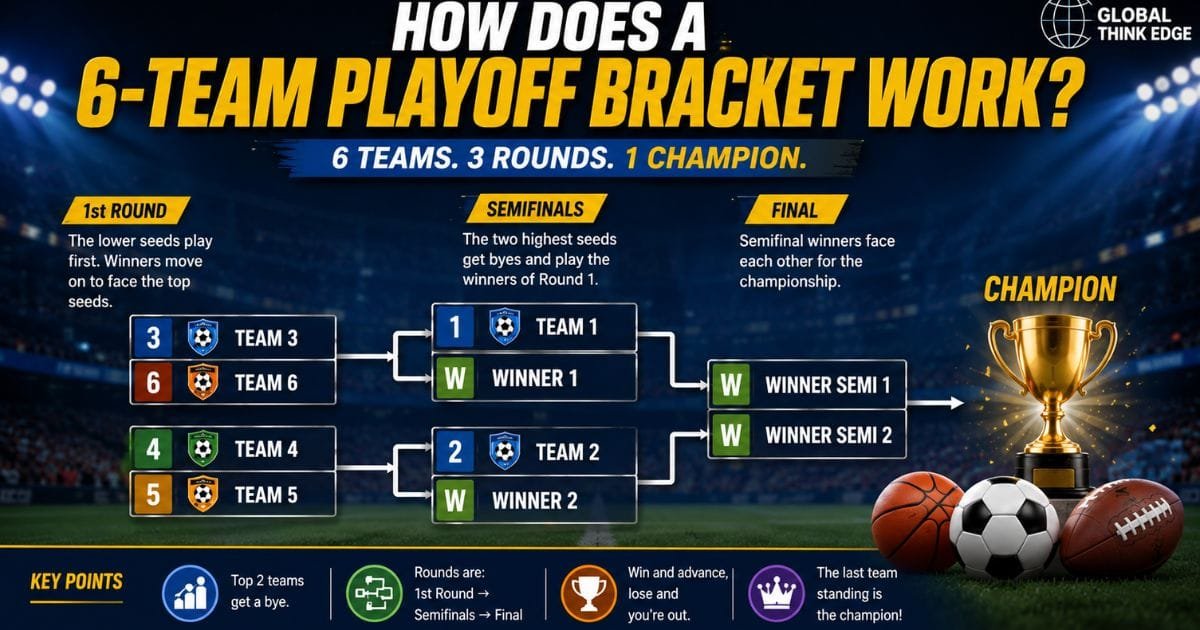
How Does a 6-Team Playoff Bracket Work?
A six-team playoff usually gives the highest-ranked teams an advantage because six teams cannot form a balanced first round.
One common structure has the top two seeds receive byes while seeds 3–6 play in the opening round.
That creates:
No. 3 vs No. 6
No. 4 vs No. 5
The winners then face the top two seeds in the next round.
This setup rewards regular-season performance while still allowing six teams to compete for the title.
What Happens When a Team Wins a Playoff Match?
When a team wins, it advances to the next stage of the bracket. Its next opponent is determined by the bracket structure, draw, or reseeding rules.
A team’s path can therefore become clearer after every round.
In a fixed bracket, the team may already know which side of the bracket it occupies. In a reseeded competition, its next opponent could depend on which other teams won.
That difference can dramatically change the potential playoff route.
What Is the Difference Between a Fixed Bracket and Reseeding?
A fixed bracket establishes the potential matchups before the tournament begins. Teams stay in their assigned positions even when unexpected results occur.
Reseeding adjusts future matchups based on the teams that advance.
| Feature | Fixed Bracket | Reseeded Bracket |
| Future path | Mostly predetermined | Adjusted after rounds |
| Upset impact | Can alter expected opponents | Can create new seed-based matchups |
| Flexibility | Lower | Higher |
| Purpose | Simple tournament structure | Reward higher seeds |
Neither system is automatically better. Organizers choose based on competitive goals and scheduling requirements.
How Do Champions League Playoffs Work?
The UEFA Champions League provides a useful example of how a modern playoff system can combine league standings, seeding, draws, and a knockout bracket.
Under the current format, 36 teams compete in a single league phase. The top eight automatically reach the round of 16, while teams finishing 9th through 24th enter the knockout phase playoffs. Teams finishing 25th or lower are eliminated.
The 9th-to-16th teams are seeded against teams finishing 17th-to-24th. The play-offs are played over two legs, with the seeded side in principle hosting the second leg.
From the knockout phase playoffs onward, the Champions League uses a bracket that establishes the route toward the final.
This illustrates an important point: not every playoff bracket begins with a traditional 16-team knockout round.

How Do Two-Legged Playoff Brackets Work?
In a two-legged playoff, two teams play each other twice, normally once at each team’s stadium.
The winner is determined by the aggregate score across both matches.
For example:
First leg: Team A 2–1 Team B
Second leg: Team B 1–1 Team A
Team A wins the tie 3–2 on aggregate.
UEFA’s Champions League qualifying and playoff rounds use two-legged ties, with the team scoring more goals across both matches advancing.
This differs from a single-game playoff, where one match determines who advances.
Why Can Playoff Brackets Be Difficult to Understand?
Playoff brackets become complicated when competitions combine several rules.
Common factors include:
Seeding
Byes
Home-field advantage
Two-legged ties
Best-of series
Reseeding
Tiebreakers
Draw restrictions
Conference or division structures
Automatic qualification
For this reason, two tournaments can both use “playoffs” while having completely different bracket systems.
The safest way to understand a bracket is to identify how teams qualify, how they are seeded, how matchups are created, and what determines advancement.
Why Does Finishing First Matter in a Playoff Bracket?
Finishing first can provide meaningful advantages, but the exact benefits depend on the competition.
A top seed might receive a bye, host more games, face a lower seed, or occupy a favorable bracket position. In some tournaments, finishing near the top can also reduce the number of difficult opponents a team must defeat.
The Champions League demonstrates this principle clearly: the top eight teams in the league phase advance directly to the round of 16, avoiding the knockout phase play-offs.

Key Takeaways About Sports Playoff Brackets
A playoff bracket is essentially a roadmap to the championship. It organizes qualified teams into matchups and shows how winners progress toward the final.
The most important things to remember are:
- Teams first qualify for the postseason.
- Seeds are assigned according to competition rules.
- Matchups are created through fixed positions, draws, or reseeding.
- Winners advance while eliminated teams leave the competition.
- Byes can give higher seeds an early advantage.
- Some playoffs use one game, while others use series or two-legged ties.
- The final surviving team becomes the champion.
Frequently Asked Questions
How does a playoff bracket work?
A playoff bracket matches qualified teams against each other and creates a progression toward the championship. Teams that win advance to later rounds, while losing teams are eliminated or, in some formats, continue through another route.
What is the playoff bracket?
A playoff bracket is a visual tournament structure showing playoff matchups and the possible route teams must follow to reach the championship final.
How many teams are usually in a playoff?
There is no universal number. Competitions may use 4, 6, 8, 10, 12, 14, 16, or another number of teams depending on their rules.
Does finishing first matter in playoffs?
Usually, yes. Higher seeds can receive advantages such as byes, home games, favorable matchups, or direct qualification for a later round.
How do Champions League playoffs work?
The current Champions League format sends teams ranked 9th through 24th in the league phase into knockout phase playoffs. The top eight advance directly to the round of 16, while eight play-off winners join them.
Final Verdict
Sports playoff brackets turn a large group of qualified teams into a clear championship race. Although the details differ between leagues, the central idea remains consistent: teams advance by winning, and the bracket gradually reduces the field until one champion remains.
Understanding seeding, byes, draws, two-legged ties, series, and reseeding makes almost any playoff system easier to follow. The key is to look beyond the bracket’s appearance and check the competition’s specific rules for qualification and advancement.
