
How Are Sports Rankings Calculated? Brilliant Facts
How Are Sports Rankings Calculated?
Sports rankings are calculated using a specific scoring system that evaluates results, performance, opponent strength, competition level, consistency, and sometimes recency. The exact formula depends on the sport. FIFA ranks football teams using a match-based points system, while World Athletics combines an athlete’s performance result with their finishing position.
A ranking is therefore more than simply counting wins. Most official systems use mathematical rules to turn competitive results into points or ratings that can be compared across athletes or teams.
Why Are Sports Rankings Important?
Sports rankings help organizations compare competitors in a consistent way, even when they do not regularly face each other.
They can influence:
Tournament qualification
Competition seeding
Draw positions
Championship recognition
Athlete selection
Historical performance comparisons
Public understanding of competitive strength
A reliable ranking system also makes it easier to track whether an athlete or team is improving or declining over time.
What Factors Are Used to Calculate Sports Rankings?
Although every sport has its own methodology, several factors commonly influence rankings.
Match or event results: Winning, placing highly, or producing a strong performance generally improves a ranking.
Opponent strength: Beating a highly ranked opponent can be more valuable than beating a lower-ranked competitor.
Competition importance: Major championships and high-level events usually carry greater ranking significance.
Performance quality: Some systems measure the actual quality of a result rather than considering only the final position.
Consistency: Multiple performances can provide a more reliable picture than one unusually good result.
Recency: Rankings often focus on a defined period so that old performances do not permanently determine current positions.
Because these factors vary by sport, there is no universal formula for calculating every sports ranking.
How Are FIFA Rankings Calculated?
The FIFA/Coca-Cola Men’s World Ranking uses a points-based SUM model. A team’s rating changes after matches depending on the result, the relative strength of the opponents, and the importance of the match.
In simple terms:
New rating = Previous rating + or − Match points adjustment
A victory over a highly ranked opponent can therefore have a much greater impact than a victory against a weaker team.
FIFA also gives different importance to different types of matches. Competitive fixtures can carry more ranking significance than ordinary friendly matches.
This approach means FIFA rankings are not simply a table of teams with the most wins. The quality and importance of those wins also matter.

Who Is No. 1 to 10 in the FIFA Rankings?
According to the latest official men’s FIFA ranking available on 20 July 2026, the top 10 teams were:
| Rank | Team | Points |
| 1 | Spain | 1,995.88 |
| 2 | Argentina | 1,970.37 |
| 3 | France | 1,948.97 |
| 4 | England | 1,922.83 |
| 5 | Brazil | 1,804.93 |
| 6 | Morocco | 1,803.99 |
| 7 | Portugal | 1,787.86 |
| 8 | Belgium | 1,778.36 |
| 9 | Netherlands | 1,775.54 |
| 10 | Mexico | 1,754.00 |
Spain occupied the No. 1 position in this ranking, followed by Argentina and France.
Because FIFA updates its rankings periodically, the exact top 10 can change after major international matches and tournaments.
How Are World Athletics Rankings Calculated?
World Athletics uses a different ranking method because athletes compete in individual events rather than playing repeated head-to-head matches.
The basic concept is
Performance Score = Result Score + Placing Score
The Result Score reflects the quality of the athlete’s performance. In many events, this is connected to the actual mark or time achieved.
The placing score rewards the athlete for where they finished in a competition. Higher-level competitions provide greater placing rewards.
This means an athlete’s ranking does not depend exclusively on running the fastest time or jumping the farthest distance. The competition in which the result was achieved also matters.
What Is a World Athletics Performance Score?
A performance score combines the quality of an athlete’s result with their competition placing.
For example, an athlete who records a strong performance and finishes highly in a major international competition can receive a substantial score.
World Athletics then uses eligible performance scores to calculate the athlete’s ranking position. The system has specific rules about the number of performances required, the ranking period, competition categories, and which results qualify.
This approach rewards both performance quality and success against competitive fields.
How Does Competition Level Affect Rankings?
Competition level can significantly affect ranking points.
Winning a major championship is generally more meaningful than winning a low-level event because the athlete or team has competed against stronger opposition under more important conditions.
World Athletics uses different competition categories and placing scores. FIFA similarly accounts for match importance when calculating ranking changes.
This prevents rankings from being distorted simply because someone competes frequently against weaker opponents.
Is a Lower Number Better in Sports Rankings?
Yes. In a conventional sports ranking, No. 1 is higher than No. 2, and No. 2 is higher than No. 10.
The ranking number represents position, not the number of points.
For example:
No. 1 = highest-ranked competitor
No. 5 = fifth position
No. 10 = tenth position
No. 50 is a lower position than the top 10
However, the points separating competitors can be very small. A team ranked No. 2 may be only a few points behind the No. 1 team.
Which Rank Is Higher, A or S?
In a typical tier-ranking system, S rank is higher than A rank.
A common hierarchy is the following:
S > A > B > C > D
S-tier normally represents the highest standard, while A-tier represents an excellent but slightly lower category.
It is important to remember that “S” and “A” are tier-list labels, not universal official sports-ranking positions.
Why Is S-Tier Better Than A?
S-tier is usually placed above A-tier because tier-list creators use S to identify an exceptional or elite category.
A common interpretation is:
| Tier | Meaning |
| S | Exceptional or elite |
| A | Excellent |
| B | Strong or above average |
| C | Average |
| D | Weak or below average |
The exact definitions can vary. A gaming community, website, or ranking creator may use a different structure.
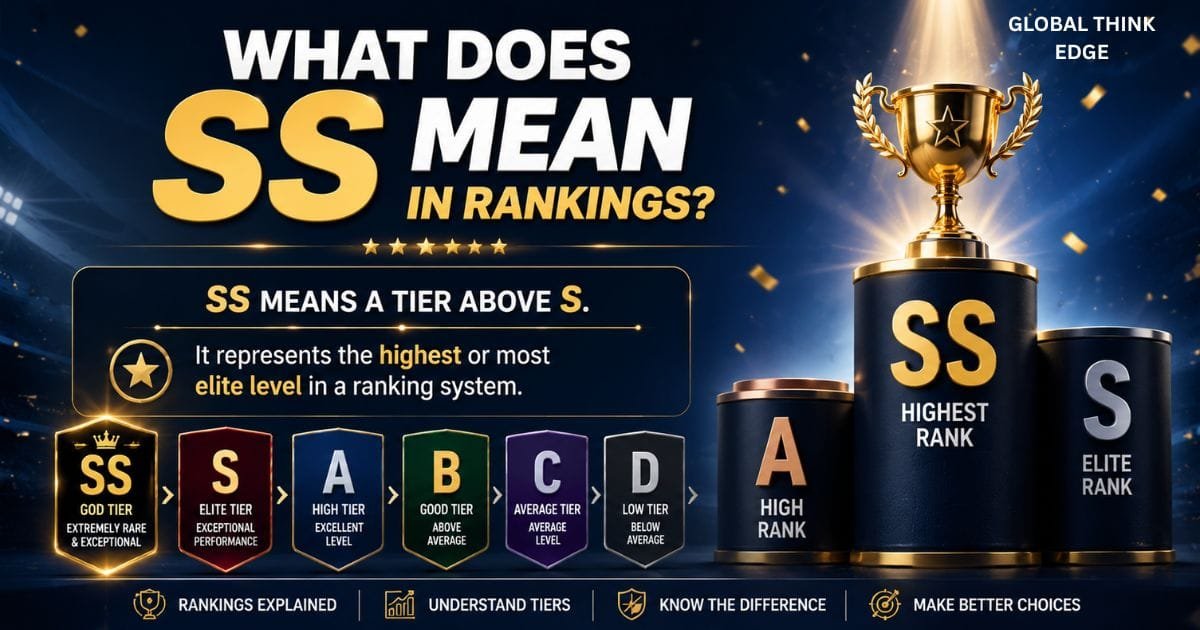
What Does SS Mean in Rankings?
SS usually means a category above S-tier when a ranking system includes it.
For example:
SS > S > A > B > C
SS can be used to identify extremely rare, elite, or exceptional performers.
However, SS is not an official universal sports-ranking category. Its meaning depends on the specific ranking system.
What Comes After S Rank?
In many custom tier lists, SS or S+ can come after S.
A system might use:
SS > S+ > S > A > B > C
Another system might stop at S and have no higher category.
Therefore, there is no universal answer to what comes after S rank. The creator of the ranking determines the hierarchy.
Is Z Rank Better Than S Rank?
Not automatically. Z rank has no universal position in standard sports rankings or common tier-ranking rules.
If a particular ranking system places Z above S, then Z is higher within that system. If Z appears below S, then S is higher.
The same principle applies to labels such as P, SS, EX, S+, or other custom tiers.
Is P Rank Better Than S Rank?
There is no universal rule that makes P rank better than S rank.
P rank can mean different things depending on the game, website, competition, or community creating the ranking.
The safest approach is to check the ranking system’s legend or methodology before comparing custom letters.
Sports Rankings vs S-Tier Rankings
These two concepts are often confused, but they work very differently.
| Feature | Official Sports Ranking | Tier Ranking |
| Format | Numbers or points | S, A, B, C, etc. |
| Calculation | Defined mathematical rules | Often subjective |
| Purpose | Measure competitive performance | Group quality levels |
| Used officially | Often, yes. | Usually not. |
| Example | FIFA ranking | S-tier list |
| Universal system | Sport-specific | No |
FIFA and World Athletics publish formal methodologies. A community-made S-tier list may simply reflect opinions or predetermined criteria.

What Makes a Sports Ranking Reliable?
A credible ranking system should clearly explain how scores are calculated and which performances count.
Important elements include:
Transparent scoring rules
Defined ranking periods
Clear competition categories
Consistent treatment of results
Published eligibility requirements
Clear tie-breaking procedures
Transparency allows athletes, teams, fans, and analysts to understand why one competitor ranks above another.
Frequently Asked Questions
How are sports rankings calculated?
Sports rankings are calculated using sport-specific formulas based on factors such as wins, losses, opponent strength, performance quality, competition importance, finishing position, and recent results. FIFA and World Athletics use different systems because team football and individual athletics require different ways to measure performance.
Who is No. 1 in the FIFA rankings?
In the latest official men’s FIFA ranking available on 20 July 2026, Spain was ranked No. 1, followed by Argentina and France. FIFA rankings can change after major international matches and tournaments, so the official ranking date should always be checked.
How are World Athletics rankings calculated?
World Athletics rankings combine an athlete’s result score and Placing Score. The result score reflects the quality of the performance, while the placing score rewards finishing position in competitions. Eligible performances are then used according to World Athletics’ ranking rules.
Which is higher, A rank or S rank?
S rank is normally higher than A rank in tier-list systems. The common order is S, A, B, C, and D. However, these labels are not universal sports standards, so a particular ranking system can define them differently.
Why is S-tier better than A-tier?
S-tier is usually designed as the highest standard in a tier list. It represents exceptional or elite quality, while A-tier generally means excellent. The exact meaning depends on the system creating the tier list.
What does SS mean in rankings?
SS usually means a tier above S when a ranking system includes it. A common hierarchy is SS > S > A > B > C. SS is a custom label rather than a universal official sports-ranking category.
What comes after S rank?
SS or S+ often comes after S in custom tier lists. However, some systems consider S the highest tier and have nothing above it. Always check the specific ranking system before interpreting the letters.
Is Z rank better than S rank?
Not necessarily. Z rank does not have a universal meaning or fixed position. It could be above S in one ranking system and below it in another.
Is P rank better than S rank?
P rank is not universally higher or lower than S rank. Its position depends entirely on the ranking system’s rules. Official sports rankings generally use defined points or numerical positions rather than arbitrary letter tiers.
Why do sports rankings change?
Rankings change when new results alter a competitor’s score or when older results stop counting under the ranking period. Strong performances, major victories, losses, and results against highly ranked opponents can all influence a position.
Key Takeaway
Sports rankings are calculated using specific formulas designed for each sport. FIFA evaluates football teams through a match-based rating system that considers results, opponent strength, and match importance, while World Athletics combines performance results with competition placing.
For tier lists, the rules are different. S is generally higher than A, while SS, S+, Z, or P depend on the individual system. The most reliable way to understand any ranking is to examine its scoring methodology rather than judging a competitor solely by a letter, number, or position.
