How Does Football Goal Difference Work? Key Winning Facts
What Does Goal Difference Mean in Football?
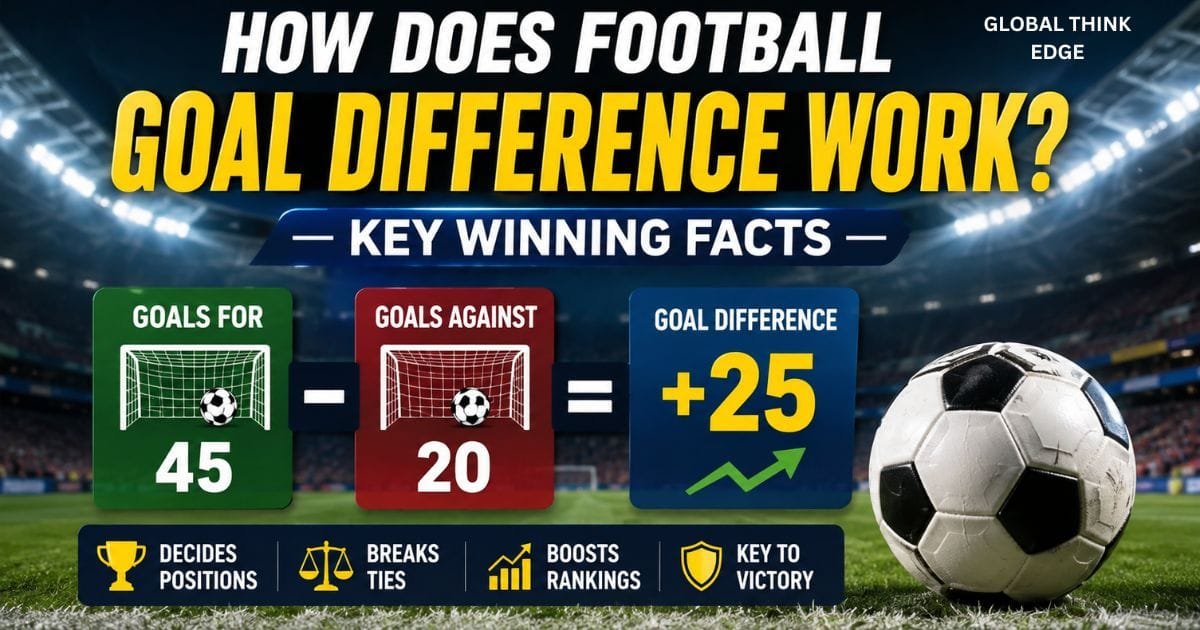
Goal difference (GD) is the difference between the goals a team scores and the goals it concedes. How does football goal difference work? The calculation is simple: Goals For (GF) − Goals Against (GA) = Goal Difference (GD). A positive GD means a team has scored more goals than it has allowed, while a negative GD means it has conceded more than it has scored.
Goal difference becomes particularly important when two or more teams finish with the same number of points. However, the exact tiebreaking rules depend on the competition. For example, the Premier League uses goal difference before head-to-head records, while some UEFA competitions use head-to-head criteria earlier.
How Is Goal Difference Calculated in Football?
The formula is:
Goal Difference = Goals Scored − Goals Conceded
For example, imagine a team has played five matches and scored 10 goals while conceding 6.
10 − 6 = +4 goal difference
Its goal difference is therefore +4.
If another team has scored 7 goals and conceded 10, its calculation would be:
7 − 10 = −3
That team has a goal difference of −3.
A team’s goal difference includes the goals scored and conceded across the matches covered by the relevant competition or league stage.
Why Is Goal Difference Important in Football?
Goal difference can decide a team’s position when teams have identical points. In leagues that use it as the first tiebreaker, a stronger goal difference can place one team above another even when both have exactly the same number of wins, draws, and losses.
For instance, consider two teams with 75 points:
| Team | Goals For | Goals Against | Goal Difference |
| Team A | 70 | 30 | +40 |
| Team B | 62 | 35 | +27 |
If the competition uses goal difference as the first tiebreaker, Team A ranks higher because +40 is better than +27.
This means teams are not only trying to win matches. Scoring more goals and limiting goals conceded can also strengthen their position in a tight league table.
Goal Difference vs Goal Average
Goal difference and goal average are not the same thing.
Goal difference subtracts goals conceded from goals scored. Goal average historically used a ratio involving goals scored and goals conceded. Modern football competitions commonly use goal difference rather than goal average, although individual competitions can have their own regulations.
The safest approach is to check the official rules for the specific tournament rather than assume every competition uses identical tiebreakers.
Is It Better to Have a Higher or Lower Goal Difference?
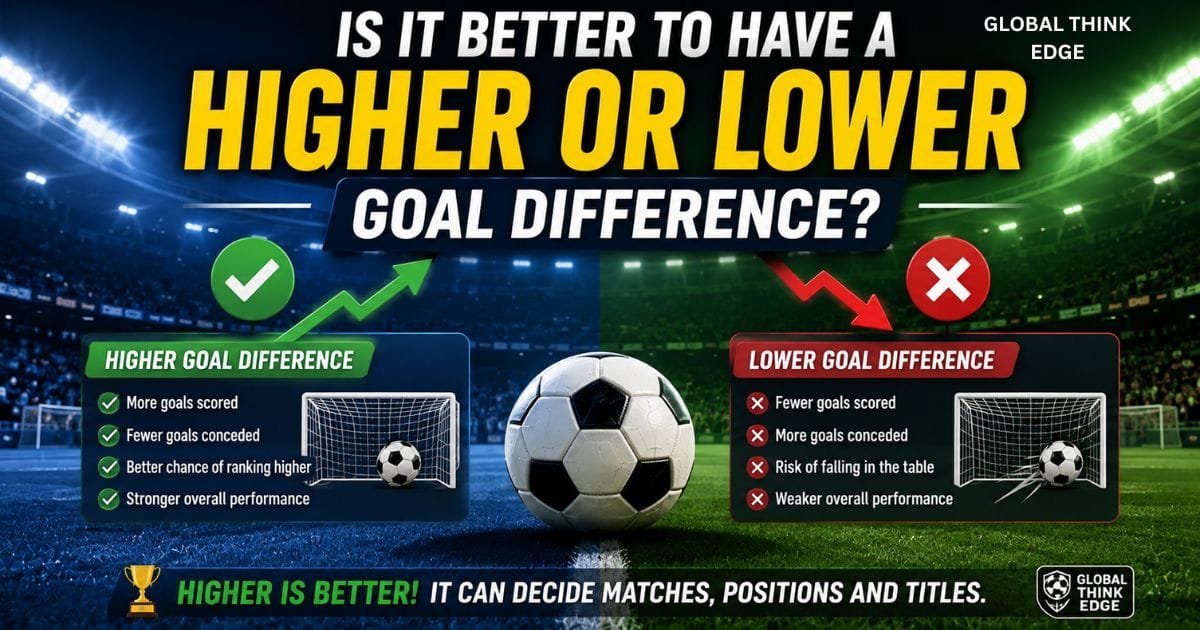
A higher goal difference is better when goal difference is used to rank teams. A positive number indicates that a team has scored more goals than it has conceded, while a negative number indicates the opposite.
For example:
+25 is better than +10
+10 is better than 0
0 is better than −5
−5 is better than −15
A high goal difference often reflects both attacking output and defensive strength. However, it does not automatically mean a team has more points because points are primarily earned from match results.
A team could have a strong goal difference but fewer points than another team if it wins fewer matches.
How Does Goal Difference Affect the League Table?
In many football leagues, teams receive points according to their results:
3 points for a win
1 point for a draw
0 points for a defeat
If teams have different numbers of points, goal difference usually does not override the points total.
For example:
| Team | Points | Goal Difference |
| Team A | 70 | +20 |
| Team B | 68 | +35 |
Team A normally remains above Team B because it has more points.
Goal difference becomes decisive when the relevant competition’s rules say it should be used after teams are level on points.
What Happens When Two Teams Have the Same Goal Difference?
If teams have the same points and the same goal difference, another tiebreaker is required. The next criterion varies by competition.
In the Premier League, the order is points, goal difference, goals scored, then points earned in head-to-head matches, followed by away goals scored in those head-to-head matches. If the relevant teams still cannot be separated in a title, European place, or relegation situation, a playoff can be used.
Other competitions follow different systems.
For example, the 2026–27 UEFA Champions League league phase uses goal difference first, followed by goals scored, away goals scored, wins, away wins, and further criteria if required.
What Comes First: Head-to-Head or Goal Difference?
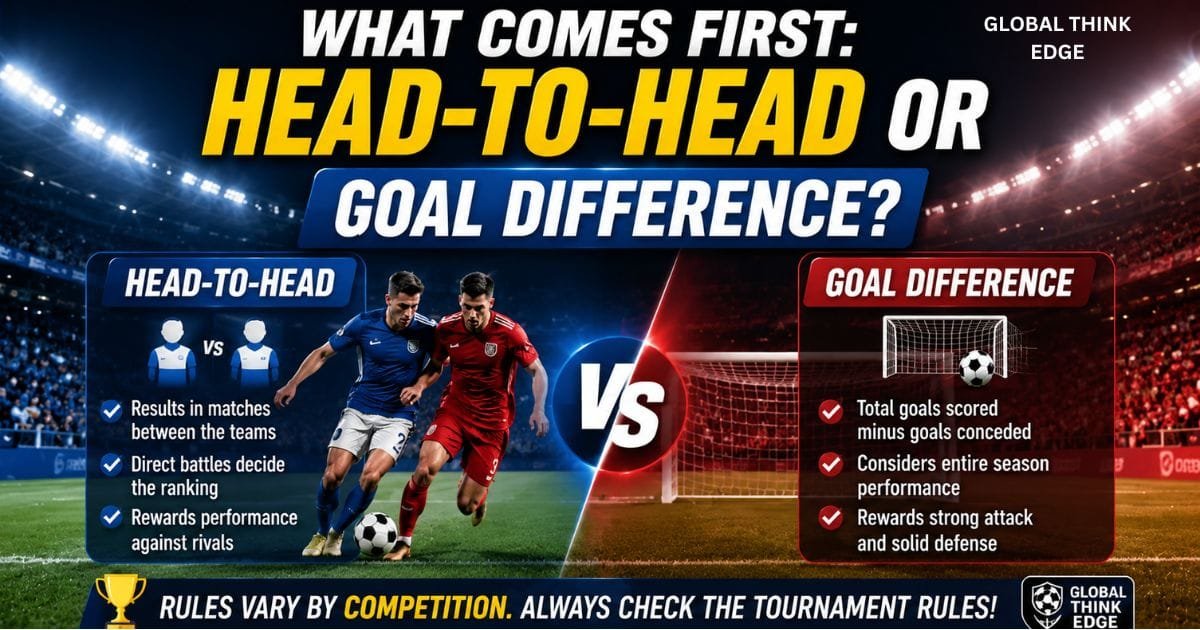
There is no universal answer because football competitions set their own tiebreaking rules.
In the Premier League, goal difference comes before head-to-head results. If teams are level on points, goal difference is considered first, followed by goals scored, and only then head-to-head points.
Some UEFA competitions use a different approach. In the 2026–28 UEFA European Championship qualifying group stage, teams level on points are first separated by points earned in matches between the teams concerned, followed by goal difference in those matches and goals scored in those matches. Overall goal difference comes later in the sequence.
Therefore, never assume that head-to-head always comes first or that goal difference always comes first.
Why Do Football Competitions Use Different Tiebreakers?
Each competition creates its own regulations to determine rankings when points are equal. Some organizers prefer overall performance across the campaign, while others place greater emphasis on matches played directly between the tied teams.
That is why a league table can use one ranking system while an international tournament uses another.
The competition’s official regulations are the final authority.
Does Goal Difference Include All Goals Scored?
Generally, yes, when a competition uses overall goal difference, the calculation covers the goals scored and conceded in the matches specified by its regulations.
However, competition rules can limit which matches count for particular tiebreakers.
For example, UEFA’s current European Championship qualifying regulations distinguish between goal difference from matches involving the tied teams and goal difference across all group matches.
This distinction matters when several teams are tied.
How Goal Difference Works With Three or More Teams
Goal difference can become more complicated when three or more teams finish level on points.
Suppose Teams A, B, and C all have the same number of points. A competition might first compare their results against each other and then examine goal difference from those matches before moving on to overall statistics.
UEFA’s 2026–28 European Championship qualifying rules use this type of multi-stage approach. They begin with points from matches among the teams concerned, followed by goal difference and goals scored in those matches. If necessary, the regulations then move to overall goal difference and other criteria.
This prevents a simple one-size-fits-all formula from being applied to every tournament.
Simple Football Goal Difference Example
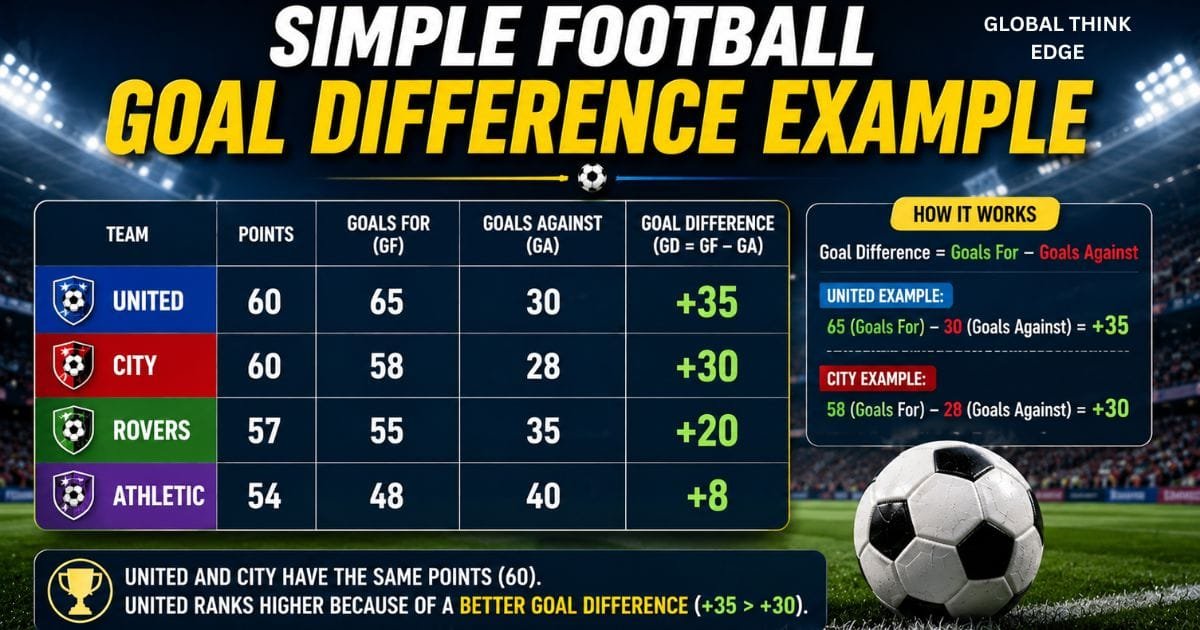
Imagine a league has four teams:
| Team | Points | GF | GA | GD |
| United | 60 | 65 | 30 | +35 |
| City | 60 | 58 | 28 | +30 |
| Rovers | 57 | 55 | 35 | +20 |
| Athletic | 54 | 48 | 40 | +8 |
United and City both have 60 points. If this competition uses goal difference as the next tiebreaker, United ranks above City because +35 is greater than +30.
The calculation for United is:
65 goals scored − 30 goals conceded = +35
The city’s calculation is
58 − 28 = +30
United therefore has the better goal difference.
Does Scoring More Goals Always Improve Goal Difference?
Scoring a goal improves a team’s goal difference by one, provided the goal counts in the relevant competition calculation.
Conceding a goal reduces goal difference by one.
For example, if a team starts a match with a +12 goal difference and wins 3–1, its goal difference becomes the following:
+12 + 3 − 1 = +14
If it instead loses 2–0:
+12 + 0 − 2 = +10
This is why both attacking and defensive performance influence goal difference.
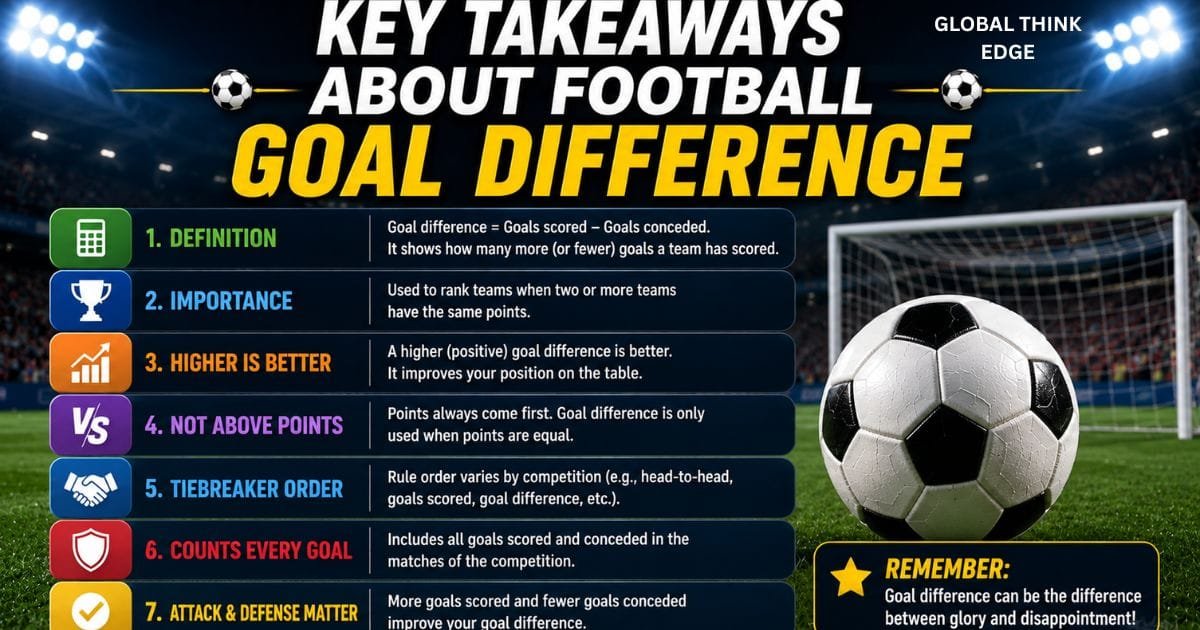
Key Takeaways About Football Goal Difference
Goal difference is one of the simplest statistics in football, but it can have a major impact on league positions.
Remember these points:
Goal difference = goals scored − goals conceded.
A positive GD means a team has scored more than it has conceded.
A negative GD means it has conceded more than it has scored.
A higher goal difference is normally better when GD is used as a tiebreaker.
Goal difference matters most when teams are level on points.
Head-to-head does not always come before goal difference.
Different leagues and tournaments can use different tiebreaking orders.
The official competition regulations determine which criterion applies.
Frequently Asked Questions
How is goal difference calculated in football?
Goal difference is calculated by subtracting goals conceded from goals scored. If a team has scored 50 goals and conceded 35, its goal difference is +15.
Is it better to have a higher or lower goal differential?
A higher goal difference is better when the competition uses it as a ranking tiebreaker. For example, +20 ranks above +10, assuming all other relevant criteria are equal.
How is goal differential calculated in soccer?
Soccer uses the same calculation: goals scored minus goals conceded. A team scoring 40 goals and conceding 25 has a +15 goal difference.
What comes first, head-to-head or goal difference?
It depends on the competition. The Premier League uses goal difference before head-to-head points, while some UEFA competitions apply head-to-head criteria before overall goal difference.
Can goal difference decide the league champion?
Yes. If teams finish level on points and the competition uses goal difference as the applicable tiebreaker, the team with the better goal difference can finish higher and potentially win the title.
Final Answer
Football goal difference measures the gap between goals scored and goals conceded. The formula is simple: GF − GA = GD. A higher goal difference is generally better, but its role in deciding league positions depends on the competition’s official tiebreaking rules.
For that reason, when two teams have the same points, always check the specific league or tournament regulations to see whether goal difference, goals scored, head-to-head results, or another criterion comes next.
