Business Growth Framework: Winning Steps to Scale Up
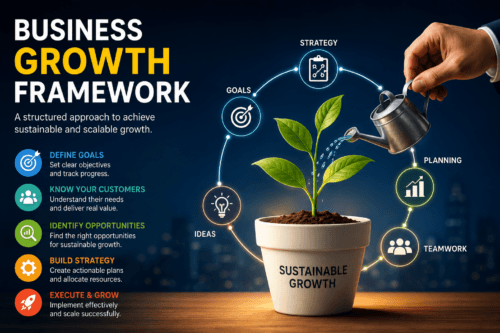
A business growth framework is a structured system that helps companies plan, manage, and execute growth through clear strategy, measurable goals, efficient operations, and strong leadership – rather than relying on guesswork or luck. Sustainable growth rarely happens by chance.
Companies that scale consistently follow a defined framework to identify opportunities, allocate resources effectively, and execute growth initiatives with confidence. Whether you run a startup, a small business, or an established company, a business growth framework gives you a repeatable path to predictable, scalable results.
What Is a Business Growth Framework?
A business growth framework is a structured approach that organisations use to plan, manage, and achieve business growth. It provides a roadmap that guides decision-making, aligns teams, and ensures that growth efforts support long-term business objectives.
Instead of pursuing random opportunities, businesses use frameworks to identify priorities, measure performance, and focus on activities that generate the greatest impact.
A strong growth framework helps businesses:
Define clear growth objectives.
Understand customer needs.
Identify new market opportunities.
Improve operational efficiency.
Measure business performance.
Scale sustainably.
Why Every Business Needs a Growth Framework
Many businesses experience periods of growth followed by stagnation. This often happens because they lack a structured system for managing expansion.
A growth framework helps businesses:
Improve Strategic Focus
Business leaders can concentrate on initiatives that align with company goals rather than chasing short-term opportunities.
Increase Operational Efficiency
Clear processes reduce wasted resources and improve productivity across departments.
Create Measurable Results
Businesses can track progress through key performance indicators (KPIs) and make data-driven decisions.
Support Sustainable Scaling
A framework ensures that growth does not create operational bottlenecks or compromise customer satisfaction.
Strengthen Competitive Advantage
Companies with clear growth strategies can adapt faster to market changes and outperform competitors.
The Foundation of Successful Growth
Every successful growth strategy begins with a solid foundation. Businesses must establish core principles before pursuing aggressive expansion.
Customer-Centric Thinking
Customers drive revenue and long-term success. Organisations that understand customer needs can create products and services that solve real problems.
Data-Driven Decision Making
Modern businesses have access to valuable data. Growth frameworks encourage leaders to use analytics rather than assumptions when making strategic decisions.
Continuous Improvement
Markets evolve constantly. Businesses must regularly evaluate performance and adjust strategies based on changing customer expectations and industry trends.
Long-Term Vision
Sustainable growth requires a balance between short-term wins and long-term objectives.

Key Components of an Effective Growth Framework
There are several key elements to a successful business growth framework.
Clear Goals/Objectives
Growth initiatives should be tied to specific business outcomes like revenue growth, customer retention or market expansion.
Insights into the market
You need to know your target audience, your competitors and industry trends.
Scalable Systems
Operations, technology, and processes should enable future growth without creating inefficiencies.
Performance Measurement
Organisations need metrics they can trust to measure progress and discover opportunities for improvement.
Aligning Leadership
Leaders can’t just tell people to grow. Everyone needs to understand the growth goals and work towards the same goals.
Step 1: Setting Clear Objectives and KPIs
Growth begins with clearly defined objectives.
Without measurable goals, businesses cannot determine whether their strategies are effective.
How to Create Effective Growth Goals
Businesses should establish goals that are:
Specific
Measurable
Achievable
Relevant
Time-bound
Examples of Growth KPIs
Revenue Growth
Tracks increase in sales over a specific period.
Customer Acquisition Rate
Measures how effectively the business attracts new customers.
Customer Retention Rate
Evaluates the percentage of customers who continue purchasing from the company.
Profit Margin
Shows how efficiently the business converts revenue into profit.
Market Share
Measures the company’s position within its industry.
Step 2: Understanding Your Market and Customers
Businesses cannot grow effectively without understanding their audience.
Conduct Market Research
Market research helps identify:
Customer pain points
Purchasing behavior
Emerging trends
Industry opportunities
Analyze Competitors
Competitor analysis provides valuable insights into:
Market positioning
Pricing strategies
Customer engagement tactics
Product offerings
Develop Customer Personas
Customer personas help businesses understand:
Demographics
Age, location, income, and occupation.
Behavioral Patterns
Buying habits and decision-making processes.
Customer Challenges
Problems customers want to solve.
Step 3: Identifying and Prioritizing Growth Opportunities
Once businesses understand their market, they can identify opportunities for expansion.
Market Expansion
Entering new geographic regions can create additional revenue streams.
Product Development
Businesses can launch new products or improve existing offerings.
Strategic Partnerships
Collaborations often provide access to new customers and markets.
Digital Transformation
Technology can improve efficiency and support scalable growth.
Customer Retention Programs
Retaining existing customers often costs less than acquiring new ones.
Popular Types of Growth Frameworks Explained
Several growth frameworks help businesses achieve different objectives.
Ansoff Growth Matrix
The Ansoff Matrix focuses on four growth strategies:
Market Penetration
Increasing sales within existing markets.
Market Development
Entering new markets with existing products.
Product Development
Introducing new products to current customers.
Diversification
Launching new products in new markets.
AARRR Growth Framework
Often called the Pirate Metrics Framework, it focuses on:
Acquisition
Activation
Retention
Referral
Revenue
This framework is especially useful for startups and SaaS companies.
OKR Framework
Objectives and Key Results (OKRs) help organisations align goals across departments while maintaining accountability.
Lean Growth Framework
This approach emphasises rapid testing, learning, and optimisation based on customer feedback.
How Frameworks Drive Strategic Execution
A growth framework transforms strategy into action.
Without execution, even the best plans fail.
Improved Team Alignment
Teams understand priorities and work toward shared objectives.
Better Accountability
Each department knows its responsibilities and performance expectations.
Faster Decision-Making
Leaders can evaluate opportunities based on strategic goals rather than assumptions.
More Efficient Resource Allocation
Resources are directed toward initiatives with the highest potential return.
Building Scalable Operations
Growth often exposes weaknesses in business processes.
Automate Repetitive Tasks
Automation improves efficiency and reduces operational costs.
Standardize Processes
Consistent workflows help maintain quality as the business expands.
Invest in Technology
Modern software solutions support collaboration, reporting, and customer management.
Leadership and Team Alignment
Strong leadership plays a critical role in business growth.
Communicate a Clear Vision
Employees should understand where the company is heading and how their work contributes to success.
Foster Accountability
Leaders must establish performance expectations and monitor results.
Encourage Innovation
Teams should feel empowered to suggest improvements and explore new opportunities.
Why Successful Companies Rely on Business Growth Framework
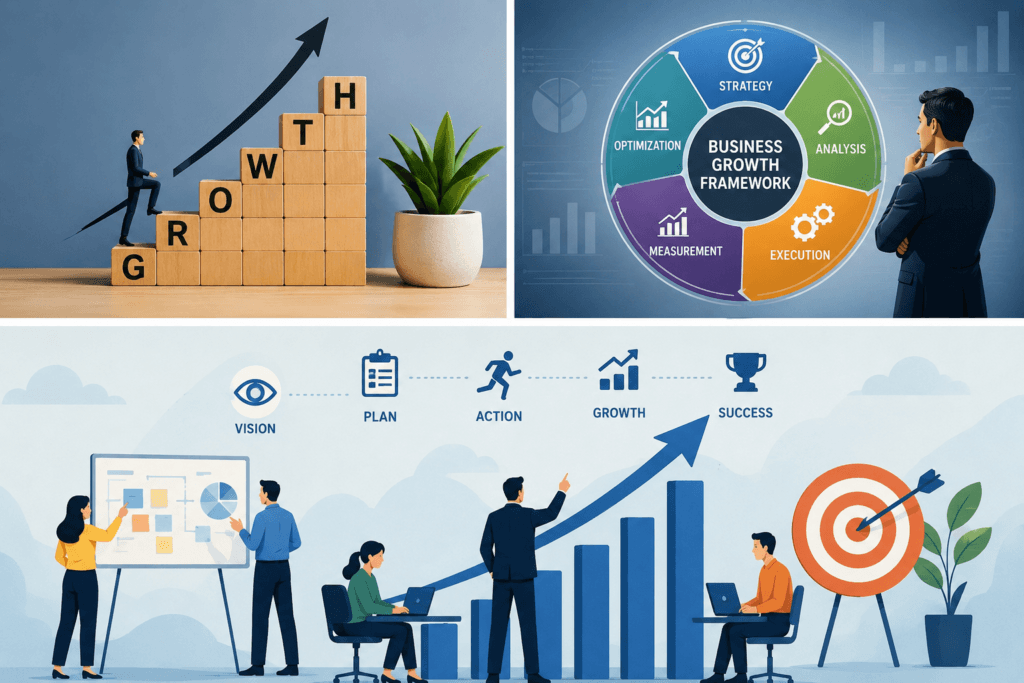
High-performing organisations rarely grow without structure.
They rely on frameworks because frameworks:
Reduce uncertainty.
Improve strategic focus.
Support sustainable scaling.
Enhance operational efficiency.
Increase organisational alignment.
Frameworks create consistency that allows businesses to grow predictably.
Common Challenges and How to Overcome Them
Lack of Clear Direction
Solution: Define measurable objectives and communicate them clearly.
Resistance to Change
Solution: Involve employees in the growth process and provide adequate training.
Limited Resources
Solution: Prioritise initiatives that offer the highest potential return.
Poor Data Quality
Solution: Implement reliable reporting and analytics systems.
Operational Bottlenecks
Solution: Continuously evaluate processes and remove inefficiencies.
Common Mistakes and Optimisation Best Practices
Mistake 1: Chasing Every Opportunity
Focus on opportunities that align with business goals.
Mistake 2: Ignoring Customer Feedback
Customer insights should guide strategic decisions.
Mistake 3: Measuring the Wrong Metrics
Track KPIs that directly support business objectives.
Mistake 4: Neglecting Team Alignment
Growth requires collaboration across all departments.
Best Practices
Review KPIs regularly.
Invest in employee development.
Use data-driven decision-making.
Optimise processes continuously.
Maintain customer focus.
Real-World Perspective: Turning Frameworks into Results
The best companies know that frameworks are not silver bullets. Results are from reproducible implementation. Businesses that regularly review performance, adapt to market conditions and invest in continuous improvement are the ones that are most likely to grow in a sustainable way. The framework provides the structure, but it is leadership, discipline, and execution that create results.
Tips for Sustaining Business Growth Framework
Focus on Customer Experience
Satisfied customers drive referrals and repeat business.
Monitor Industry Trends
Stay informed about changing market conditions.
Invest in Employee Development
Skilled employees contribute directly to business performance.
Maintain Financial Discipline
Healthy cash flow supports long-term growth.
Embrace Innovation
Continuous innovation helps businesses remain competitive.
Key Takeaways
A structured business growth framework offers a well-defined roadmap for sustainable expansion.
To measure success, you need to have clear objectives and KPIs.
Understanding customers and the market helps make better decisions.
Scalable operations promote long-term growth.
Strong leadership and team alignment speed execution.
Continuous optimisation helps businesses remain competitive.
Frequently Asked Questions (FAQs)
What is a business growth framework?
A business growth framework is a formal mechanism that guides an organisation in the effective planning, implementation and measurement of growth initiatives.
Why is growth architecture important?
It helps to steer, optimise resource allocation, align teams and keep growing the business.
What’s the best growth framework for startups?
Startups tend to follow the AARRR Framework, Lean Growth Framework, and OKR Framework because they are all about rapid learning and measurable growth.
How often should businesses review their growth framework?
Most businesses should review performance monthly and conduct strategic evaluations quarterly.
Can small businesses use growth frameworks?
Yes. Growth frameworks benefit businesses of all sizes by improving focus, efficiency, and decision-making.
Conclusion: Turning Your Growth Framework into Commercial Impact
A business growth framework is the bedrock of sustainable success. It allows organisations to move beyond guesswork and provides a structured approach for planning, execution and measuring performance. Businesses that clearly state their objectives, understand their customers, develop scalable systems and align leadership to strategy are setting stronger foundations for long-term growth.
The most successful companies do not simply create growth frameworks. They consistently execute, measure, optimise, and adapt them. By following a proven framework and maintaining a commitment to continuous improvement, businesses can transform strategic plans into measurable commercial impact and achieve lasting competitive advantage.
