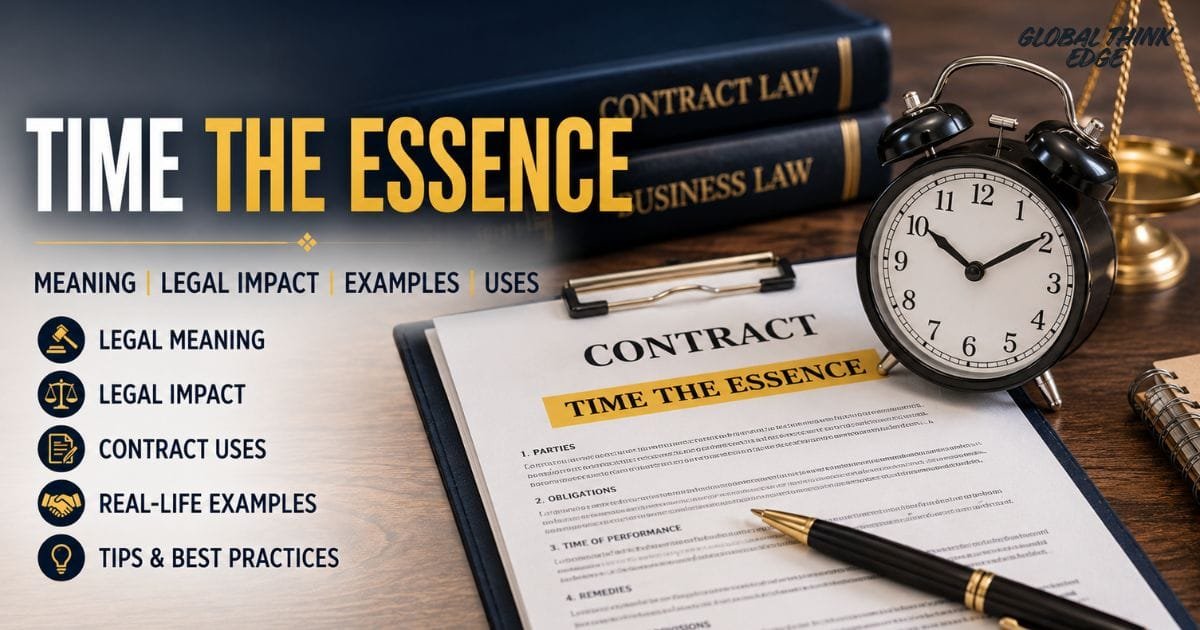
Time the Essence: Complete Contract Guide
Introduction: What Does “Time the Essence” Mean?
The phrase “time the essence” means that completing a task within the agreed deadline is an essential part of an agreement. If one party fails to meet that deadline, the delay may be treated as a material breach of the contract, giving the other party legal rights such as terminating the agreement or seeking compensation.
Although people often use the phrase in everyday conversations to stress urgency, its legal meaning is much stronger. In contracts, it transforms a simple deadline into a binding obligation that both parties must respect.
Understanding how this clause works can help businesses, property buyers, contractors, and service providers avoid costly disputes while ensuring projects stay on schedule.
Understanding the Origin of the Phrase
The expression has existed for centuries, but it became especially important in contract law. Courts traditionally viewed deadlines as flexible unless the contract clearly showed that timing was critical.
To remove uncertainty, lawyers began including the words “time the essence“ in agreements. This wording tells everyone involved that performance on time is not optional—it is a fundamental condition of the contract.
Today, the clause appears in many commercial, construction, employment, and real estate agreements because it provides certainty and reduces misunderstandings.
Why This Clause Is Important
Every contract depends on trust, but trust alone cannot guarantee timely performance. When delays affect finances, project schedules, or legal obligations, timing becomes just as important as the work itself.
At times, the essence clause offers several important benefits:
Makes deadlines legally enforceable.
Protects both parties from unnecessary delays.
Reduces uncertainty during contract performance.
Encourages accountability.
Provides clear legal remedies if deadlines are missed.
For example, if a property sale must close before a mortgage approval expires, even a short delay could jeopardise the entire transaction. In such situations, timing directly affects the value of the agreement.
How a Time the Essence Clause Works
A standard contract may include completion dates without making them legally essential. However, one time the essence clause is included, meeting those dates becomes a fundamental contractual obligation.
Deadlines Become Essential
The specified completion date is no longer a guideline. It becomes a condition that each party must satisfy unless both sides agree to extend the deadline.
Rights of the Non-Breaching Party
If one party misses the agreed deadline without legal justification, the other party may have the right to the following:
Cancel the contract.
Refuse further performance.
Claim financial damages.
Seek other remedies available under the agreement or applicable law.
Flexibility Still Exists
Although the clause is strict, parties can still modify deadlines by mutual written agreement. Keeping a written record helps prevent future disputes about whether an extension was granted.
When Is Time Considered Essential?
Not every contract automatically treats timing as a critical obligation. Whether time is legally essential depends on the agreement and the surrounding circumstances.
Express Contract Terms
The strongest protection exists when the contract clearly states that time the essence. Courts usually give significant weight to this wording because it reflects the parties’ intentions.
Nature of the Agreement
Even without the exact phrase, timing may be essential if a delay would defeat the contract’s purpose.
Examples include:
Delivery of seasonal products.
Event planning services.
Stock market transactions.
Perishable goods.
Emergency repair services.
Later Notice
Sometimes, a contract begins without strict timing requirements. If one party later provides reasonable written notice making timely performance essential, the deadline may become legally significant, depending on the governing law and the facts of the case.
Legal Consequences of Missing the Deadline
Missing an essential deadline can trigger serious legal consequences.
Breach of Contract
Failure to perform on time may amount to a material breach rather than a minor delay.
Contract Termination
The innocent party may have the right to end the agreement without waiting for further performance.
Financial Damages
If the delay causes measurable losses, the affected party may seek compensation.
Liquidated Damages
Some contracts specify a fixed amount payable for each day or occurrence of delay. These clauses can reduce disputes because the parties agree in advance on the financial consequences of late performance.

Common Situations Where the Clause Is Used
A time the essence clause appears in many industries where delays can create financial or operational problems.
Real Estate Transactions
Property purchases often involve mortgage approvals, inspections, title transfers, and scheduled closing dates. Missing a deadline may result in cancellation of the transaction or financial penalties.
Construction Projects
Construction contracts rely on milestone dates for excavation, structural work, inspections, and final completion. Delays can increase costs for contractors, owners, and subcontractors.
Commercial Agreements
Businesses frequently include the clause in supplier contracts, manufacturing agreements, distribution arrangements, and purchase orders to maintain reliable operations.
Professional Service Contracts
Consultants, software developers, designers, and freelancers may use the clause when a delayed project would negatively affect product launches, marketing campaigns, or regulatory deadlines.
Advantages and Potential Risks
While the clause offers strong legal protection, it also requires careful use.
| Advantages | Potential Risks |
| Creates clear expectations | Minor delays may lead to major disputes |
| Improves accountability | Reduced flexibility |
| Strengthens legal enforcement | Increased risk of contract termination |
| Helps projects stay on schedule | Possible litigation if interpreted differently |
| Protects commercial interests | May strain long-term business relationships |
Choosing whether to include the clause depends on the nature of the transaction and the consequences of delayed performance.
How Courts Interpret a “Time the Essence” Clause
Including a time is of the essence clause does not automatically mean every delay will produce the same legal outcome. Courts usually examine the wording of the contract, the conduct of both parties, and the reason for the delay before deciding whether a breach has occurred.
Several factors often influence a court’s decision:
Whether the deadline was clearly stated.
Whether both parties understood that timing was critical.
Whether one party previously accepted late performance.
Whether the delay caused significant financial or commercial harm.
Whether either party acted in good faith.
For this reason, businesses should never assume that simply adding the clause guarantees success in a legal dispute. Clear drafting and consistent enforcement are equally important.
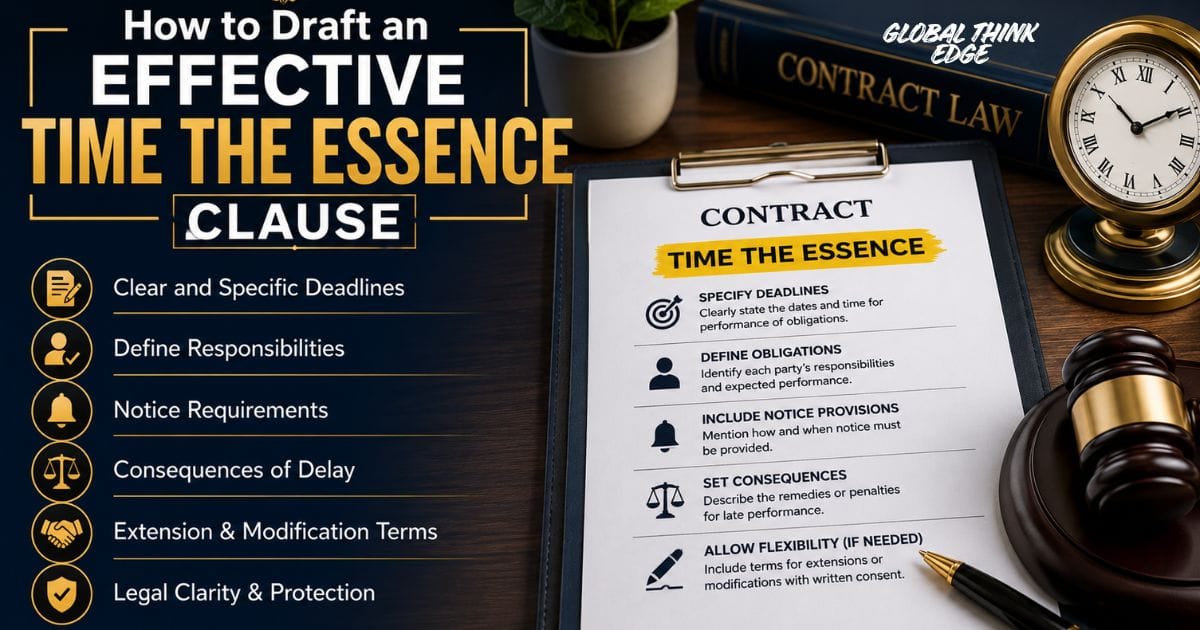
How to Draft an Effective Time the Essence Clause
A well-written clause should leave little room for misunderstanding. It should clearly identify the deadline, explain each party’s responsibilities, and describe the consequences of failing to perform on time.
When drafting the clause, consider these best practices:
State the exact dates or deadlines.
Identify which obligations require strict compliance.
Explain any notice requirements.
Include available remedies for late performance.
Describe whether deadline extensions are allowed and how they must be approved.
Avoid vague wording such as “as soon as possible” or “within a reasonable time” if strict timing is essential. Specific language provides greater certainty and reduces the likelihood of future disputes.
Practical Examples
Understanding the clause becomes much easier through real-world situations.
Example 1: Real Estate Purchase
A buyer agrees to complete the purchase of a property by June 30, and the contract states that time is of the essence. If the buyer fails to close on time without an approved extension, the seller may cancel the agreement and retain the earnest money if permitted by the contract.
Example 2: Construction Project
A contractor promises to finish a commercial building before a retail business opens. Because the opening date cannot be delayed, the contract includes a strict deadline. Missing that deadline may require the contractor to pay agreed liquidated damages.
Example 3: Business Supply Agreement
A manufacturer needs raw materials before production begins. If the supplier delivers several weeks late, production stops and customer orders are affected. A time the essence clause strengthens the manufacturer’s legal position when seeking compensation.
Time the Essence vs. Ordinary Contract Deadlines
Many people assume every contractual deadline carries the same legal weight. In reality, there is an important difference.
| Feature | Time Is of the Essence | Ordinary Deadline |
| Legal importance | Essential contractual obligation | General performance requirement |
| Missing the deadline | May amount to a material breach | May not automatically constitute a serious breach |
| Right to terminate | Often available if conditions are met | Usually depends on the severity of the delay |
| Court interpretation | Strictly examined | More flexible |
| Commercial certainty | High | Moderate |
Common Misconceptions
Several misunderstandings surround this legal concept.
Myth 1: Every contract deadline is automatically essential.
Reality: Most deadlines are not considered legally essential unless the contract or surrounding circumstances clearly indicate that timing is critical.
Myth 2: Even a one-minute delay always ends the contract.
Reality: Courts often consider the facts, the parties’ conduct, and the impact of the delay before determining the appropriate remedy.
Myth 3: Verbal agreements provide the same protection.
Reality: Written contracts are generally far easier to enforce because they clearly record the parties’ intentions.
Synonyms and Related Terms
Although the exact phrase has a specific legal meaning, similar expressions include:
Critical deadline
Essential performance
Time-sensitive obligation
Material contract term
Strict compliance requirement
The opposite concept involves flexible deadlines or performance within a reasonable time, where a minor delay does not automatically create a material breach.

Time the Essence Beyond Legal Contracts
The phrase is not limited to legal documents. It is also used in everyday situations whenever acting quickly is important.
Examples include:
Medical emergencies where immediate treatment can improve outcomes.
Business negotiations with limited opportunities.
Project management with fixed launch dates.
Job applications with submission deadlines.
Academic assignments due on a specific date.
In these situations, the phrase emphasizes urgency, even though it may not create a legal obligation.
Frequently Asked Questions
Is time automatically of the essence in every contract?
No. A deadline is not automatically essential simply because it appears in a contract. Clear wording or the nature of the transaction usually determines whether timing is legally critical.
Can a time the essence clause be waived?
Yes. A party may waive strict enforcement by accepting repeated late performance or agreeing to extend deadlines. To avoid confusion, any waiver or extension should be documented in writing.
Can the deadline be extended?
Yes. Both parties may agree to modify the contract and establish a new deadline. Written amendments provide the strongest evidence of the revised agreement.
What happens if one party misses the deadline?
Depending on the contract and applicable law, the non-breaching party may terminate the agreement, seek damages, enforce contractual remedies, or negotiate a revised performance schedule.
Is this clause useful for small businesses?
Absolutely. Small businesses often rely on predictable delivery dates, payment schedules, and project completion times. A properly drafted clause can reduce uncertainty and protect valuable commercial relationships.
Key Takeaways
‘Time the essence’ makes timely performance a fundamental contractual obligation.
Missing an essential deadline may result in contract termination or financial liability.
The clause is widely used in real estate, construction, commercial, and service agreements.
Clear drafting helps reduce misunderstandings and strengthens legal protection.
Courts consider both the contract language and the parties’ conduct when resolving disputes.
Businesses should review the clause carefully before signing any agreement involving critical deadlines.
Conclusion
A time the essence clause is more than a standard contractual phrase; it is a powerful legal tool that emphasizes the importance of meeting agreed deadlines. When used correctly, it protects both parties, promotes accountability, and minimizes costly delays.
However, strict deadlines also require careful planning and clear communication. Before including or accepting this clause, ensure that every deadline is realistic, every responsibility is clearly defined, and any future changes are documented in writing. By understanding how the clause operates in practice, individuals and businesses can negotiate stronger contracts, reduce legal risks, and build more reliable professional relationships.
