What Is 5GE? Clear Facts About AT&T’s 5G Evolution
What Is 5GE and Why Does It Matter?
If you’ve ever looked at your smartphone and noticed 5GE instead of 5G or LTE, you may have wondered what it actually means. Many users assume they’re connected to a true 5G network, but that’s not entirely accurate. Understanding the difference is important because it affects how you evaluate your mobile network, internet speeds, and overall device performance.
What is 5GE? 5GE, which stands for 5G Evolution, is a marketing name introduced by AT&T for its enhanced 4G LTE Advanced network. It is not true 5G. Instead, it uses advanced LTE technologies such as carrier aggregation, 4×4 MIMO, and 256 QAM to deliver faster speeds and improved reliability than standard LTE.
Although 5GE offers a better mobile experience than traditional 4G LTE, it does not use the new radio technology or network architecture that defines genuine 5G. Knowing this distinction helps you make informed decisions when choosing a smartphone, comparing mobile carriers, or upgrading your wireless plan.
Quick Answer: 5GE is AT&T’s upgraded LTE Advanced network. It delivers better performance than standard 4G LTE but is not the same as true 5G.
Understanding the Meaning Behind 5GE
The abbreviation 5GE stands for 5G Evolution. AT&T introduced this label before expanding its nationwide 5G network to highlight improvements made to its LTE infrastructure.
Instead of launching a completely new wireless standard, AT&T upgraded many of its existing LTE towers with advanced technologies that increased speed, network efficiency, and capacity. The company then branded this improved service as 5G Evolution.
Because the name contains the term 5G, many consumers believed they were already connected to a fifth-generation network. However, industry experts generally classify 5GE as an enhanced version of LTE Advanced, which remains part of the 4G family.
This branding decision sparked discussions across the telecommunications industry because it blurred the distinction between improved LTE and genuine 5G technology.
A Quick Look at Mobile Network Evolution
To better understand where 5GE fits, it’s helpful to look at the evolution of mobile networks.
| Generation | Main Purpose | Typical Performance |
| 3G | Mobile internet and email | Basic browsing |
| 4G LTE | Fast streaming and downloads | High-speed mobile data |
| LTE Advanced | Improved LTE performance | Faster and more reliable |
| 5GE | AT&T branding for LTE Advanced | Enhanced 4G experience |
| 5G | New wireless generation | Ultra-fast speeds and low latency |
This timeline makes one fact clear: 5GE is an evolution of LTE, not a new generation of wireless technology.
What Is 5GE AT&T?
One of the most common questions people ask is “What is 5GE AT&T?”
The answer is straightforward. 5GE is exclusive to AT&T and appears when your compatible smartphone connects to the carrier’s enhanced LTE Advanced network.
Rather than replacing LTE, AT&T improved its existing infrastructure using several advanced networking technologies. These improvements increased data throughput, reduced congestion, and provided a smoother experience for activities such as video streaming, online gaming, and web browsing.
The 5GE icon simply tells users they are connected to this upgraded LTE network. It does not indicate that the device is communicating with a genuine 5G radio network.
Today, AT&T offers both 5GE and true 5G depending on your location, network availability, and device compatibility.
Why Did AT&T Create the 5GE Brand?
AT&T introduced 5GE for several reasons:
To highlight significant upgrades to its LTE network.
To demonstrate faster speeds than traditional LTE.
To prepare customers for the transition to real 5G.
To distinguish its enhanced network from competitors’ standard LTE services.
While the branding successfully attracted attention, it also created confusion among consumers who assumed that 5GE and 5G were the same technology.
How Does 5GE Work?
Unlike true 5G, which relies on an entirely new radio interface called 5G NR (New Radio), 5GE improves existing LTE infrastructure using several proven technologies.
These enhancements allow more data to travel efficiently across the network without changing the underlying wireless generation.
Carrier Aggregation
Carrier aggregation combines multiple LTE frequency bands into a single connection. Instead of using one channel, your smartphone can communicate over several channels simultaneously.
This increases download speeds and improves network stability, especially in busy urban areas.
4×4 MIMO Technology
Multiple Input Multiple Output (MIMO) technology uses multiple antennas on both your phone and nearby cell towers.
A 4×4 MIMO configuration enables more data streams to be transmitted at once, increasing capacity and improving signal quality without requiring additional spectrum.
256 QAM
256 Quadrature Amplitude Modulation (256 QAM) increases the amount of information transmitted with each wireless signal.
This allows users to download files faster while making better use of available network resources.
Intelligent Network Optimization
AT&T also enhances network performance by optimising traffic management, reducing congestion, and upgrading cell tower software.
These behind-the-scenes improvements help provide a smoother browsing experience during periods of heavy network usage.
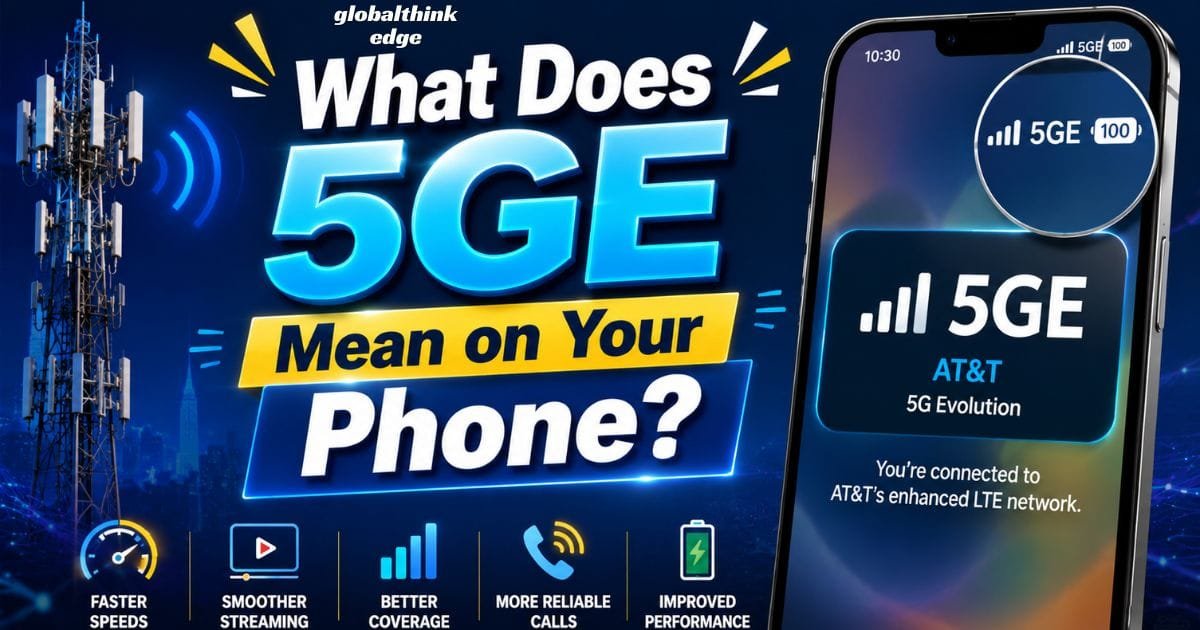
What Does 5GE Mean on Your Phone?
When your phone displays 5GE, it simply means you’re connected to AT&T’s enhanced LTE Advanced network.
The icon appears automatically when:
Your smartphone supports LTE Advanced features.
You’re connected to a compatible AT&T cell tower.
The enhanced LTE network provides the best available connection.
It does not mean your phone has switched to a genuine 5G network.
For most users, everyday activities such as checking email, watching YouTube, browsing social media, and making video calls feel noticeably smoother than on older LTE networks.
However, if true 5G coverage becomes available and your device supports it, your phone will typically display a 5G or 5G+ indicator instead.
What Is 5GE on iPhone?
Many iPhone users search “What is 5GE on iPhone?“ after noticing the symbol at the top of their screen. The good news is that seeing 5GE doesn’t indicate a problem with your device.
If your iPhone displays 5GE, it means the phone is connected to AT&T’s enhanced LTE Advanced network rather than a true 5G network.
Older iPhone models that do not include 5G hardware can connect to LTE Advanced and display the 5GE icon when using AT&T’s network. Newer iPhones with 5G capability automatically switch to a genuine 5G connection whenever coverage is available. If 5G coverage is weak or unavailable, the device may temporarily fall back to LTE or 5GE depending on network conditions.
This automatic switching ensures you receive the best available connection without changing any settings manually.
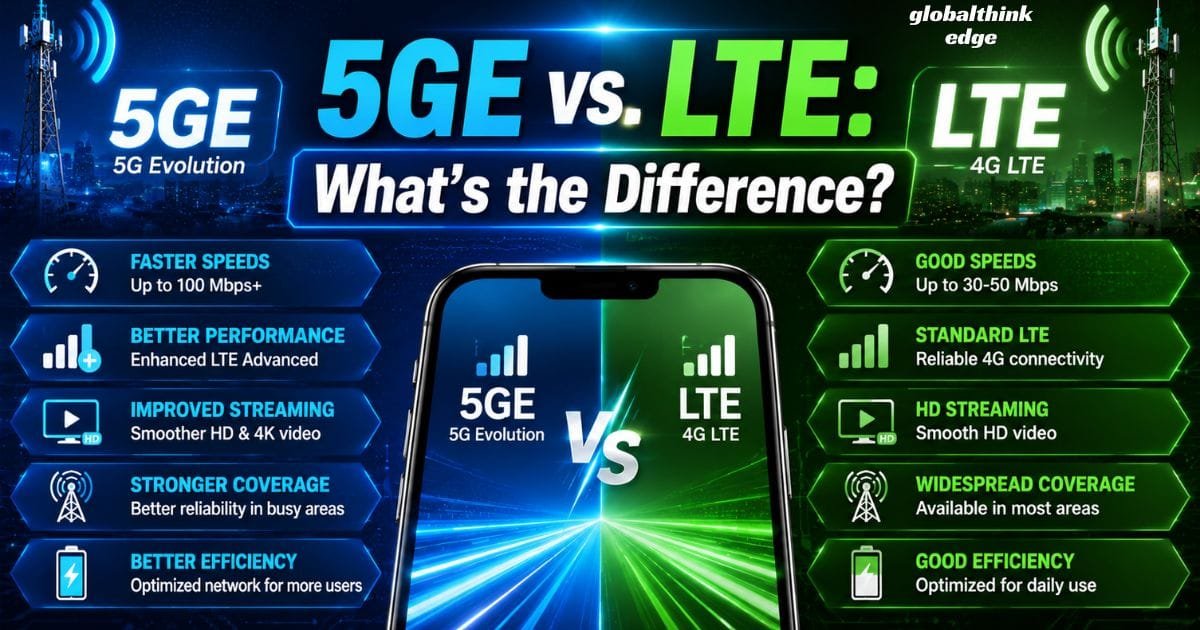
5GE vs. LTE: What’s the Difference?
Since 5GE is based on LTE technology, many people wonder whether there is any real difference between the two.
The answer is yes. While both belong to the 4G family, 5GE incorporates several advanced technologies that improve overall performance.
| Feature | Standard LTE | 5GE (LTE Advanced) |
| Network Generation | 4G | Enhanced 4G |
| Carrier Aggregation | Limited | Advanced |
| 4×4 MIMO | Not Always Available | Yes |
| 256 QAM Support | Limited | Yes |
| Download Speed | Good | Faster |
| Network Efficiency | Standard | Improved |
| Video Streaming | Smooth | More Stable |
| Large Downloads | Moderate | Faster |
For everyday users, these improvements translate into faster downloads, smoother HD video streaming, fewer interruptions during video calls, and better performance in crowded locations.
5GE vs. 5G: Understanding the Real Difference
Although their names are similar, 5GE and 5G are fundamentally different technologies.
| Feature | 5GE | True 5G |
| Technology | LTE Advanced | 5G New Radio (NR) |
| Network Generation | Enhanced 4G | Fifth Generation |
| Typical Speed | 30–100 Mbps | 100 Mbps–1 Gbps+ |
| Latency | 30–50 ms | 1–20 ms |
| Capacity | Higher than LTE | Significantly Higher |
| Device Support | LTE Phones | 5G Phones |
| Future Applications | Limited | AI, IoT, Smart Cities |
The biggest advantage of true 5G is not just higher download speeds. It also provides lower latency, supports many more connected devices, and enables technologies such as autonomous vehicles, smart factories, augmented reality, and advanced IoT solutions.
5GE simply improves the existing LTE experience; it does not replace it.
Is 5GE Faster Than LTE?
Yes. In most situations, 5GE delivers better performance than traditional LTE.
Because it uses carrier aggregation, advanced antenna systems, and improved signal processing, users often experience the following:
Faster app downloads
Shorter webpage loading times
Better HD video streaming
More reliable video calls
Reduced buffering during peak hours
However, actual speeds vary based on several factors, including:
Your location
Signal strength
Network congestion
Smartphone capabilities
Distance from the nearest cell tower
No mobile network can guarantee maximum speeds all the time.
Is 5GE Better Than 5G?
No.
While 5GE is an excellent improvement over LTE, it cannot compete with the capabilities of a genuine 5G network.
True 5G offers:
Much faster download and upload speeds
Lower latency for gaming and video conferencing
Better support for thousands of connected devices
Improved performance in crowded stadiums and cities
Greater long-term scalability
If both networks are available, a compatible 5G device will generally provide the better experience.
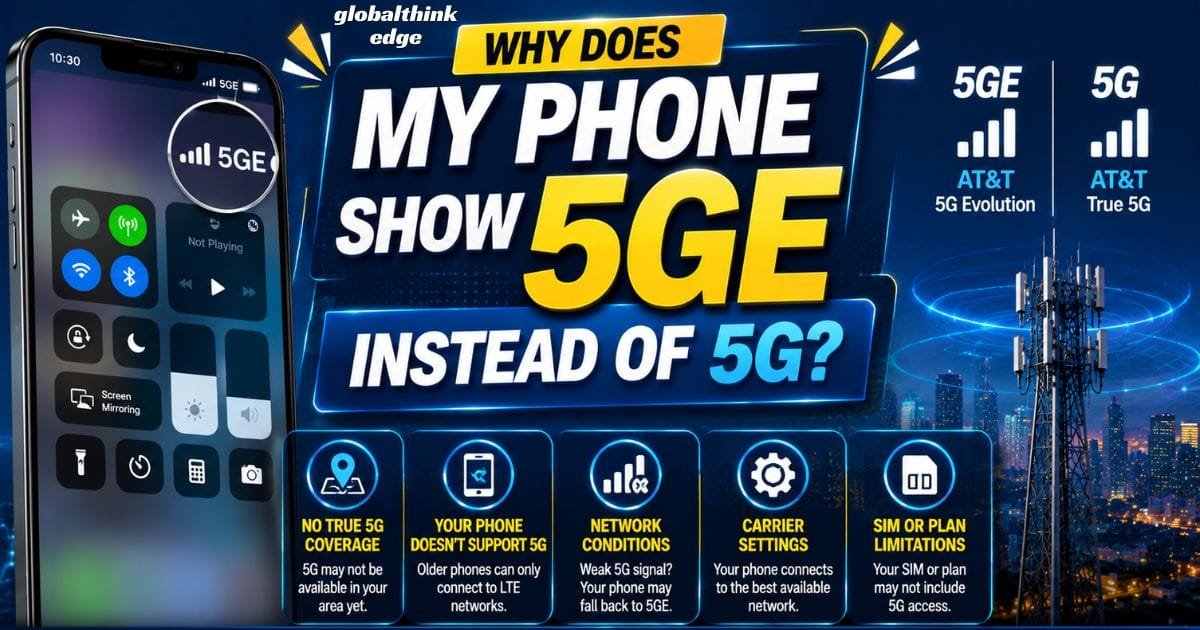
Why Does My Phone Show 5GE Instead of 5G?
There are several common reasons.
Your Area Doesn’t Have True 5G Coverage
Although 5G coverage continues to expand, many regions still rely on LTE Advanced networks.
Your Phone Doesn’t Support 5G
Older smartphones can only connect to LTE-based networks, including 5GE.
Network Conditions
Even modern 5G phones may temporarily switch to LTE Advanced when signal quality changes.
Carrier Configuration
AT&T automatically displays the 5GE icon whenever your device connects to its enhanced LTE network.
How Can You Check Whether You’re Using Real 5G?
Instead of relying only on the icon, you can verify your connection by:
Opening your phone’s network settings.
Checking whether your device supports 5G.
Viewing your carrier’s coverage map.
Running a speed test.
Confirming that your mobile plan includes 5G access.
These steps provide a more accurate picture than simply looking at the status bar.
Why the 5GE Branding Created Confusion
One topic many articles overlook is the impact of the 5GE branding itself.
Because the name closely resembles 5G, many users assumed they were already using next-generation wireless technology. This led to confusion across the industry, especially when comparing mobile carriers.
Technology experts generally agree that 5GE should be viewed as LTE Advanced with a marketing label, not as a separate wireless generation.
Understanding this distinction helps consumers compare networks based on actual technology rather than branding.
Does 5GE Improve Battery Life?
Battery performance depends on several factors, including screen brightness, background apps, signal quality, and processor efficiency.
A strong 5GE signal may reduce battery usage because the phone spends less time searching for a stable connection. However, if coverage is weak and the device constantly switches between LTE, 5GE, and 5G, battery drain may increase slightly.
In most real-world situations, users are unlikely to notice a major difference in battery life solely because of 5GE.
How Does 5GE Perform for Streaming and Gaming?
For everyday mobile use, 5GE provides a reliable experience.
Users can comfortably:
Stream HD and many 4K videos.
Join video meetings.
Browse social media.
Listen to music without interruptions.
Play most online multiplayer games.
Competitive gamers and users of cloud gaming platforms may still benefit from true 5G’s lower latency, but for general entertainment, 5GE delivers consistent performance.
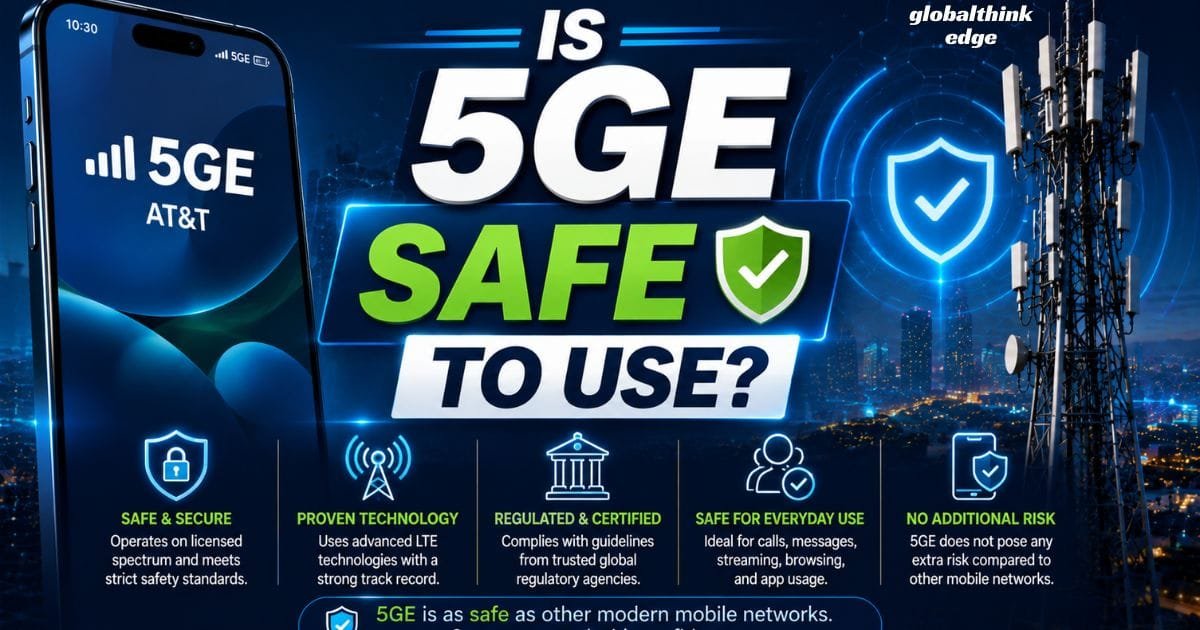
Is 5GE Safe to Use?
Yes. From a consumer perspective, 5GE is considered as safe as other modern cellular networks because it operates using licensed radio frequencies and established LTE technologies.
It does not introduce a new type of radio signal beyond what has already been used in advanced 4G LTE networks. Mobile carriers must also comply with regulatory safety standards established by government agencies in the countries where they operate.
For everyday users, there is no additional action required when using a 5GE connection. Your device automatically manages the network based on signal quality and availability.
Does 5GE Cost Extra?
No. Seeing the 5GE icon on your phone does not automatically increase your monthly bill.
If your mobile plan includes access to AT&T’s LTE network, your device can connect to the enhanced LTE Advanced network whenever it is available. Whether you see LTE or 5GE depends on network coverage and device compatibility not on an additional subscription fee.
However, it’s still worth checking your carrier’s plan details, as data limits and premium features vary between plans.
Can You Turn Off 5GE?
In most cases, no. There is usually no dedicated setting that allows you to disable only the 5GE indicator.
The icon changes automatically based on the network your phone is connected to. If your device moves into an area with true 5G coverage and supports 5G, the indicator may switch accordingly. Likewise, if only standard LTE is available, the display will update automatically.
Rather than focusing on the icon, it’s more useful to evaluate your actual network performance, such as download speeds, streaming quality, and call reliability.
Common Myths About 5GE
Several misconceptions continue to circulate online. Here are the facts.
Myth 1: 5GE Is Real 5G.
Fact: 5GE is an enhanced version of LTE Advanced, not a true fifth-generation wireless network.
Myth 2: Every Carrier Uses 5GE
Fact: The 5GE branding is specific to AT&T. Other carriers use different branding for their LTE and 5G services.
Myth 3: You Need a New SIM Card for 5GE
Fact: Most users do not need a new SIM card to connect to AT&T’s enhanced LTE network.
Myth 4: 5GE Always Delivers Gigabit Speeds
Fact: Actual speeds depend on factors such as location, network congestion, signal strength, and your smartphone’s capabilities.
Myth 5: A 5GE Icon Means Your Phone Is Future-Proof
Fact: While 5GE improves LTE performance, only a 5G-compatible device can fully benefit from next-generation 5G networks as they continue to expand.
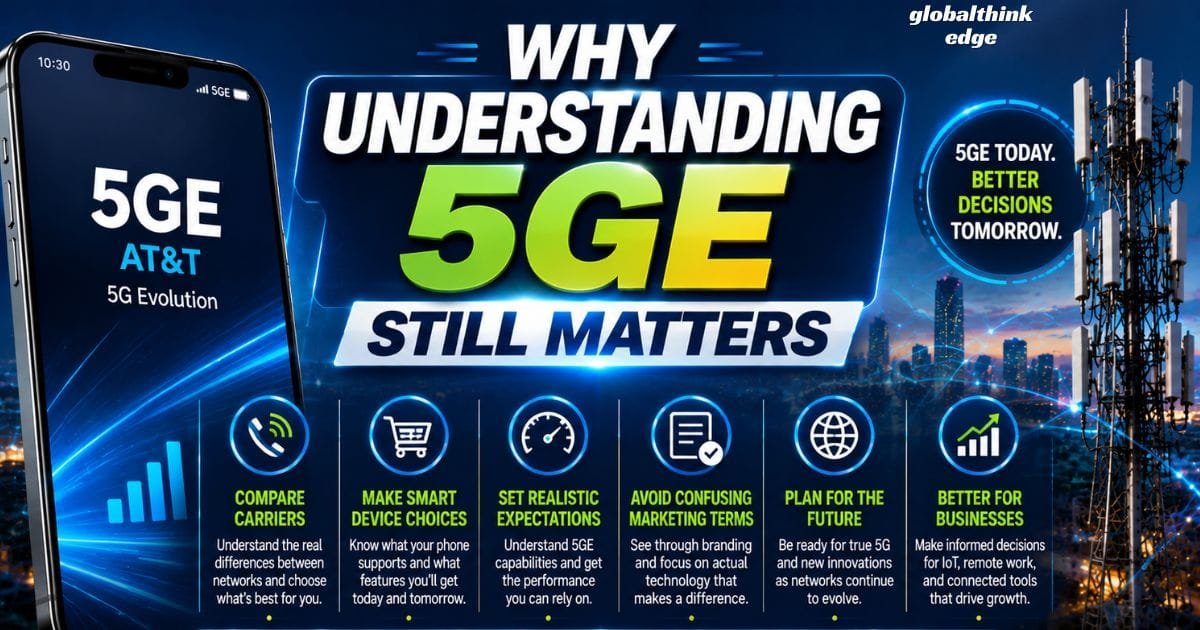
Why Understanding 5GE Still Matters
Although true 5G is becoming more widely available, millions of users still connect to LTE Advanced networks every day.
Understanding what 5GE actually means helps you:
Compare mobile carriers more accurately.
Avoid confusing marketing terms with network technology.
Make informed decisions when purchasing a new smartphone.
Better understand your phone’s network indicators.
Set realistic expectations for speed and performance.
For businesses, knowing the difference between 5GE and 5G is equally valuable when planning connected devices, remote work solutions, or IoT deployments.
Key Takeaways
5GE stands for 5G Evolution, a marketing name used by AT&T.
It is based on LTE Advanced, not true 5G New Radio (5G NR).
Technologies like carrier aggregation, 4×4 MIMO, and 256 QAM help improve speed and network efficiency.
5GE generally performs better than standard LTE but cannot match the speed, latency, or capacity of a genuine 5G network.
If your phone displays 5GE, it simply means you’re connected to AT&T’s enhanced LTE network.
To access true 5G, you’ll need both 5G coverage and a 5G-compatible smartphone.
Frequently Asked Questions
Is 5GE the same as LTE?
No. 5GE is an enhanced version of LTE Advanced that uses additional technologies to improve speed, reliability, and overall performance.
Is 5GE actually 5G?
No. Despite the name, 5GE is not true 5G. It remains part of the 4G LTE ecosystem.
Why does my iPhone show 5GE instead of 5G?
Your iPhone is connected to AT&T’s enhanced LTE network. If true 5G coverage becomes available and your device supports it, the indicator will switch to 5G automatically.
Is 5GE faster than LTE?
Yes. In most real-world situations, 5GE delivers better speeds and network efficiency than traditional LTE.
Does 5GE require a 5G phone?
No. Many LTE-compatible smartphones can connect to AT&T’s 5GE network without requiring 5G hardware.
Can I disable the 5GE icon?
Generally, no. The indicator reflects your current network connection and changes automatically based on network availability.
Is 5GE available outside AT&T?
The 5GE branding is unique to AT&T. Other carriers use different names for their LTE and 5G services.
Will 5GE eventually become true 5G?
No. 5GE will not evolve into true 5G. As carriers continue expanding 5G infrastructure, users with compatible devices will connect directly to genuine 5G networks instead.
Final Thoughts
If you’ve been wondering what is 5GE, the answer is now much clearer. 5GE (5G Evolution) is AT&T’s enhanced LTE Advanced network, designed to provide faster speeds and better reliability than standard 4G LTE. While it offers noticeable improvements for streaming, browsing, video calls, and everyday mobile use, it is not the same as true 5G.
Understanding this distinction helps you avoid confusion caused by network branding and allows you to make better decisions when choosing a smartphone or mobile carrier. As real 5G coverage continues to expand, more users will benefit from its higher speeds, lower latency, and advanced capabilities. Until then, 5GE remains a reliable upgrade over traditional LTE and delivers a solid mobile experience for most daily tasks.
Whether you’re comparing networks, upgrading your device, or simply trying to understand the icon on your phone, knowing the difference between 5GE, LTE, and 5G ensures you have realistic expectations and a clearer understanding of today’s mobile technology.
