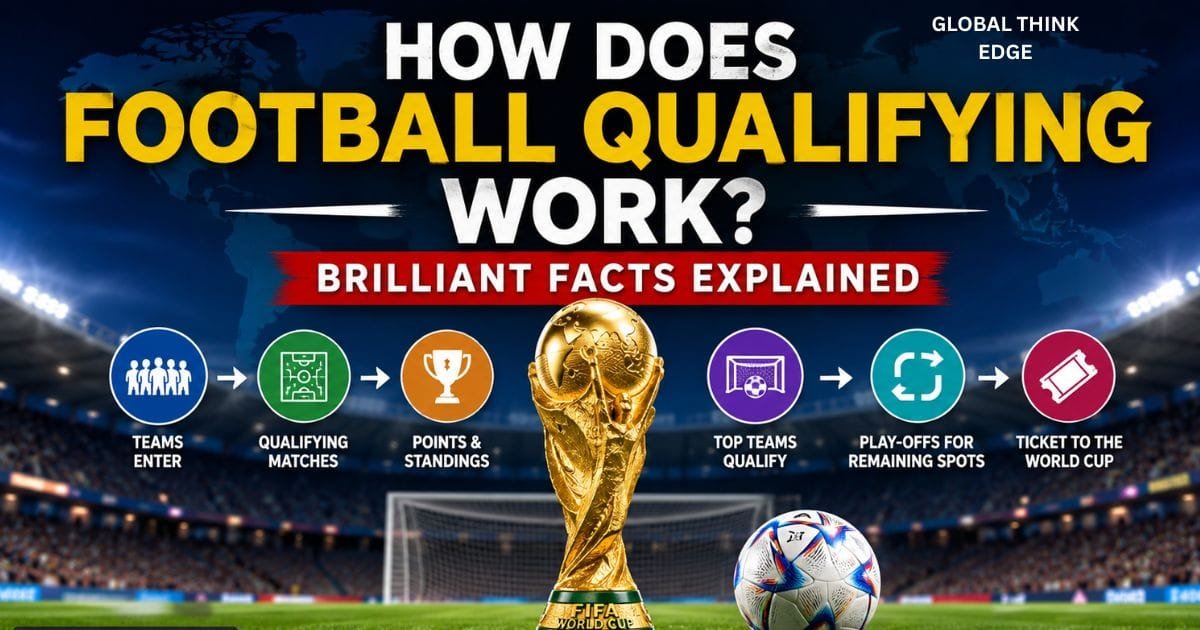
How Does Football Qualifying Work? Brilliant Facts
How Does Football Qualifying Work?
Football qualifying is the process national teams use to earn a place in a major international tournament. Teams are placed into qualifying groups or preliminary rounds within their confederation, then compete for points and qualification places. Depending on the competition, teams may qualify directly by finishing high in their group or advance through play-offs.
The exact system varies between the FIFA World Cup, UEFA European Championship, Copa América, and other tournaments. Each continental confederation controls its own qualifying structure, while FIFA determines the overall World Cup allocation and competition framework.
For the 2026 FIFA World Cup, the system is especially significant because the tournament expanded to 48 teams, creating more qualification places across the six confederations.
What Is a Football Qualifier?
A football qualifier is a match played during a qualifying competition to determine which national teams reach the final tournament.
A team normally earns points from qualifying matches:
Win: 3 points
Draw: 1 point
Loss: 0 points
Teams are then ranked according to their points and the competition’s official tie-breaking rules. Some competitions use home-and-away matches, while others use single-leg games or multiple qualifying rounds.
The important point is that qualifying does not work the same way everywhere. The number of teams, groups, matches, and available places depends on the tournament and confederation.
How Do World Cup Qualifiers Work in 2026?
The 2026 World Cup qualifying system is divided between FIFA’s six confederations: UEFA, AFC, CAF, Concacaf, CONMEBOL, and OFC. Each region has its own route to the tournament.
The 2026 World Cup has 48 final-tournament places. Canada, Mexico, and the United States qualified automatically as the three host nations, while the remaining places were distributed among the confederations through regional qualifying competitions.
The direct allocations are:
| Confederation | Direct places | Play-off opportunity |
| AFC | 8 | 1 |
| CAF | 9 | 1 |
| Concacaf | 6 | 2 |
| CONMEBOL | 6 | 1 |
| OFC | 1 | 1 |
| UEFA | 16 | — |
These allocations show why a team’s qualifying route depends heavily on where its national association belongs.
How Does UEFA Qualifying Work?
UEFA’s 2026 World Cup qualifying competition used 12 groups of four or five teams. Teams played traditional home-and-away matches, with each group winner qualifying directly for the World Cup.
That produced 12 direct European qualifiers. The remaining four European places were decided through play-offs involving the 12 group runners-up and four best-ranked UEFA Nations League group winners that had not already finished in the top two of their World Cup qualifying group.
The play-offs used four separate paths. Each path contained a single-leg semi-final and a single-leg final, with the four path winners taking the remaining European places.
This means a UEFA team does not necessarily need to win its qualifying group to reach the World Cup. Finishing second can still provide another route through the play-offs.
How Does AFC Qualifying Work?
Asian qualifying uses a more extensive multi-round system because many national teams compete for a limited number of places.
For the 2026 World Cup, the AFC route included five qualifying rounds. The opening round involved 20 teams competing over two legs, with 10 winners advancing. The second round then featured nine groups of four, with group winners and runners-up moving into the third round.
The 18 teams reaching the third round were divided into three groups of six. The top two teams in each group qualified directly.
The teams finishing third and fourth moved into another stage, where two additional direct World Cup places were available. The remaining route could lead to the FIFA Play-Off Tournament.
This illustrates an important feature of World Cup qualifying: some confederations use several elimination rounds before teams even reach their final qualifying groups.

How Does African Qualifying Work?
CAF used a group-based system for the 2026 World Cup. The first stage consisted of nine groups, with eight groups containing six teams and one containing five.
Teams played home and away matches against their group opponents. The winner of each group qualified directly for the World Cup, giving Africa nine direct places.
The four best runners-up then entered a separate CAF play-off tournament. Its winner earned a place in the FIFA Play-Off Tournament, giving that team another opportunity to reach the World Cup.
How Does Concacaf Qualifying Work?
Concacaf’s 2026 qualifying route was also structured in several stages. After an opening round for selected teams, 30 teams competed in the second round across groups.
Each team played four matches in that stage, with the group winners and runners-up advancing to the final round. Those 12 teams were then divided into three groups of four and played six matches each, including three home games and three away games.
The three final-round group winners qualified directly for the World Cup.
Because Canada, Mexico, and the United States were hosts, they did not need to qualify through this process.
What About South America?
CONMEBOL uses a notably straightforward qualifying format compared with some other confederations.
South American national teams compete in a league-style qualification competition in which teams face one another across the qualifying campaign. Results produce a single standings table rather than separate groups.
For the expanded 2026 tournament, six CONMEBOL teams qualified directly, while another team earned a place in the FIFA Play-Off Tournament.
The league format makes consistency particularly important because a team must accumulate enough points across many matches rather than simply win a small group.
What Happens If a Team Does Not Qualify Directly?
A team that misses a direct qualification position may still have another route, depending on its confederation.
Some competitions use play-offs, where teams compete in knockout matches for the remaining tournament places. Other qualifying systems can eliminate a team immediately once it finishes outside the required positions.
For the 2026 World Cup, the FIFA Play-Off Tournament determined the final two places. Six teams took part: two from CONCACAF and one each from AFC, CAF, CONMEBOL, and OFC.
The four lowest-ranked teams entered the opening semi-finals, while the two higher-ranked teams advanced directly to the next stage. The winners of the two final matches secured the last two World Cup places.

What Happens After Qualifying for the World Cup?
Once a national team qualifies, it joins the confirmed field for the final tournament. The team then prepares for the tournament draw, squad selection, training camp, and group-stage matches.
Qualification itself does not guarantee a place in the starting lineup for any individual player. The national team coach still selects the final squad according to eligibility, form, fitness, tactics, and other sporting considerations.
At the World Cup, qualified teams enter the final tournament rather than continuing through qualifying rounds.
For 2026, the World Cup finals are being staged across Canada, Mexico, and the United States. The tournament runs from June 11 to July 19, 2026.
How Do You Qualify to Play on a World Cup Team?
Players do not personally qualify for the World Cup through the qualifying table. National teams qualify, while individual players are selected by their national-team coach.
A player generally needs to meet the relevant nationality and eligibility requirements before being considered. The coach then chooses players for international matches and eventually the tournament squad.
That means a player can represent a country during qualifying but still miss the final World Cup squad because of injury, competition for places, tactical decisions, or selection rules.
Likewise, a player who did not appear in qualifying may still be selected for the final tournament if they are eligible and the coach considers them suitable.
Football Qualifying vs. the Final Tournament
| Stage | Main purpose | What determines progress? |
| Preliminary round | Reduce the field | Aggregate or single-match results |
| Qualifying group | Rank teams | Points and tie-breakers |
| Qualifying league | Build one overall table | Total points and ranking |
| Play-offs | Decide remaining places | Knockout results |
| Final tournament | Crown the champion | Group and knockout results |
This distinction is useful because qualifying and the tournament itself are separate competitions. A team must first earn its place before competing for the trophy.
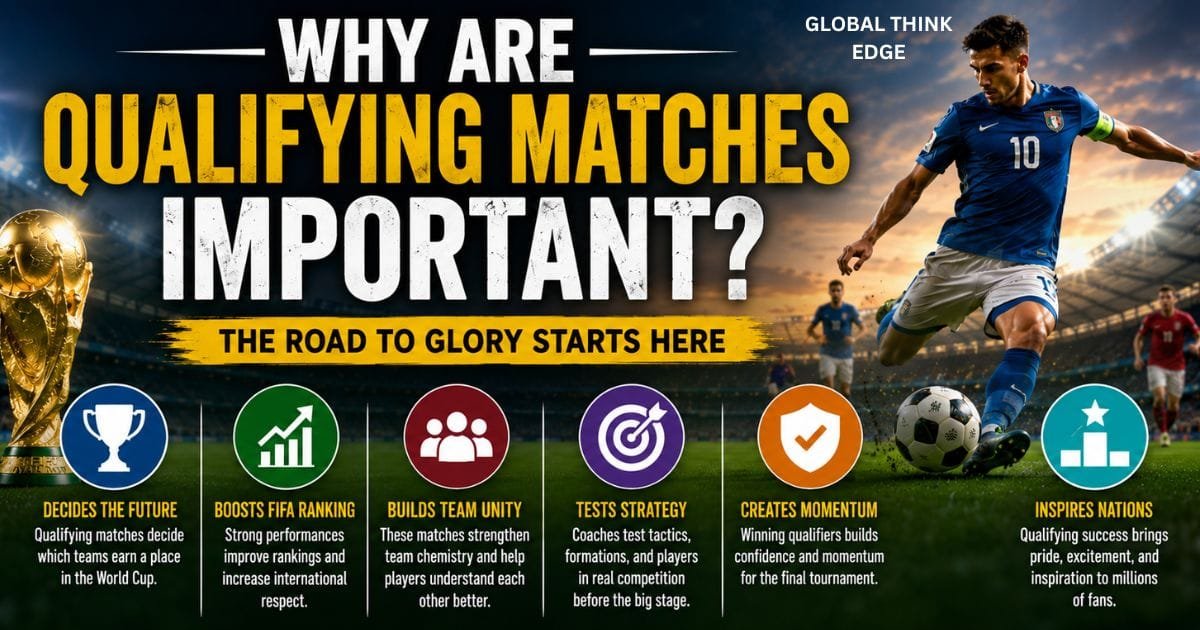
Why Are Qualifying Matches Important?
Qualifying matches determine much more than a team’s tournament status. They can influence FIFA rankings, player development, squad confidence, and the competitive experience of national teams.
A strong qualifying campaign also reduces pressure later. Teams that finish first in their groups often avoid the uncertainty of a play-off, while teams near the qualification line may need results on the final matchdays.
Because each confederation has different rules, fans should always check the specific tournament regulations rather than assuming every qualifying competition follows the same format.
Key Takeaways
Football qualifying works by giving national teams a structured route into a major tournament. Teams compete in groups, leagues, preliminary rounds, or play-offs, depending on the competition and confederation.
For the 2026 World Cup, the expanded 48-team format created additional opportunities across the world. UEFA has 16 direct places, while AFC, CAF, Concacaf, CONMEBOL, and OFC have their own qualification systems and potential playoff routes.
The simplest way to understand qualifying is the following:
Enter the regional competition → play the required matches → earn points or win knockout ties → finish in a qualifying position → reach the final tournament.
Frequently Asked Questions
Is football qualifying the same for every tournament?
No. The FIFA World Cup, UEFA European Championship, and other international tournaments can use completely different qualifying formats. The rules depend on the competition and governing confederation.
Do all teams need to qualify for the World Cup?
No. Host nations can receive automatic qualification under the applicable tournament rules. For 2026, Canada, Mexico, and the United States qualified automatically as hosts.
Can a team qualify without winning its group?
Yes. In some systems, runners-up can qualify directly or enter play-offs. UEFA’s 2026 World Cup qualifying system is a clear example, with group runners-up receiving a play-off route.
Does qualifying determine which players play at the World Cup?
No. Qualifying determines which national teams reach the tournament. Coaches select the players who represent those teams in the final competition.
What is the difference between qualifying and a play-off?
Qualifying is the broader competition used to determine tournament places. A play-off is usually a later stage that gives teams another opportunity to secure a remaining place after the main qualifying phase.
Does goal difference matter in qualifying?
It can. Many football competitions use goal difference or other statistical criteria to separate teams that finish level on points. However, the exact tie-breakers depend on the competition’s regulations.
Can a team qualify early?
Yes. A team can mathematically secure qualification before all of its scheduled matches have been played if its points advantage becomes impossible for competing teams to overcome.
What is the main idea behind football qualifying?
The core idea is simple: national teams compete within their confederation for a limited number of tournament places. The teams that perform well enough either qualify directly or earn another chance through a play-off.
