Nice Translator: Best Ways to Translate “Nice” Correctly
Why the Word “Nice” Deserves More Attention Than Most People Think
The word “nice” is one of the most frequently used words in English, yet it is also one of the easiest to mistranslate. Many people assume it always means “good” or “pleasant,” but its actual meaning depends entirely on the situation. Whether you’re describing a kind person, complimenting someone’s work, talking about beautiful weather, or greeting someone politely, the correct translation can change significantly.
A reliable nice translator does much more than replace English words with foreign-language equivalents. It understands the context, recognizes cultural differences, and selects the most natural translation for native speakers.
If your goal is to translate “nice,” learn “nice” in Spanish translation, or discover how modern AI translators compare with human expertise, this guide covers everything you need to know in one place.
Why Context Is More Important Than the Dictionary
Most dictionaries list several meanings for the word “nice.” While technically correct, simply choosing the first translation often leads to unnatural sentences.
For example, consider these sentences:
She is a nice teacher.
That’s a nice car.
Nice work!
Have a nice day.
The weather is nice today.
Although every sentence contains the word “nice,” each one expresses a different idea. In one sentence it means “kind,” in another it means “attractive,” while elsewhere it expresses appreciation or pleasant conditions.
This is why professional translators focus on meaning before vocabulary.
What Does “Nice” Actually Mean?
Depending on the conversation, nice can represent several different meanings.
| Meaning | Example |
| Kind | She is a nice person. |
| Friendly | Our neighbors are very nice. |
| Pleasant | It was a nice evening. |
| Beautiful | That’s a nice house. |
| Enjoyable | We had a nice vacation. |
| Impressive | Nice presentation! |
| Polite | He gave a nice response. |
Understanding the intended meaning is the first step toward accurate translation.

How a Nice Translator Chooses the Right Translation
Professional translators rarely translate individual words in isolation. Instead, they analyze several factors before selecting the best equivalent.
Sentence Context
Words surrounding “nice” often reveal its intended meaning.
For example:
Nice weather → Pleasant weather
Nice person → Kind person
Nice dress → Beautiful dress
Even though the English word remains the same, the translated word changes.
Tone of Conversation
Formal writing requires different vocabulary than casual conversation.
A business email may use a more professional equivalent, while friends speaking informally may choose conversational expressions.
Cultural Differences
Some languages prefer indirect compliments, while others use stronger descriptive words.
A translation that sounds natural in Spain may sound unusual in Mexico or Argentina. This is one reason experienced translators consider regional language differences instead of relying solely on dictionaries.
“Nice” in Spanish Translation: Choosing the Correct Word
One of the most common online searches is Nice in Spanish translation. Surprisingly, there is no single Spanish word that correctly translates “nice” in every situation.
Spanish uses different words depending on what “nice” describes.
| English Meaning | Spanish Translation | Best Used For |
| Kind | Amable | Friendly people |
| Pleasant | Agradable | Weather, experiences, atmosphere |
| Beautiful | Bonito | Houses, clothes, places |
| Cute | Lindo | Pets, children, gifts |
| Great | Genial | Informal compliments |
| Friendly | Simpático | Someone with an approachable personality |
This flexibility is one reason Spanish sounds more natural than literal translations.
Translate Nice Into Spanish with Real Examples
Learning through examples makes translation much easier than memorizing vocabulary lists.
| English Sentence | Natural Spanish Translation |
| She is nice. | Ella es amable. |
| Nice weather today. | Hace un clima agradable. |
| That’s a nice house. | Esa es una casa bonita. |
| Nice to meet you. | Mucho gusto. |
| Have a nice day. | Que tengas un buen día. |
| Nice job! | ¡Buen trabajo! |
| That’s nice. | Qué bien. |
| What a nice surprise! | ¡Qué bonita sorpresa! |
Notice that no single Spanish word appears in every example. Native speakers naturally change vocabulary according to the meaning of the sentence.
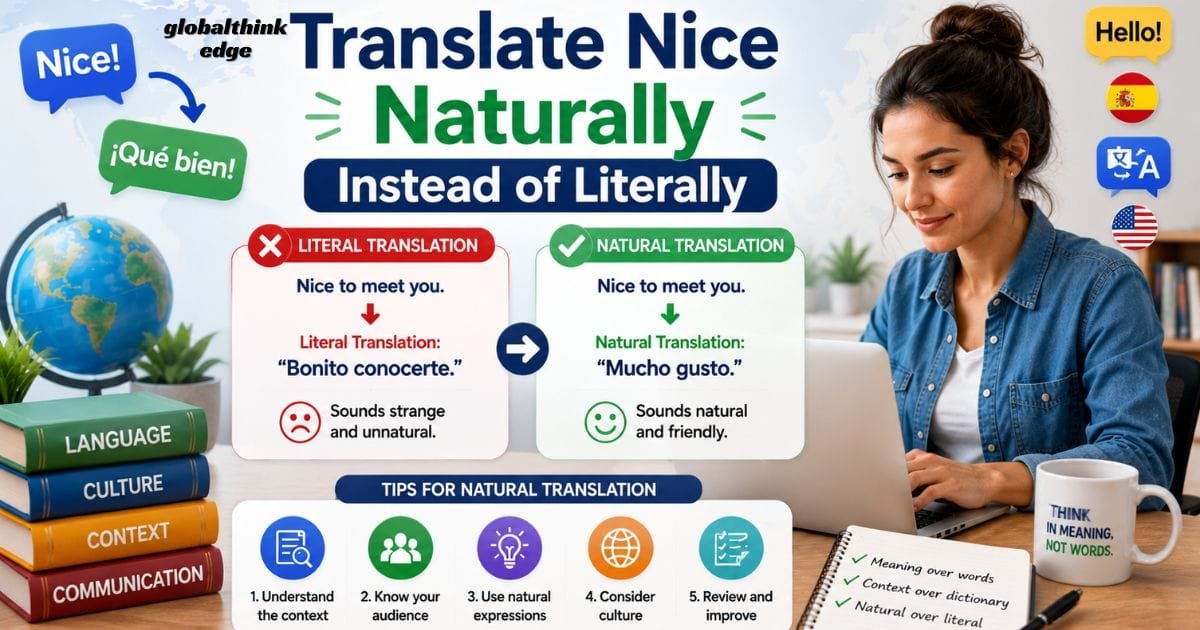
Translate Nice Naturally Instead of Literally
If you want to translate nice into Spanish, avoid translating word by word.
Instead, follow these simple steps:
1. Read the complete sentence.
2. Identify what “nice” is describing.
3. Determine whether the tone is formal or informal.
4. Choose the Spanish word that native speakers would actually use.
This method produces translations that sound natural rather than robotic.
Common Mistakes People Make When Translating “Nice”
Many beginners unknowingly repeat the same translation errors.
Avoid these common mistakes:
Using bonito for every situation is not practical.
Ignoring whether “nice” refers to personality or appearance.
Translating expressions literally.
Forgetting regional Spanish differences.
Depending entirely on machine translation without reviewing the result.
For example, translating “She’s nice” as “Ella es bonita” changes the meaning completely. Instead of saying she is kind, you are saying she is beautiful.
Spanish Variations You Should Know
Spanish is spoken in more than twenty countries, so vocabulary naturally varies.
| Region | Common Preference |
| Spain | Bonito, agradable |
| Mexico | Padre (informal), bonito |
| Argentina | Lindo |
| Colombia | Bonito, amable |
| Chile | Lindo, simpático |
These differences are usually small, but understanding them helps your translations sound more authentic.
Translate “Nice” Into Other Languages
Although Spanish receives the most attention, the same principle applies to many languages. One English word rarely has only one correct translation.
| Language | Common Translation |
| French | Gentle, agreeable, pretty |
| German | Nett, schön |
| Italian | Gentile, bello |
| Portuguese | Gentil, bonito |
| Arabic | لطيف |
| Urdu | اچھا، مہربان، خوبصورت |
| Japanese | 優しい (yasashii), 素敵 (suteki) |
| Chinese | 好、漂亮、友好 |
Each language uses different words depending on context, making accurate translation more about understanding meaning than memorizing vocabulary.
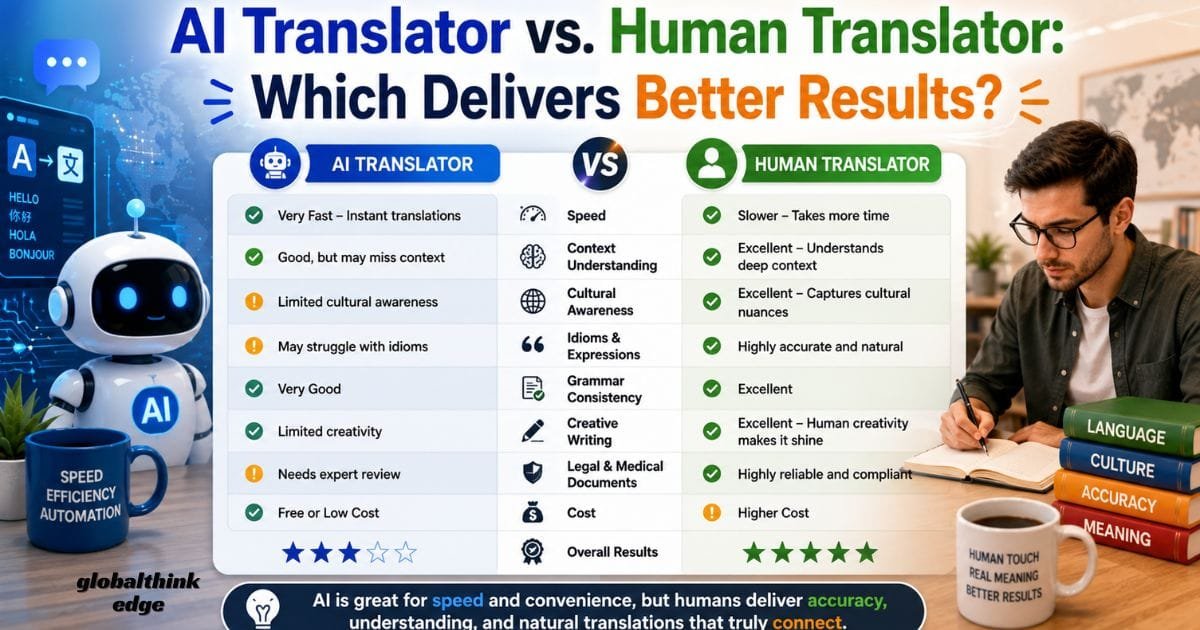
AI Translator vs. Human Translator: Which Delivers Better Results?
Translation technology has improved dramatically over the past few years. AI-powered tools can now translate entire documents in seconds, making communication faster and more accessible. However, speed does not always guarantee accuracy.
A professional, nice translator understands not only vocabulary but also context, tone, culture, and the purpose of the message.
| Feature | AI Translator | Human Translator |
| Translation Speed | Excellent | Moderate |
| Context Understanding | Good | Excellent |
| Cultural Awareness | Moderate | Excellent |
| Idioms & Expressions | Sometimes Incorrect | Highly Accurate |
| Grammar Consistency | Very Good | Excellent |
| Creative Writing | Limited | Excellent |
| Legal & Medical Documents | Needs Review | Highly Reliable |
| Cost | Usually Free or Low | Higher |
Key takeaway: AI translators are excellent for everyday conversations and quick translations, while human translators remain the better choice for business, legal, academic, or marketing content where precision matters.
Can AI Translate the Word “Nice” Perfectly?
Not always.
Modern AI models understand context better than older translation systems, but they can still make mistakes when a word has multiple meanings.
For example:
She is nice. → Refers to personality.
That’s a nice painting. → Refers to appearance.
Nice work! → Expresses praise.
Nice try. → Can be genuine or sarcastic depending on tone.
Without enough context, even advanced AI may choose the wrong translation.
When Human Translation Is the Better Choice
Machine translation works well for simple text, but certain situations still require human expertise.
Choose a professional translator when working with:
Legal contracts
Medical reports
Business agreements
Website localization
Marketing campaigns
Academic research
Books and creative writing
These documents require precision, cultural understanding, and natural language that AI alone cannot always provide.

Practical Tips for More Accurate Translation
Professional translators follow proven techniques that improve accuracy regardless of the language.
Read the Entire Sentence First
Never translate one word at a time. The surrounding words reveal the intended meaning.
Understand the Purpose
Ask yourself why the word is being used. Is it describing a person, an object, an experience, or expressing appreciation?
Think About Your Audience
Formal business communication requires different wording than casual conversations.
Avoid Literal Translation
Word-for-word translation often sounds unnatural. Focus on conveying the original meaning instead.
Double-Check Important Content
For contracts, academic work, or published content, always review the translation or have it checked by a qualified translator.
Common Translation Mistakes to Avoid
Even experienced language learners occasionally make these errors.
Translating every occurrence of “nice” with the same word.
Ignoring local language variations.
Using automatic translations without proofreading.
Forgetting that tone changes meaning.
Misinterpreting compliments, greetings, or idioms.
A small mistake can completely change the intended message.
Best Practices for Translating “Nice” Naturally
If you want translations that sound fluent to native speakers, follow these best practices:
Focus on meaning instead of individual words.
Learn common phrases rather than isolated vocabulary.
Compare translations from trusted sources.
Read example sentences before choosing a translation.
Practice using the word in different contexts.
These habits improve both language learning and translation accuracy.

How to Choose the Best Translation Tool
Different translation tools serve different purposes. Instead of searching for a single “best” translator, choose one based on your needs.
| Purpose | Recommended Option |
| Everyday conversations | AI translator |
| Language learning | Dictionary + example sentences |
| Business communication | AI with human review |
| Website content | Professional translator |
| Legal or medical documents | Certified human translator |
The right tool depends on the importance of accuracy, not just convenience.
Quick Summary
If you only remember a few points from this guide, make them these:
The word “nice” has several meanings.
Context always determines the correct translation.
There is no single Spanish word that works in every sentence.
AI translators are fast but may miss subtle meanings.
Human translators provide the highest accuracy for important content.
Learning through examples produces better translations than memorizing vocabulary lists.
Frequently Asked Questions
What is the best translator for the word “nice”?
The best translator is one that understands context. Modern AI tools are excellent for everyday use, while professional human translators provide the highest level of accuracy for important documents.
Is there one correct “nice” in Spanish translation?
No. Depending on the sentence, amable, agradable, bonito, lindo, genial, or simpático may all be correct.
Why do online translators give different results?
Translation systems use different language models and context analysis. The same sentence may produce different translations depending on the platform and the wording you provide.
Can I rely on AI for professional translation?
AI works well for drafts and everyday communication. However, business, legal, academic, and medical content should always be reviewed by a qualified human translator.
How can I translate “nice” more accurately?
Read the full sentence, understand the intended meaning, and choose a translation that sounds natural in the target language instead of translating word for word.
Does “Have a nice day” translate literally into Spanish?
Not usually. Native speakers commonly say “Que tengas un buen día,” which conveys the same meaning naturally rather than translating each word directly.
Final Thoughts
A dependable nice translator does far more than replace English words with their foreign-language equivalents. It analyzes context, tone, audience, and cultural nuances to produce translations that feel natural and accurate.
Whether you’re trying to translate “nice,” searching for the correct “nice” in Spanish translation, or learning how to translate “nice” into Spanish, remember that the best translation always depends on the situation. One English word can have multiple correct equivalents, and choosing the right one requires understanding the complete message not just the vocabulary.
For everyday conversations, modern AI translators provide fast and helpful results. For professional, academic, legal, or creative content, human expertise remains the gold standard. By combining reliable translation tools with contextual understanding, you can communicate clearly, avoid common mistakes, and produce translations that native speakers genuinely understand and appreciate.
